
Introduction
A few years ago, moving assets between blockchains often felt like navigating unfamiliar roads at night. A user would bridge funds from one network to another, wait for confirmations, switch wallets, search for a decentralized exchange, and finally swap into the asset they actually wanted. Every extra step introduced another opportunity for confusion, delay, or unexpected fees.
Today, the experience looks very different. Modern crypto interfaces have become smoother and more connected. Many platforms now combine bridging, routing, liquidity access, and token conversion into what feels like a single action. Because of that evolution, the terms bridge and cross chain swap are now frequently used as if they describe the same thing.
They do not. The difference is still important, especially for users trying to understand how assets move across ecosystems and why some routes feel simpler than others.
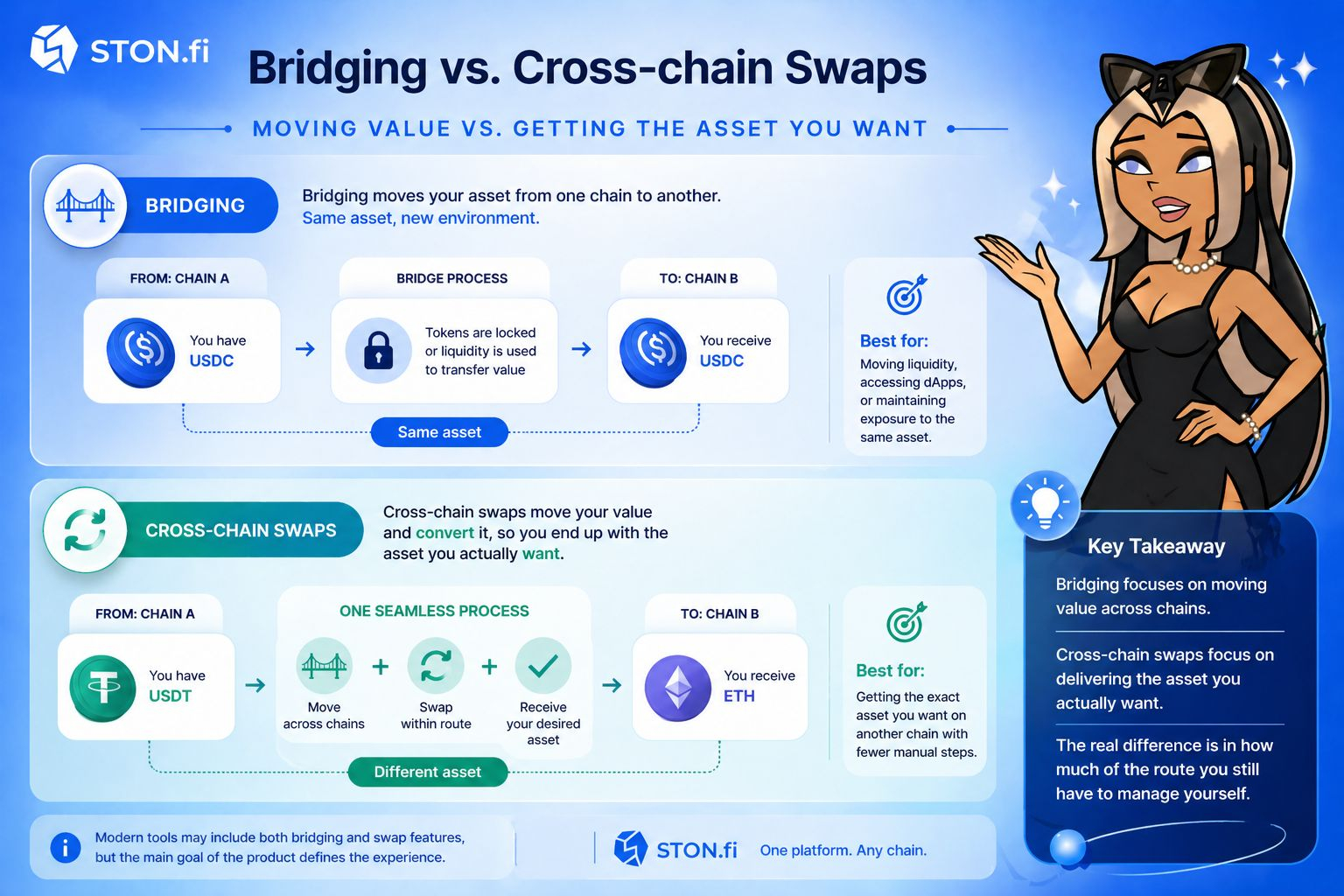
At the center of the distinction is one simple idea. A bridge is primarily designed to move value between blockchains. A cross chain swap is primarily designed to help a user arrive on another blockchain with the asset they actually want.
That may sound subtle at first, but it changes the entire user experience.
Understanding Bridges
A bridge is an infrastructure tool that transfers value from one blockchain ecosystem to another. The purpose is not necessarily to change assets. The main objective is to move value across networks.
Imagine a user holding USDC on Ethereum who wants to use funds on TON or another chain. A bridge creates the connection between those separate ecosystems so value can travel from one environment to another.
Traditionally, the expectation is straightforward. If someone bridges USDC from one chain to another, they usually expect to receive the same asset or an equivalent representation of it on the destination chain. The user is focused on relocation rather than conversion.
Bridges became essential because blockchains do not naturally communicate with one another. Ethereum, TON, Polygon, Base, and other networks all operate independently. Without bridges, assets would remain isolated inside their original ecosystems.
How Bridges Traditionally Work
Although bridge architecture can become technically complex, most beginner level workflows are built around two major approaches.
Lock and Mint Systems
In a lock and mint model, the original asset is locked on the source chain while a corresponding wrapped version is created on the destination chain.
For example, if tokens are locked on Ethereum, the bridge may issue an equivalent wrapped representation on another blockchain. The wrapped token represents the locked value held elsewhere.
This mechanism became one of the reasons wrapped assets gained popularity across decentralized finance ecosystems.
The important detail is that the original value does not disappear. It is simply represented differently on another network.
Liquidity Based Transfers
A second common model relies on liquidity pools that already exist across multiple chains.
Instead of locking tokens and issuing wrapped equivalents, the bridge uses available liquidity on the destination chain to fulfill the transfer. From the user perspective, this can feel faster and more seamless because the destination assets are already available.
The core purpose, however, remains the same. The system is still focused on moving value from one blockchain environment to another.
The Challenges Behind Bridge Workflows
As blockchain activity expanded, users began encountering practical issues inside traditional bridge flows.
One challenge is complexity. Bridging often requires several separate actions. A user may need to bridge assets first, wait for settlement, and then perform another swap afterward. More steps naturally increase the possibility of mistakes or unexpected costs.
Another challenge is liquidity dependency. Some routes only function efficiently when sufficient liquidity exists on both sides of the transfer. Limited liquidity can affect pricing, timing, or route availability.
Fees also become more noticeable in multi step workflows. Users may pay network fees on both chains while also covering routing or execution costs.
Security has historically been another major concern. Bridges have repeatedly become high value targets because they interact with assets across multiple ecosystems. As a result, bridge infrastructure has often received significant scrutiny within the broader crypto industry.
Even when transactions eventually complete successfully, delays and route interruptions can still occur depending on congestion, settlement models, or liquidity conditions.
Modern products attempt to reduce these frictions, but understanding the underlying workflow still matters.
What Is a Cross Chain Swap?
A cross chain swap combines two different actions into a single experience.
First, value moves across blockchains. Second, the asset itself can change during the process.
Instead of bridging first and swapping later, the user enters one route that handles both stages together.
For example, a person may start with USDT on one blockchain and receive ETH on another chain after the transaction completes. The user does not necessarily need to manage every intermediate step manually.
That outcome driven design is what separates cross chain swaps from traditional bridge centered workflows.
The emphasis is no longer only about transportation. The emphasis is about arriving with the intended destination asset.
Why Cross Chain Swaps Feel Simpler
The appeal of cross chain swaps comes largely from user experience.
Traditional workflows can require multiple interfaces and decisions. A user may need to determine which bridge to use, which token to move, where liquidity exists, and which decentralized exchange offers the best conversion afterward.
Cross chain swap systems aim to reduce that burden.
Instead of presenting several disconnected actions, they attempt to create one continuous route from starting asset to final asset. Behind the scenes, the infrastructure may still involve bridging, routing, liquidity sourcing, and settlement layers. The difference is that the user no longer has to manage each stage independently.
This shift reflects a broader trend across decentralized finance. Infrastructure is increasingly designed around outcomes rather than isolated technical processes.
Why Modern Bridges Blur the Line
The distinction between bridges and cross chain swaps has become less obvious because many newer bridge products now include advanced routing features.
Some modern systems can automatically handle liquidity sourcing, destination side swaps, settlement coordination, and token conversion inside a unified interface.
From the user perspective, these products may behave almost identically to cross chain swap platforms.
A bridge today may no longer act as a simple tunnel between chains. It can function more like a complete transaction engine that determines how assets move, convert, and settle across ecosystems.
This is why the terminology often overlaps in everyday crypto discussions.
Still, the difference remains useful when viewed from the perspective of primary purpose.
If the main objective is transferring value between blockchains, the workflow is fundamentally bridge oriented.
If the main objective is arriving with a different destination asset through one combined process, the workflow is fundamentally a cross chain swap.
Comparing the Two Approaches
The Main Goal
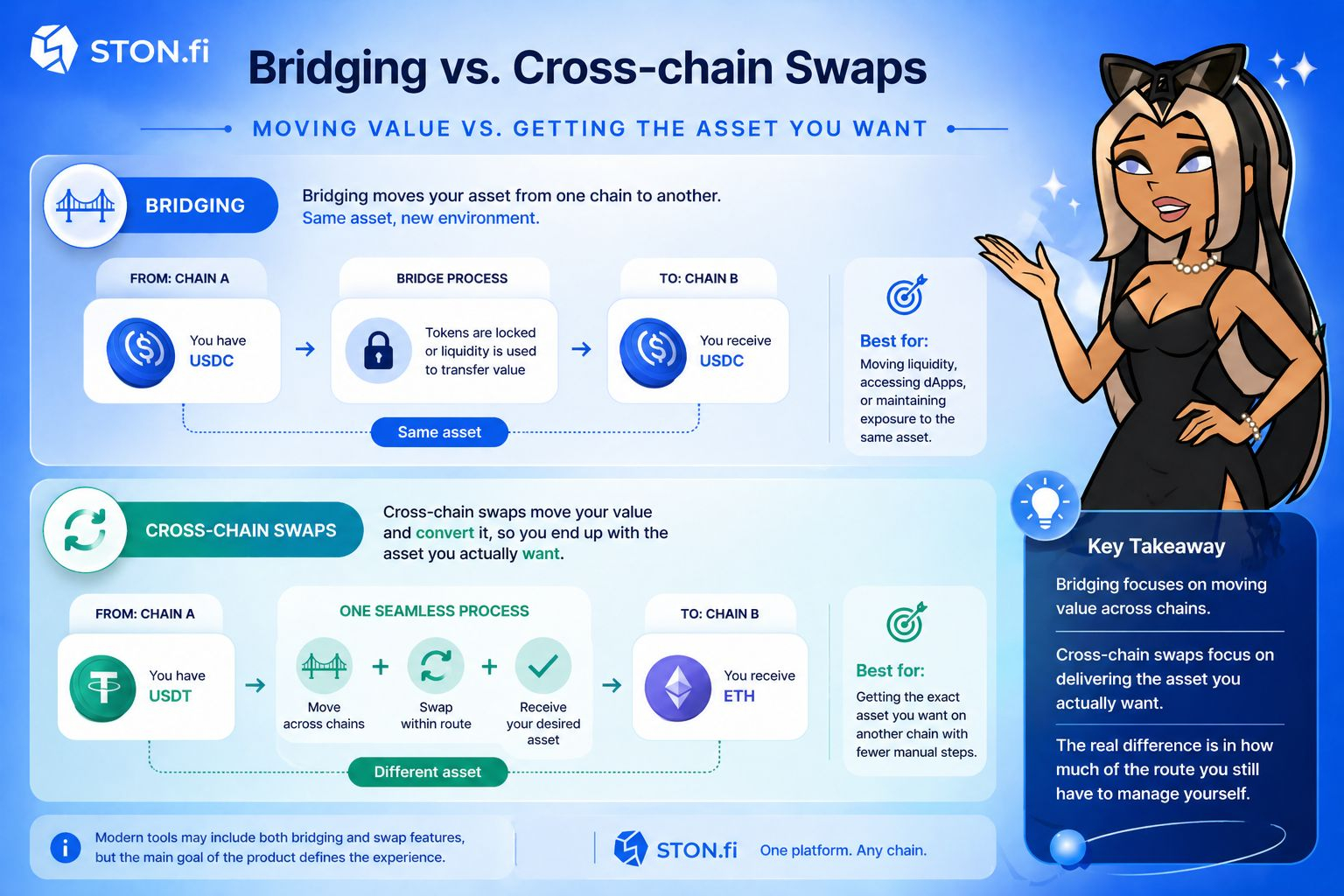
Bridges are primarily designed to relocate value across ecosystems.
Cross chain swaps are primarily designed to relocate value while also delivering a specific destination asset.
The User Experience
Bridge workflows often involve additional manual actions after the transfer is complete.
Cross chain swaps attempt to reduce manual coordination by combining multiple stages into one route.
Typical Use Cases
A bridge may be more suitable when users want to maintain exposure to the same asset while moving across ecosystems.
A cross chain swap may feel more natural when users already know which asset they want to hold on the destination chain.
Route Management
In bridge oriented workflows, users often remain responsible for part of the process after the transfer occurs.
In cross chain swap systems, more of the route logic is handled automatically behind the scenes.
Final Thoughts
The crypto industry has moved far beyond the early days of simple chain to chain transfers. Modern infrastructure increasingly combines bridging, routing, liquidity access, and settlement into unified user experiences. That evolution is exactly why bridges and cross chain swaps now appear so closely connected.
Even so, the distinction still matters.
A bridge is fundamentally centered on moving value between blockchains. A cross chain swap is fundamentally centered on helping users reach another blockchain with the asset they actually want to hold.
The difference is not just technical. It reflects how much of the process the user still has to manage personally.
As decentralized ecosystems continue becoming more interconnected, understanding that distinction helps users navigate cross chain activity with greater clarity and confidence.
To explore more educational content and follow ongoing ecosystem developments, visit https://blog.ston.fi/
𝐎𝐟𝐟𝐢𝐜𝐢𝐚𝐥 𝐑𝐞𝐬𝐨𝐮𝐫𝐜𝐞𝐬:
Official Site: ston.fi
Technical Documentation: docs.ston.fi
Analytics Dashboard: dune.com/stonfi
Follow for News: x.com/ston_fi