

Yesterday while returning home from the market, I stopped near a small tea stall where a few old friends were already sitting and arguing about AI again
one of them was saying general AI will eventually dominate everything.
one model will do all the work, he kept repeating.
another friend disagreed immediately.
he said: real systems don’t work like that even humans survive through specialization.
honestly that line stayed in my head much longer than i expected.
because the more i watch the AI space lately, the more it feels like people are misunderstanding where the future value of intelligence might actually come from.
everyone talks about bigger models, more compute, faster responses, more powerful agents.
but very few people talk about coordination between intelligence systems.
and strangely enough that’s where @OpenLedger started making much more sense to me recently.
because OpenLedger doesn’t feel focused only on building more AI.
it feels more focused on building infrastructure for how different intelligence systems might eventually collaborate, share value, and coordinate trust.
and maybe that becomes more important later than people currently realize.
at first i also believed the future would belong entirely to giant general AI models.
the idea sounded simple: bigger AI = better AI.
but after watching how companies and institutions actually use AI, the picture starts looking very different.
because real-world systems usually depend on specialized expertise.
hospitals don’t run through one person doing everything. financial systems don’t rely on one employee making every decision. even governments work through specialized departments.
AI may evolve similarly.
instead of one massive intelligence replacing everything
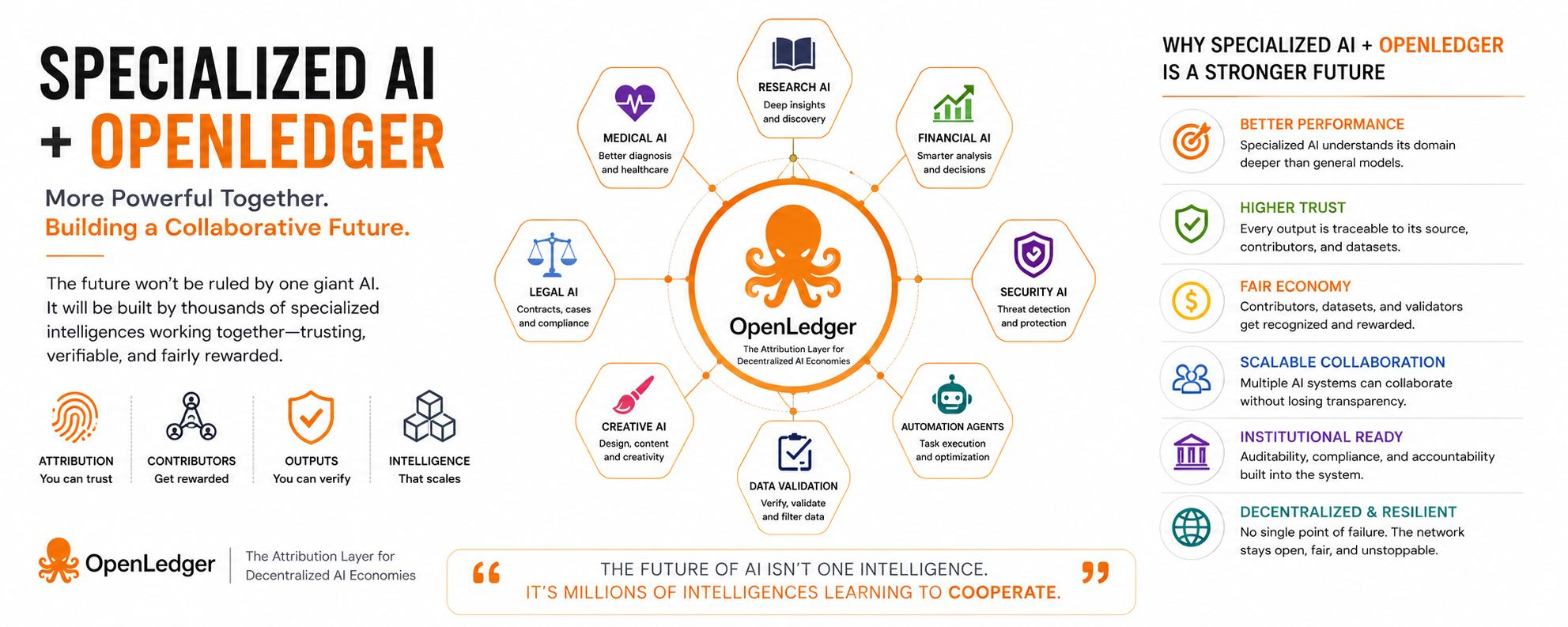
we may end up with ecosystems of specialized AI systems working together: medical AI, financial AI, legal AI, research AI, security AI, creative AI, automation agents, data validation systems.
and honestly, that future feels much more realistic to me.
but the moment intelligence becomes distributed across many systems, another problem appears immediately:
coordination.
how do these systems trust each other? how do they verify outputs? how do contributors receive fair value? how do institutions audit decisions how do datasets remain traceable?
that’s where things start becoming messy.
because capability alone is not enough anymore.
once AI systems start interacting economically, transparency suddenly matters much more.
and maybe that’s why OpenLedger keeps focusing so heavily on attribution, contributors, Datanets, decentralized coordination, and transparent participation.
at first those ideas sound less exciting than flashy AI demos.
but historically invisible infrastructure layers usually become the most important later. the internet itself worked like that.
people noticed apps first.
but underneath everything, invisible systems quietly became critical: payment rails, cloud infrastructure, identity systems, data coordination, compliance layers.
AI probably evolves the same way.
because eventually the question stops being: which AI is smartest?
and slowly becomes: which intelligence systems can actually work together reliably
that’s a completely different problem.
and honestly, specialized AI may make that problem even bigger.
because once multiple intelligence systems start interacting with: finance, healthcare, automation, governance, research, digital identity
trust stops being optional.
someone needs to verify: where outputs came from, which datasets shaped them, who contributed, who validated, who becomes responsible if something fails.
and that’s where decentralized coordination starts making more sense.
especially if future AI economies become too large for centralized systems to manage efficiently alone.
the interesting thing is i don’t think most people are paying attention to this shift yet.
right now the market still rewards visible intelligence: smarter outputs, faster generation, better reasoning.
but long-term value may end up forming around something less visible: coordination infrastructure.
systems capable of organizing how intelligence flows between contributors, agents, validators, datasets, and applications.
and maybe that’s where projects like OpenLedger quietly become much more important later.
not because they promise magical AI. but because collaborative intelligence systems probably cannot scale properly without transparent coordination layers underneath them.
the strange part is after that tea stall conversation ended, i kept thinking about one thing on the way home.
maybe the future of AI isn’t one giant intelligence controlling everything.
maybe it’s millions of specialized intelligences learning how to cooperate.
and if that future actually arrives
then infrastructure projects focused on attribution, coordination, and transparent collaboration may end up mattering far more than people currently expect.
