
I used to look at AI systems mainly through the lens of intelligence. I thought the real problems were model quality, hallucinations, or benchmark performance. But after spending time around OpenLedger, my perspective started changing.
For the first time, I realized the most interesting problem in AI might not be intelligence at all — it might be trust hesitation.
That small moment where an answer already exists, but the system still does not trust it enough to treat it as economically final.
That is what felt different inside OpenLedger’s workflow. Datasets, inference, validation, and payment logic are tied together so tightly that every request feels less like a normal AI query and more like a small financial event.
You notice it most during inconsistent load conditions.
Sometimes the model responds immediately, but the system still pauses because another validation layer needs more confidence before value can move. At first, it feels like unnecessary delay. Then slowly you realize the delay itself may actually be part of the product.
One idea kept staying in my mind:
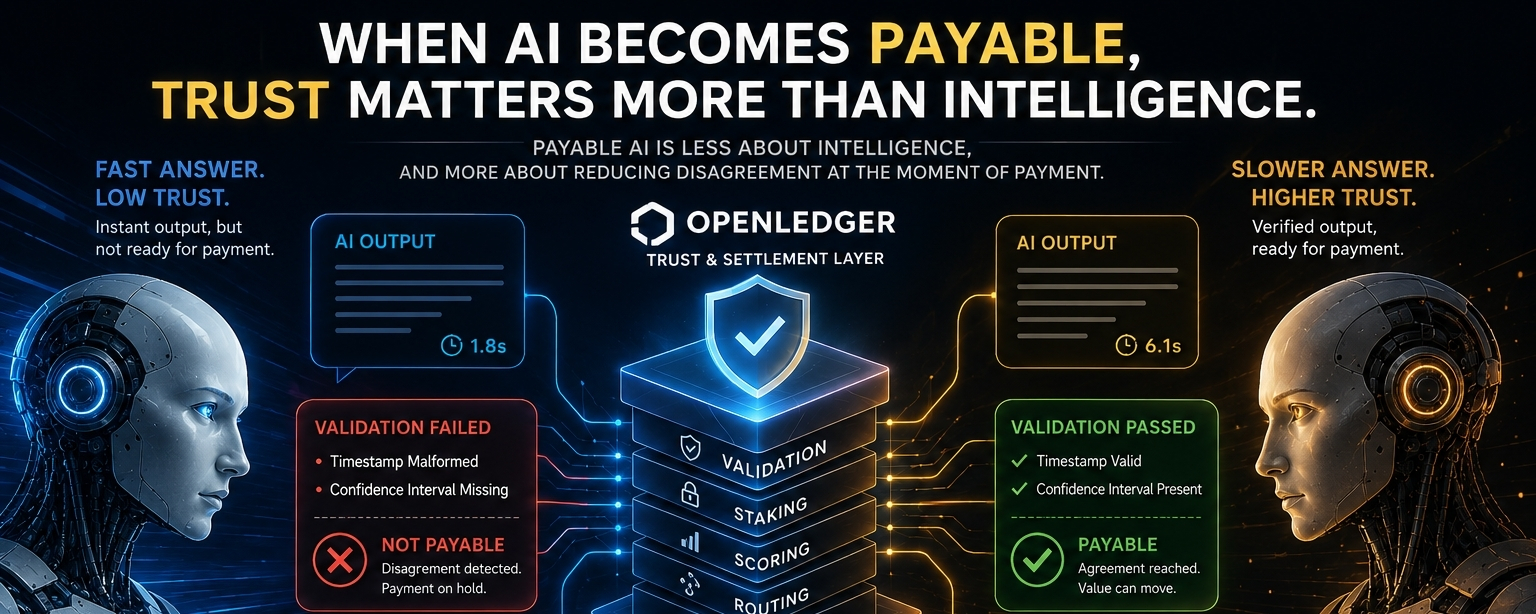
“Payable AI is less about intelligence and more about reducing disagreement before payment.”
That idea only became real after I started observing retries closely.
I tested a structured extraction workflow across different providers connected to OpenLedger’s stack. The first response came back almost instantly, while the validation pass took several more seconds.
What surprised me was that the slower response often became the accepted one because the faster output failed formatting consistency checks.
Nothing catastrophic. Just small inconsistencies. A malformed timestamp. A missing confidence interval.
Things a human would ignore instantly.
But payment systems do not tolerate ambiguity very well.
That was the point where OPEN stopped feeling like “just another token” to me. I realized the token only becomes meaningful when the system has to decide whether an output deserves economic finality.
Most people imagine AI payment rails as a thin financial wrapper around API usage, but OpenLedger feels far more procedural than that.
At times, the infrastructure feels less like a chatbot platform and more like a system negotiating with itself.
I noticed this most clearly in retry behavior.
I intentionally used malformed prompts to observe how routing changed during repeated partial failures. After several retries, the system became noticeably more conservative.
Latency increased. But invalid outputs dropped sharply.
On the surface, that sounds like a positive tradeoff. But then the uncomfortable question appears:
Who absorbs the cost of additional validation and slower confirmation?
That is when I understood something important:
Friction never disappears. It only relocates.
OpenLedger does not allow cheap fast inference to dominate blindly. Instead, it pushes uncertainty upward into coordination layers where validation scoring, staking posture, and routing trust decide whether outputs remain economically useful.
And honestly, I am still not fully convinced regular users actually want this.
Maybe enterprises do. Maybe researchers do.
But most normal users prefer speed… right until money becomes attached to the answer.
If two AI systems produce the same result, and one responds instantly while the other pauses for verification, which one feels more intelligent?
Most people still choose the faster system.
But the moment automatic payment settlement enters the equation, preferences shift almost immediately.
That is where $OPEN starts feeling structurally necessary instead of cosmetically attached.
To me, OPEN feels less like a reward token and more like a coordination pressure mechanism.
Because without real consequences tied to trust degradation, every participant becomes incentivized to maximize throughput regardless of output integrity.
Retry storms become cheap. Consensus scoring becomes noise. And routing quietly centralizes around whoever can absorb failure the longest.
I noticed this especially with smaller models.
Some of them were technically correct, yet still lost routing preference because their formatting inconsistency increased downstream correction costs.
The models were not bad. They were simply expensive to trust operationally.
And I think that distinction will matter more in future AI systems than most people realize.
But there is also an uncomfortable tradeoff here.
Systems optimized for payable reliability slowly become less socially $OPEN even if they remain technically decentralized.
Validation thresholds create behavioral gates. Staking requirements create patience asymmetry.
Some participants can survive long trust accumulation cycles. Others cannot.
And maybe that is the point where AI coordination systems start resembling financial systems.
Invisible reputation corridors begin forming, where certain inference paths are treated as safer before execution even begins.
Personally, I no longer trust pure engagement-driven AI systems the same way I used to, because too many models prioritize responsiveness over accountability.
But there is still a real possibility that OpenLedger overcorrects.
And creates a future where economically trusted AI becomes slower, heavier, and increasingly inaccessible to smaller contributors.
And honestly, I still do not know which failure mode is worse.
A fast system that lies confidently.
Or a payable system where credibility itself slowly becomes a participation tax.
One detail still stays in my mind.
During a multi-step validation cycle, the accepted and rejected outputs were almost identical.
Same meaning. Same conclusion.
The only real difference was that the accepted version passed consistency scoring cleanly enough for settlement logic to stop hesitating.
The intelligence barely changed.
The confidence accounting did.
@OpenLedger$OPEN #OpenLedger .