
Most people use AI every day without knowing where the underlying data comes from, who trained the models, or who profits from the process. A simple chatbot response can rely on millions of hidden human decisions, scraped datasets, and distributed computing resources that remain invisible to the public. Yet despite the growing importance of data in the AI economy, ownership and compensation around it still feel strangely unresolved.
This gap has become more visible as AI systems grow larger and more commercially valuable. Companies collect user interactions, developers contribute models, and communities provide feedback loops that improve outputs over time. But the economic structure behind AI often remains concentrated in a few platforms with limited transparency. Data contributors rarely receive direct value, and smaller developers struggle to access infrastructure powerful enough to compete with larger ecosystems.
Before projects like OpenLedger appeared, several attempts tried to address fragments of this problem. Some blockchain networks focused on decentralized storage, others concentrated on AI marketplaces, and a few experimented with tokenized compute systems. Yet many of these efforts faced a difficult reality: AI infrastructure is deeply interconnected. Data without usable models has limited utility. Models without liquidity or distribution struggle to attract developers. And decentralized systems often introduce complexity that ordinary users cannot realistically manage.
One of the deeper issues was coordination. Traditional AI systems evolved inside centralized environments because centralized companies could efficiently combine storage, compute, training, payments, and governance under one structure. Blockchain systems, by contrast, often fragmented these layers across separate protocols. The result was technical experimentation without a coherent economic loop capable of sustaining long-term participation.
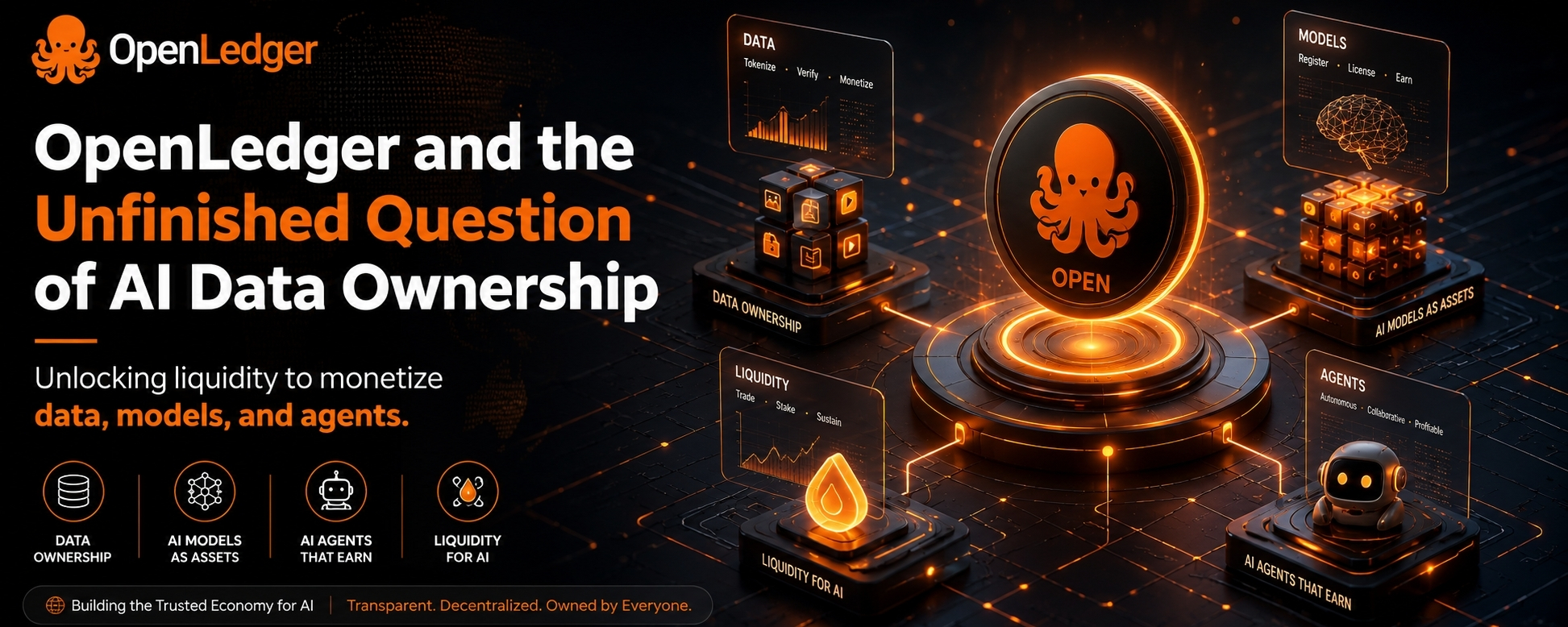
OpenLedger enters this environment with a broader ambition. Rather than focusing only on storage or inference, it attempts to build an AI-focused blockchain infrastructure where datasets, models, and autonomous agents can function as financial assets within the same ecosystem. The project frames this as a liquidity problem as much as a technical one. In its view, AI resources remain underutilized partly because ownership and monetization mechanisms are poorly connected.
The core design of OpenLedger revolves around the idea that contributors to AI systems should be able to register, verify, and monetize their contributions on-chain. Data providers, model creators, and application developers could theoretically participate in a shared economic network instead of relying entirely on centralized intermediaries. This sounds simple on paper, but it represents a significant architectural shift from conventional AI deployment models.
Technically, the project combines blockchain infrastructure with AI-specific coordination layers. Instead of treating AI outputs as external services connected to crypto applications, OpenLedger attempts to integrate them directly into network logic. Models and agents are positioned as composable on-chain resources rather than isolated software products. This approach reflects a larger trend inside crypto where protocols increasingly aim to tokenize productive digital assets instead of static financial instruments alone.
An interesting aspect of OpenLedger is its emphasis on AI agents as economic participants. Much of the current AI conversation still assumes humans remain at the center of every transaction. OpenLedger explores a different direction where autonomous agents can potentially access liquidity, interact with services, and contribute value across decentralized environments. Whether this becomes practical or remains mostly theoretical is still uncertain, but it signals how blockchain infrastructure may evolve alongside increasingly autonomous software systems.
At the ecosystem level, OpenLedger appears to position itself between infrastructure and coordination. It is not merely a smart contract chain, but also not purely an AI platform. Instead, it attempts to create shared rails for attribution, incentives, and interoperability across AI-driven applications. If successful, this could reduce friction for developers building AI-native decentralized services.
Still, several challenges remain difficult to ignore. Verifying the quality and originality of datasets is notoriously complicated. AI models are rarely static products; they continuously evolve through retraining and fine-tuning. Measuring contribution fairly inside such systems may become highly subjective. Blockchain records can improve transparency, but they do not automatically solve disputes around intellectual property or data provenance.
There is also the issue of scalability. AI workloads require significant computational resources, and decentralized systems historically struggle with efficiency compared to centralized cloud providers. OpenLedger may improve coordination mechanisms, but it still operates within the broader limitations of blockchain infrastructure. If costs rise too quickly or throughput becomes constrained, smaller contributors could once again find themselves excluded.
Another tension involves accessibility. Projects that combine AI and blockchain often assume users possess technical knowledge across two already complex industries. Developers may adapt more easily, but ordinary participants could face steep learning curves. If the ecosystem becomes dominated by specialized actors, the promise of broader

