
One thing honestly surprised me while studying @undefined ….
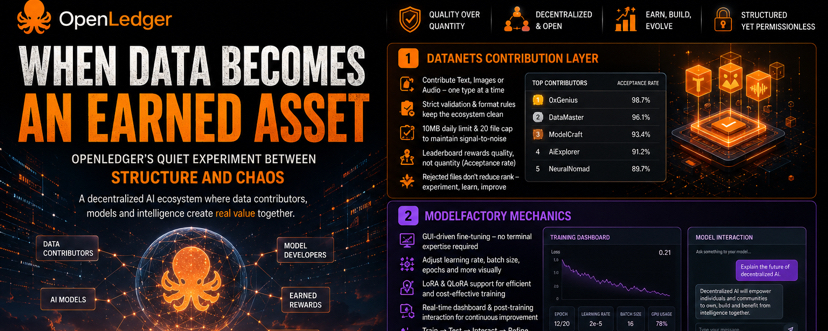
At first glance, the whole system feels extremely controlled — strict limits, validation rules, contribution filters, file caps. Normally in Web3, we expect “permissionless everything.” But OpenLedger is clearly moving in a different direction.
And maybe that is intentional.
Because the deeper I looked into the architecture, the more it felt less like a normal AI platform and more like an experiment in turning data into an earned asset rather than just random digital noise.
The Datanets layer explains this perfectly.
Most people assume contribution systems reward volume:
upload more = earn more.
But OpenLedger seems to reject that mentality completely.
Acceptance rate matters more than quantity.
That changes the psychology of contribution itself.
The 10MB daily limits and submission caps may sound restrictive, but technically it solves one of the biggest problems in decentralized systems:
signal-to-noise collapse.
Unlimited contribution sounds ideal in theory, but in reality it usually creates spam, duplication and low-value datasets. OpenLedger appears to be testing whether controlled contribution can actually create higher-quality AI ecosystems.
What I found surprisingly smart is that rejected uploads don’t destroy your ranking.
That is important.
Because systems built entirely around punishment usually discourage experimentation. Here, experimentation is still allowed — but quality is rewarded.
Then comes ModelFactory, which honestly feels like the most ambitious layer in the entire ecosystem.
This part changes OpenLedger from “data infrastructure” into something much bigger.
They are attempting to transform LLM fine-tuning from a technical research workflow into something visually accessible through GUI-based interaction.
That matters more than people realize.
Normally, AI fine-tuning feels locked behind engineers, terminals and infrastructure complexity. But OpenLedger is simplifying the process without completely removing control.
Learning rates, epochs, batch sizes, LoRA adaptation — all visually manageable.
That is not just beginner-friendly design.
That is AI democratization strategy.
And their support for LoRA + QLoRA feels practical rather than hype-driven because full fine-tuning has become economically unrealistic for most users today.
The real-time interaction loop is also interesting:
Train → Test → Interact → Refine
Instead of treating model training like a one-time event, they are designing it more like a continuous feedback system.
Supported ecosystem coverage is another thing worth noticing.
DeepSeek, Qwen, Mistral, LLaMA, BLOOM, GPT-2, ChatGLM…
At first it looks excessive.
But strategically, wide compatibility prevents ecosystem isolation. If only elite models are supported, experimentation becomes narrow. Broad model coverage creates larger innovation space.
Honestly, the entire system reminds me of a disciplined kitchen.
Nobody is allowed to randomly throw ingredients everywhere.
But once the final product is ready, everyone can taste, evaluate and improve it.
That balance between openness and structure is probably the hardest thing to achieve in decentralized AI.
And maybe that is the real experiment here.
Can decentralized systems remain open without collapsing into noise?
Can data become a true economic asset if validation becomes stronger than pure contribution volume?
I don’t think there is a final answer yet.
But I do think OpenLedger is trying to solve a much deeper problem than most AI projects are discussing right now.
And whether it succeeds or not… this experiment is definitely worth watching 🚀