
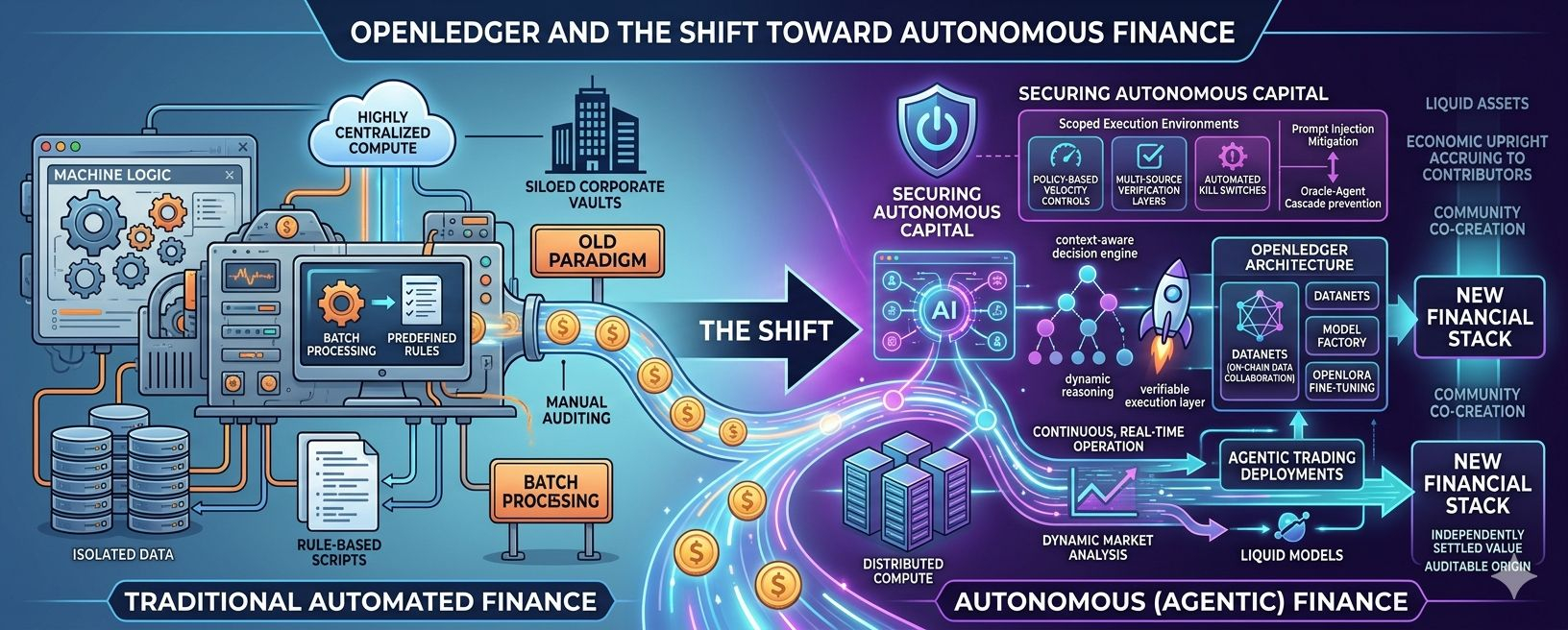
Since you want it to feel more natural and less like a formal analysis piece, here’s a more human, conversational version while keeping the strong narrative:
OpenLedger, DeFAI and a Question I Keep Thinking About… 🤔
The more I try to understand what OpenLedger is building, the more I feel the conversation is bigger than just AI or DeFi.
It feels like they’re questioning something finance has worked on for decades.
In traditional finance, if you want professionals to manage capital, you pay for it.
Banks charge fees. Asset managers charge AUM. Institutions sit between users and execution.
That has always been normal.
Then DeFi came and changed part of the equation.
Money became programmable.
Rules became code.
But now DeFAI seems to be asking something different:
What if execution itself becomes autonomous?
Not just automated transactions — actual strategy execution where AI watches markets, reacts to conditions and executes based on predefined logic.
If that works at scale… that’s a pretty big shift.
Because suddenly access to advanced yield strategies may not stay limited to institutions or people behind expensive subscriptions.
In theory, infrastructure becomes open.
Execution becomes faster.
Capital becomes smarter.
But I also keep thinking about the other side.
How reliable are AI decisions during extreme volatility?
How clean is oracle data?
Who takes responsibility when automated execution goes wrong?
Technology can remove friction, but trust is harder to automate.
So I’m not fully convinced yet.
Still early.
But direction feels clear.
Finance is slowly moving from manual → programmable → autonomous.
And maybe the biggest question isn’t whether AI can manage capital.
Maybe it’s whether people will trust it enough to let it.
Interesting space to watch 🚀
