
A few days ago I was watching people on X talk about AI agents like they were already replacing entire jobs overnight.
Everyone sounded confident.
“AI is the future.”
“Agents will run everything.”
“Mass adoption is here.”
So I decided to actually explore some AI platforms myself instead of just reading hype posts all day.
Honestly? It got confusing fast.
One project wanted me to understand model deployment. Another expected me to know how GPU infrastructure worked. Then suddenly I was reading about APIs, vector databases, fine-tuning, inference layers… and somewhere in the middle of all that I realized most normal people would probably close the tab immediately.
That’s when something clicked for me.
A lot of AI today still feels built for developers first and regular users second.
And maybe that’s the real problem.
Because people keep talking about AI becoming mainstream while the experience still feels too technical for the average person trying to enter the space for the first time.
That’s partly why OpenLedger caught my attention.
Not because it promised some crazy futuristic fantasy, but because the project seems focused on the infrastructure layer most people completely ignore.
The foundation underneath AI systems.
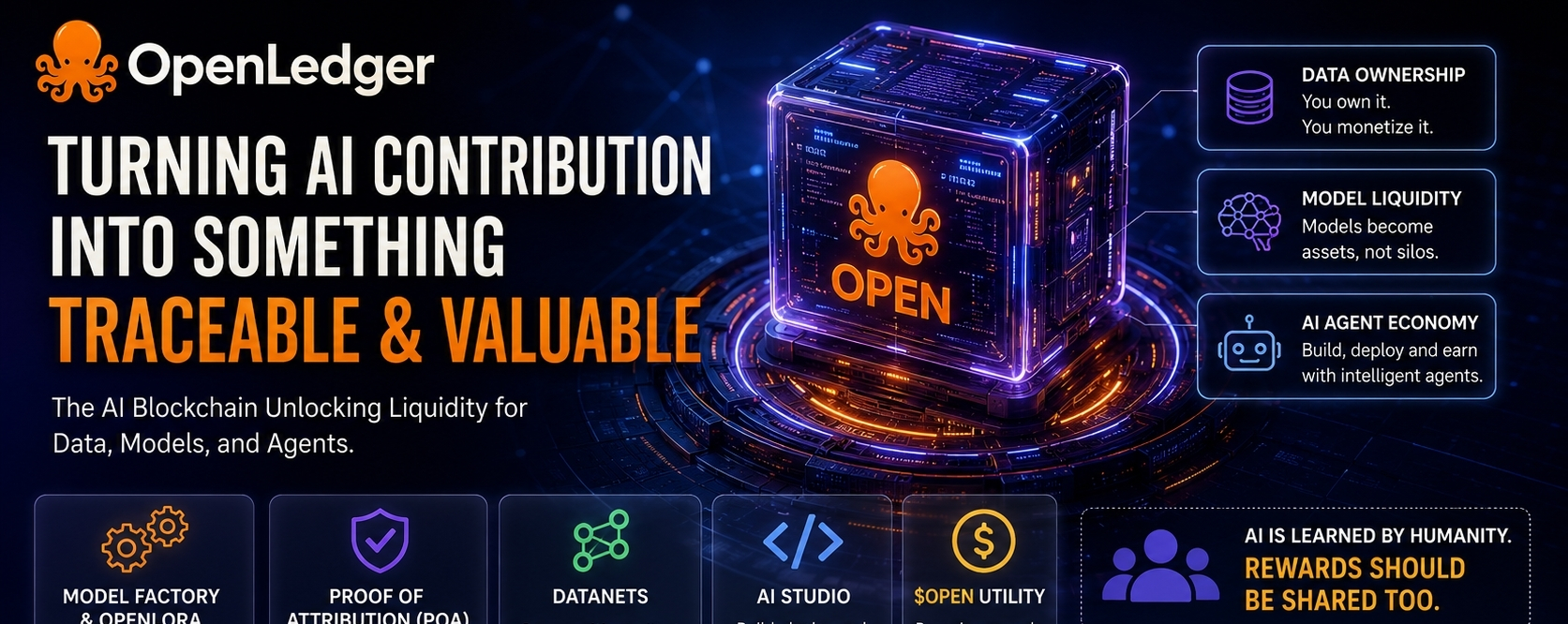
The interesting part for me was realizing OpenLedger is not only thinking about AI models themselves. They’re thinking about the entire ecosystem around contribution, ownership, and accessibility.
And honestly, that matters a lot more than people think.
Their Model Factory and OpenLoRA system stood out because it feels like they’re trying to simplify how builders train, fine-tune, and launch AI models instead of making everything feel locked behind deep technical knowledge.
But the thing that really made me stop and think was Proof of Attribution.
Because the more I thought about it, the stranger modern AI started feeling.
Millions of people contribute to AI every single day without getting recognized for it. Conversations, research, online activity, datasets, feedback, creative work… all of that becomes part of the machine learning process somehow.
Yet once a model becomes successful, the people behind the data disappear completely from the story.
OpenLedger seems to be challenging that idea.
Their PoA system tracks contribution and data influence so contributors are not invisible anymore. Instead of value disappearing into a black box forever, there’s at least an attempt to connect contribution back to rewards through the ecosystem.
That feels important.
Especially now.
Because AI is growing insanely fast, but the conversation around ownership still feels unfinished. Everyone focuses on smarter outputs while ignoring where the intelligence is actually coming from in the first place.
And then I started reading more about Datanets.
That part honestly makes sense the deeper you think about it.
People talk nonstop about powerful AI models, but high-quality data is the real fuel behind everything. Without strong datasets, even advanced systems become unreliable. OpenLedger’s idea of communities helping collect and structure LLM-ready data together feels like something that could become much bigger later if AI keeps expanding at this pace.
AI Studio also feels like an important piece.
Not everyone wants to become a machine learning engineer just to experiment with AI agents. Most people simply want tools that feel accessible enough to start building without needing months of technical study first.
That’s where a lot of projects fail.
They build for experts and forget normal users exist.
OpenLedger at least feels aware of that gap.
And maybe that’s why it doesn’t feel like another short-term “AI + crypto” trend to me anymore. It feels more like infrastructure preparing quietly in the background while everyone else is distracted by hype cycles and price charts.
The bigger question for me now is this:
If AI systems are learning from millions of human contributions every day, does it still make sense for only a handful of companies to control most of the value?
Because sooner or later, people are going to care a lot more about attribution than they do right now.
And projects already building around that idea early could end up becoming far more important than most people currently realize.