
May 24, 2026
A few month ago i noticed something strange while testing different AI agent connect to crypto tools . The agents themselves were not the main issue. Most could summarize data, trigger transactions, or coordinate simple workflows reasonably well. The real problem appeared one layer deeper. Nobody could explain why a user should trust the outputs once incentives became adversarial. The conversation around AI infrastructure still feels heavily focused on capability while ignoring verification. In crypto terms, it reminds me of the early DeFi period where everyone optimized composability before understanding how fragile incentive systems become under stress.
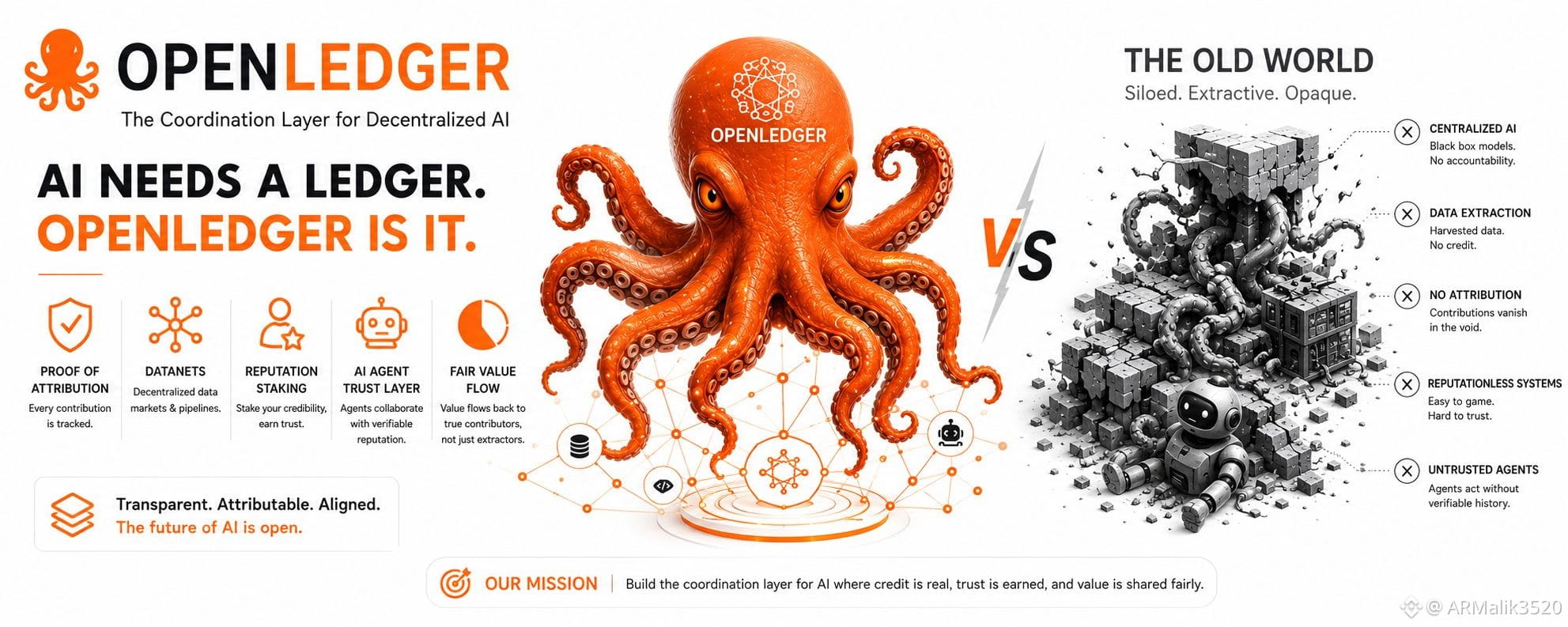
That is partly why OpenLedger has become more interesting to watch lately. Not because it promises some perfect decentralized AI future, but because it seems to be approaching AI as a coordination problem rather than just a compute problem. I think that distinction matters more than people realize. Most AI systems today depend on invisible labor and unverifiable data pipelines. Models absorb information from contributors, APIs, forums, datasets, and human feedback loops, yet attribution usually disappears somewhere between ingestion and output generation. Economically, that creates a strange imbalance. The entities extracting the most value are often the ones least accountable for where intelligence actually came from.
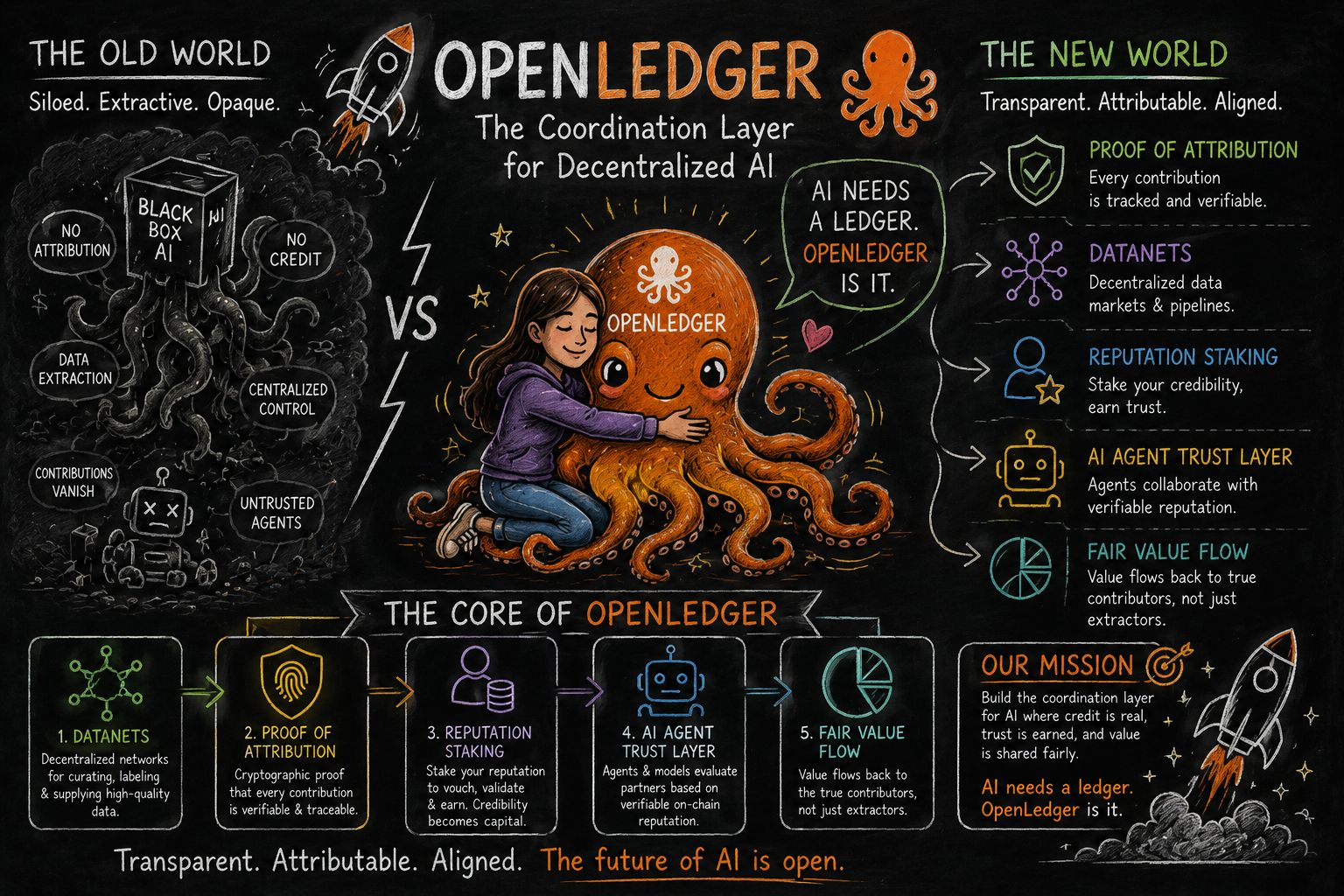
Crypto infrastructure historically tries to solve trust through transparency and economic alignment. But AI introduces a harder version of the problem because intelligence itself is probabilistic. You are no longer verifying a balance or confirming a block hash. You are evaluating whether a model output deserves credibility. That is much harder to price. OpenLedger’s experimentation around datanets and Proof of Attribution seems aimed directly at this tension. The underlying idea appears simple on the surface: track contribution flows so value and reputation can be connected back to the participants who shaped the system. But structurally, that creates second-order implications that go far beyond rewards distribution.
If attribution becomes reliable, then AI infrastructure stops behaving like a black box and starts behaving more like an economic network. Suddenly data providers, model builders, validators, and agents all operate within visible incentive loops. That changes participant behavior. Contributors become more selective about quality because reputation becomes stakeable. Developers become more cautious about manipulating outputs because attribution trails create accountability pressure. Even governance changes because the system can theoretically distinguish between meaningful contributors and passive speculators.
At least in theory.
The difficult part is that attribution systems themselves can become targets for manipulation. Once reputation has economic value, people will inevitably optimize for metrics instead of truth. Crypto already has years of experience with this dynamic. Liquidity mining produced mercenary capital. Social engagement farming distorted attention markets. Governance systems often became dominated by capital concentration rather than expertise. AI networks will likely inherit similar distortions, except now the manipulation occurs through data quality, synthetic interactions, coordinated model poisoning, or reputation gaming.
That is where I think many optimistic AI infrastructure discussions become too simplistic. Scaling coordination systems is not only about throughput or decentralization. It is about maintaining signal quality while incentives become increasingly financialized. Under pressure, most systems drift toward low-cost extraction behaviors unless there are meaningful penalties for degrading trust. OpenLedger’s challenge is not simply attracting contributors. It is creating conditions where honest participation remains economically rational even when adversarial strategies become profitable in the short term.
The interesting thing is that AI agents may intensify this problem dramatically. Once agents begin interacting autonomously across markets, APIs, and decentralized systems, trust can no longer rely purely on brand recognition or institutional reputation. Agents will need machine-readable credibility layers. They will need ways to evaluate whether a dataset was manipulated, whether a contributor has historically produced reliable outputs, or whether another agent is economically incentivized to deceive them. In that environment, attribution stops being a social feature and becomes infrastructure.
But infrastructure experiments rarely evolve cleanly. The history of crypto is full of systems that worked elegantly at small scale before collapsing under real economic pressure. Coordination failures usually appear gradually and then all at once. I suspect AI networks will experience similar cycles. Some contribution markets will become noisy. Some reputation systems will be sybiled. Some governance layers will drift toward plutocracy despite good intentions. OpenLedger may encounter all of those pressures eventually.
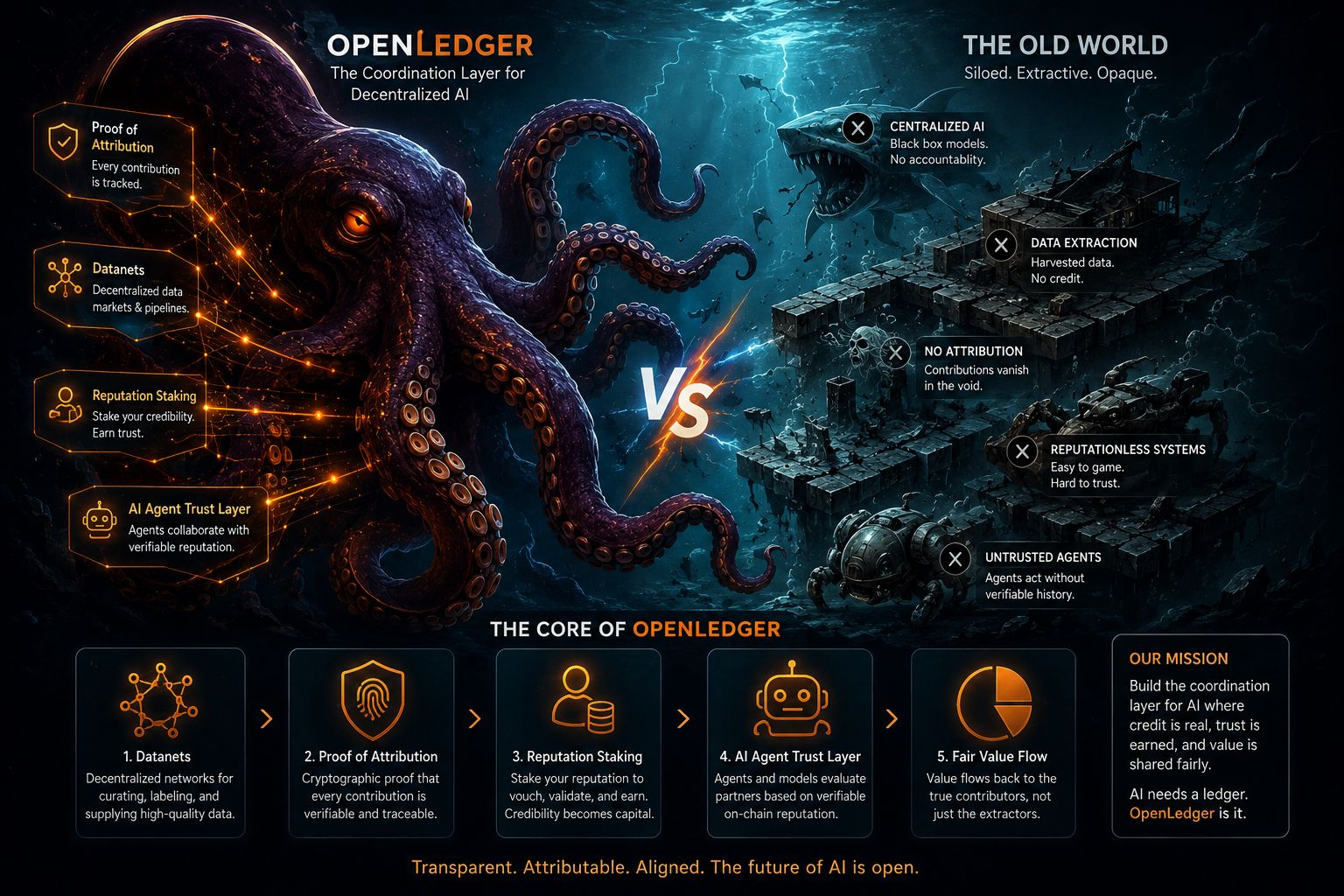
Still, I think the broader direction is worth paying attention to because it reframes AI from a pure intelligence race into a trust architecture problem. The long-term winners in AI infrastructure may not be the systems with the most powerful models. They may be the systems that most effectively align incentives between contributors, agents, and users without collapsing into extraction or manipulation. That is a much harder problem than generating outputs, and probably a more important one.
The deeper realization for me is that decentralized AI may ultimately depend less on who owns the models and more on who can sustain credible coordination at scale. I am not sure the industry fully understands that distinction yet.$OPEN $ONDO
