
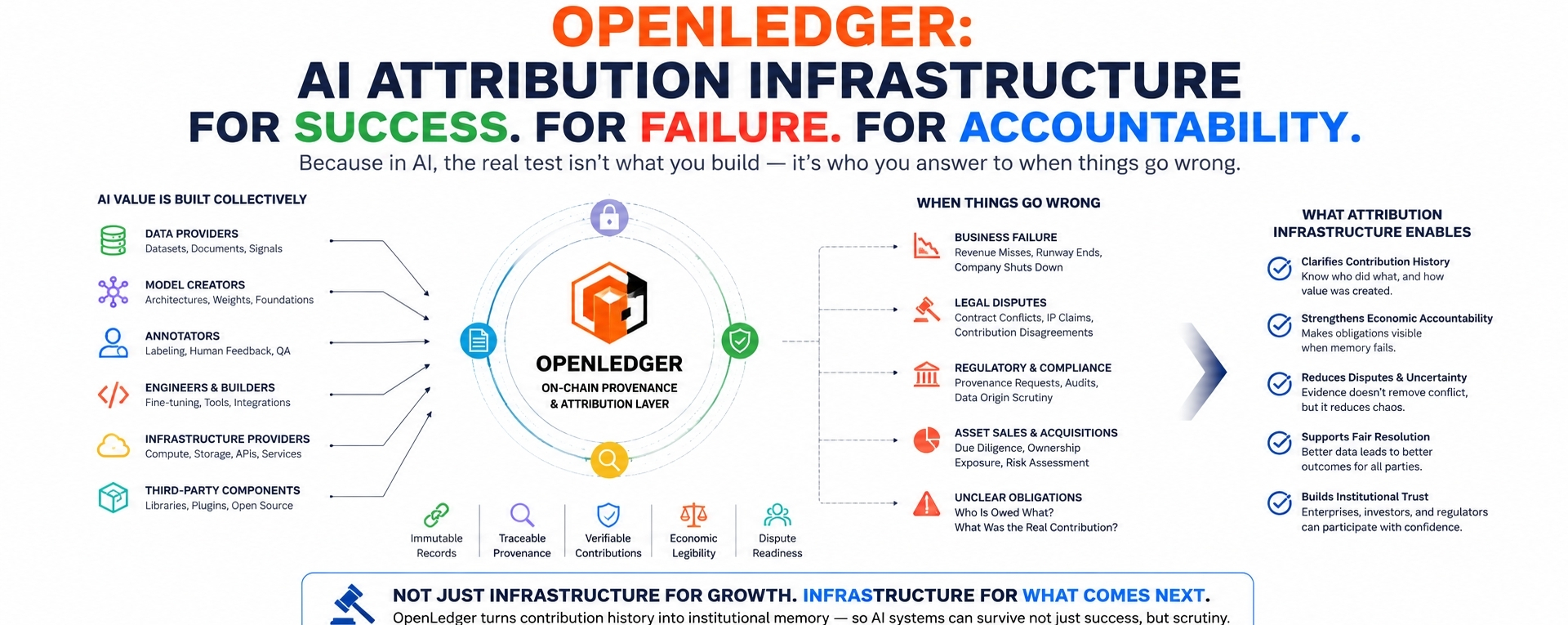
OpenLedger, AI Attribution, and the Forgotten Problem Nobody Wants to Talk About: What Happens When the AI Company Dies?
The AI industry has become obsessed with creation.
Creating smarter models.
Creating autonomous agents.
Creating new markets.
Creating synthetic labor.
Creating trillion-dollar companies.
Every conference, every investor deck, every roadmap presentation revolves around the same assumption:
The future is expansion.
More intelligence.
More automation.
More scale.
More revenue.
More growth.
But the longer I watch the AI industry evolve, the more I find myself asking a different question.
A much less exciting question.
A much less marketable question.
And possibly a much more important one.
What happens when the company fails?
Not when it succeeds.
Not when the token goes up.
Not when the funding round closes.
Not when users arrive.
Not when the valuation doubles.
What happens when everything goes wrong?
Because eventually, for many companies, it will.
And strangely, AI seems almost philosophically unprepared for that reality.
The Industry Keeps Designing for Success
Most conversations around AI infrastructure assume a happy ending.
The model becomes useful.
The product finds market fit.
Customers arrive.
Revenue grows.
Contributors get rewarded.
Everyone wins.
Attribution systems are usually discussed through this lens.
The narrative is familiar.
Data creators deserve recognition.
Annotators deserve visibility.
Researchers deserve compensation.
Model contributors deserve economic participation.
The idea makes intuitive sense.
If value is created collectively, value should be distributed collectively.
That is how most people frame attribution.
And to be clear, there is nothing wrong with that argument.
But I increasingly think it misses the more important reason attribution infrastructure exists.
Because mature economic systems are not judged by how they handle success.
They are judged by how they handle failure.
Success is easy.
Failure reveals architecture.
Every Mature Industry Has a System for Economic Disagreement
Think about traditional finance.
Banks fail.
Companies collapse.
Assets change hands.
Creditors make claims.
Investors fight over ownership.
Suppliers demand payment.
Regulators demand answers.
None of this is unusual.
In fact, entire industries exist to manage these situations.
Bankruptcy courts.
Audit firms.
Settlement networks.
Accounting standards.
Corporate governance frameworks.
Legal record systems.
Most people never think about these institutions because they operate quietly in the background.
But they are incredibly important.
Without them, markets become chaotic.
Not because people are dishonest.
Because people remember things differently when money is involved.
A contract that looked obvious during growth suddenly becomes ambiguous during collapse.
A verbal agreement becomes disputed.
A partnership becomes contested.
An ownership claim becomes complicated.
Economic stress changes behavior.
It always has.
It always will.
The remarkable thing about AI is not that these problems exist.
The remarkable thing is how little attention the industry pays to them.
AI Is Building Economic Complexity Faster Than It Is Building Accountability
Look beneath the surface of a modern AI company.
The structure is far more complicated than most people realize.
A healthcare AI startup might use:
- Licensed medical datasets
- Third-party foundation models
- External annotation providers
- Open-source model components
- Proprietary fine-tuning pipelines
- Retrieval systems
- API services
- Cloud infrastructure
- Human review teams
- Compliance vendors
From the outside, customers see a single product.
Internally, the product is an economic ecosystem.
A web of dependencies.
A chain of contributions.
A stack of obligations.
Every layer helped create value.
Every layer participated in the final outcome.
Yet in most cases, those relationships remain partially invisible.
Why?
Because nobody cares while growth continues.
As long as revenue arrives, ambiguity is tolerable.
As long as investors are happy, nobody audits every assumption.
As long as incentives align, everyone acts as though the system is coherent.
Then reality arrives.
And reality always arrives.
Imagine the Company Doesn't Survive
Forget the optimistic scenario.
Let's examine the ordinary one.
The company misses growth targets.
Cash reserves shrink.
Fundraising becomes difficult.
Competition increases.
Legal costs rise.
Management begins restructuring.
Six months later the company is effectively finished.
Now the questions begin.
Questions that were never important during growth suddenly become urgent.
Who owns what?
Who contributed what?
Who is owed what?
What assets can be sold?
What liabilities remain?
Which datasets materially influenced the product?
Which contributors have legitimate claims?
Which contracts survive?
Which obligations disappear?
These are not technical questions anymore.
They are economic questions.
And economic questions require evidence.
Not memories.
Not assumptions.
Evidence.
This Is Where OpenLedger Becomes More Interesting
Most people describe OpenLedger as attribution infrastructure.
I understand why.
That is the easiest explanation.
Track contributions.
Measure provenance.
Reward participants.
Create transparency.
Simple.
But I suspect that description undersells what attribution infrastructure could become.
Because attribution may eventually matter less as a reward mechanism and more as an accountability mechanism.
Not infrastructure for prosperity.
Infrastructure for uncertainty.
Not infrastructure for growth.
Infrastructure for conflict.
That distinction changes everything.
The Hidden Market Nobody Talks About
There is a massive difference between creating value and proving how value was created.
The AI industry spends nearly all of its energy on the first problem.
Very little on the second.
Yet history suggests the second problem becomes more important over time.
Consider financial auditing.
Accounting systems do not generate revenue.
They document reality.
Supply chain tracking does not create products.
It creates traceability.
Property registries do not create land.
They create clarity around ownership.
The economic value of these systems comes from reducing uncertainty.
And uncertainty becomes expensive when stakes rise.
The same principle applies to AI.
As models become embedded inside healthcare, finance, law, defense, insurance, and enterprise operations, provenance stops being a luxury.
It becomes infrastructure.
Attribution Is Really About Institutional Memory
One insight keeps returning to me.
Most organizations rely heavily on social memory.
People remember who contributed.
Teams remember why decisions were made.
Managers remember agreements.
Founders remember dependencies.
But social memory is fragile.
People leave.
Teams dissolve.
Companies get acquired.
Documents disappear.
Cloud services shut down.
Knowledge fragments.
The larger the organization becomes, the worse this problem gets.
Eventually, memory becomes an unreliable database.
And once significant money is involved, selective memory becomes surprisingly common.
This is why durable attribution matters.
Not because it creates truth.
Because it creates evidence.
Those are very different things.
Evidence cannot eliminate disagreement.
But it can dramatically reduce uncertainty.
Crypto Should Understand This Better Than Anyone
One reason this topic fascinates me is because crypto has already experienced versions of it.
Every bull market creates the illusion of alignment.
Protocols grow.
Communities expand.
Token prices rise.
Everyone appears cooperative.
Then conditions change.
Revenue shrinks.
Treasuries contract.
Incentives weaken.
And suddenly invisible assumptions become visible conflicts.
Validator disputes.
Governance battles.
Treasury disagreements.
Ownership controversies.
Questions nobody cared about during expansion become central during contraction.
AI will experience the same phenomenon.
Not because AI is flawed.
Because economics are economics.
Human behavior does not change simply because the technology changes.
The Enterprise Adoption Story Is Being Misunderstood
Many people believe enterprises hesitate because AI still lacks capability.
I think that explanation is incomplete.
Capability is improving rapidly.
In many cases it is already sufficient.
The larger concern is exposure.
Organizations are asking questions that retail markets rarely consider.
What are our legal risks?
Where did this model come from?
Can we verify data lineage?
What happens if a licensing dispute emerges?
Can regulators audit the system?
Who is accountable if provenance claims are challenged?
These are not exciting questions.
They do not generate viral social media threads.
But they influence billion-dollar purchasing decisions.
And they are fundamentally attribution questions.
The Problem Nobody Has Solved
Of course, attribution itself is incredibly messy.
Not every contribution deserves economic significance.
Not every dataset deserves perpetual compensation.
Not every interaction creates ownership.
At some point a system must decide:
What actually mattered?
That sounds simple until you attempt it.
Was a dataset responsible for 30% of model performance?
Or 3%?
Was an annotation provider economically material?
Or merely supportive?
Should thousands of micro-contributions create permanent claims?
Or should only major contributors matter?
Every answer introduces governance.
Every governance system introduces politics.
Every political system introduces conflict.
There is no clean solution.
Only tradeoffs.
The Dangerous Illusion of "Putting It On-Chain"
Crypto communities often make a mistake.
They assume visibility equals resolution.
It doesn't.
Recording information is not the same thing as enforcing outcomes.
A blockchain can preserve history.
It cannot automatically settle every dispute.
It cannot compel legal compliance.
It cannot override courts.
It cannot eliminate conflicting interpretations.
Transparency helps.
But transparency is not sovereignty.
The distinction matters.
Because the true challenge is not recording contribution.
The true challenge is building institutions that know what to do with those records.
Maybe the Real Product Is Not Attribution
Maybe the real product is economic legibility.
That phrase sounds boring.
But boring infrastructure often captures the most durable value.
Markets become larger as they become more understandable.
Capital flows more efficiently when uncertainty decreases.
Institutions participate more confidently when obligations are visible.
Trust scales when verification becomes easier.
Perhaps attribution networks ultimately succeed not because they reward contributors.
Perhaps they succeed because they make complex AI systems economically understandable.
And in large markets, understanding is valuable.
Sometimes more valuable than innovation itself.
The Future Test of AI Infrastructure
The AI industry currently measures success by acceleration.
Faster models.
Faster inference.
Faster deployment.
Faster adoption.
But acceleration is only half of maturity.
The other half is resilience.
Can the system survive disagreement?
Can it survive audits?
Can it survive acquisitions?
Can it survive litigation?
Can it survive bankruptcy?
Can it survive the moment when incentives stop aligning?
Those questions rarely appear in product demos.
Yet they determine whether an industry becomes institutionalized or remains speculative.
The Most Valuable Infrastructure Is Often Built for Bad Days
Perhaps the market is evaluating attribution networks through the wrong lens.
Everyone asks how they create value during success.
Few ask how they preserve order during failure.
But history repeatedly shows that the strongest institutions are not the ones that perform best when conditions are ideal.
They are the ones that remain useful when conditions deteriorate.
When companies collapse.
When ownership is disputed.
When obligations become unclear.
When memories conflict.
When trust disappears.
That is when infrastructure proves its worth.
And that is why OpenLedger increasingly looks less like a creator-reward platform and more like something much larger.
Not an AI growth engine.
Not a tokenized incentive layer.
Not merely an attribution network.
But potentially the foundation of a future accountability layer for artificial intelligence.
Because the true sign of a mature economic system is not how efficiently it creates wealth.
It is how effectively it manages uncertainty after that wealth becomes contested.
AI spends most of its time talking about intelligence.
Eventually it will have to talk about responsibility.
And when that day arrives, attribution may stop being a niche feature and become one of the most important pieces of infrastructure in the entire AI economy.
