

At first glance, systems like this can feel almost over-designed. Too many rules layered on top of too many validations, sitting on infrastructure that is supposed to be open, fluid, and permissionless.
So the natural reaction is to dismiss it as something slightly against the spirit of Web3—less freedom, more control.
But that reading doesn’t hold for long.
Because once you spend enough time with the structure, it stops looking like restriction for restriction’s sake. What emerges instead is intention. A deliberate attempt to transform messy, uncontrolled information into something that can actually be measured, trusted, and reused at scale.
That’s where @OpenLedger starts to feel less like a standard AI infrastructure project and more like a quiet but serious experiment around a deeper question:
What if data itself wasn’t just collected—but earned?
And once that idea settles in, everything else begins to rearrange itself around it.
---
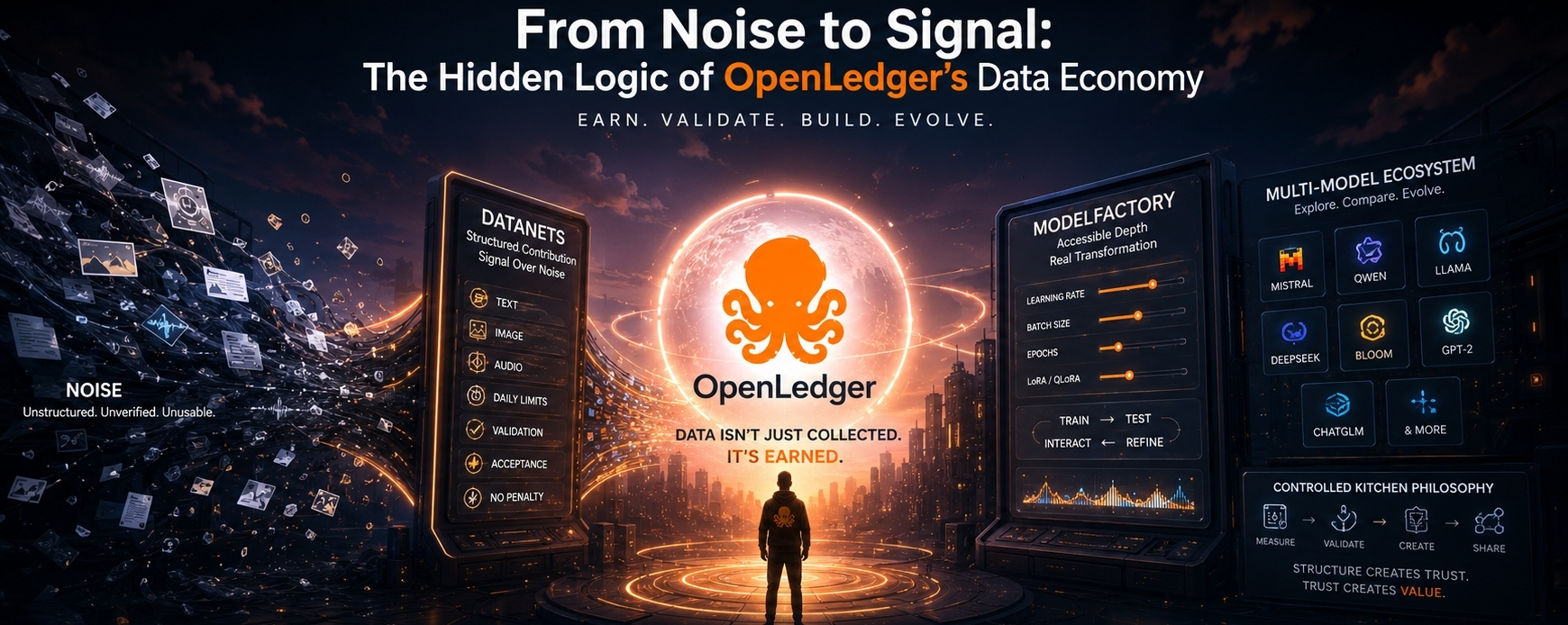
Datanets: turning contribution into signal instead of noise
The first thing that stands out is how deliberately “non-traditional Web3” it feels.
Separate formats for text, images, and audio. Strict daily limits. File caps. Clear boundaries on what can and cannot be submitted.
At first, it looks restrictive.
But the purpose becomes clearer when you focus on what the system is trying to protect rather than what it is limiting.
Because open systems without structure don’t naturally scale value—they scale noise. And once noise takes over, even the most decentralized system becomes practically useless.
So instead of maximizing contribution, the system optimizes for signal.
That single shift changes everything.
Even the leaderboard reflects this philosophy. It is not built around volume. It is built around acceptance. What matters is not how much you submit, but what the system recognizes as valuable.
And perhaps the most important detail is what doesn’t happen: rejected submissions do not harm your standing.
That subtle decision reshapes behavior entirely. It removes fear from experimentation. It encourages iteration without penalty. It turns contribution into a learning loop rather than a performance metric.
In simple terms, it rewards trying, not just succeeding.
---
ModelFactory: making complexity accessible without removing depth
If Datanets is about collecting structured input, ModelFactory is about what happens after—when that input becomes something usable.
This is the transformation layer.
Instead of locking model training behind engineering-heavy workflows, scripts, and terminal commands, it brings it into a visual environment. Learning rate, batch size, epochs—parameters that usually require technical handling—become adjustable components in an interface.
On the surface, this looks like simplification.
But underneath, it’s something more careful: accessibility without dilution.
Beginners are not excluded. Experts are not limited. The system reduces friction between intention and execution without flattening the underlying complexity.
Support for LoRA and QLoRA reinforces this direction. Full fine-tuning is too expensive and heavy for most users, so lightweight adaptation becomes the practical bridge that keeps experimentation alive.
And the process they are pointing toward is not static. It is cyclical:
train → test → interact → refine
A loop instead of a line. A continuous evolution instead of a final output.
---
A multi-model ecosystem instead of a single path
Another important design choice is the breadth of supported models.
Mistral, Qwen, LLaMA variants, DeepSeek, BLOOM, GPT-2, ChatGLM—different architectures, different eras, different philosophies.
This is not about selection. It is about expansion.
Because once multiple models coexist in the same environment, the question is no longer “which is best,” but “how do different systems behave under different conditions?”
That creates a different kind of experimentation space—less competitive, more comparative. Less about dominance, more about understanding.
---
The controlled kitchen philosophy
A useful way to understand the entire system is to imagine a highly disciplined kitchen.
Nothing is added randomly. Ingredients are measured. Processes are validated. Everything follows structure before becoming part of the final output.
But once the dish is ready, it is shared, tasted, and evaluated.
That contrast is the core idea.
Control is not opposed to openness—it enables meaningful openness later.
And rather than limiting creativity, it redirects it. Because success in such a system does not come from noise or randomness. It comes from alignment with structure.
---
A quieter layer: knowledge that behaves dynamically
Another less visible layer is the way knowledge is handled.
Instead of static documentation, the system leans toward structured, retrievable information sources that can be queried when needed.
Documentation becomes interactive rather than passive. You don’t just read it—you pull it into context.
That small shift changes the relationship between user and system from consumption to interaction.
---
Final reflection: a system built on tension
At its core, the most interesting part of this design is not any single feature.
It is the tension holding everything together.
On one side: openness, decentralization, contribution.
On the other: structure, validation, controlled quality.
Most systems resolve this by choosing one direction.
This one attempts to maintain both.
That balance is difficult. It is fragile. It can fail in either direction if pushed too far.
But if it holds, it points toward something larger than just another AI platform.
It suggests a functioning data economy—where data is not only stored or collected, but continuously earned, validated, and reintegrated into a loop between humans and models.
The real question is not whether this idea is interesting.
It already is.
The real question is whether it can scale without losing its openness—or whether, at scale, it gradually becomes another form of centralized control wrapped in better language.
For now, it remains in that in-between state.
Not finished. Not proven.
But quietly significant.
And worth watching closely.