
At 2:14 a.m., the alerts never sound cinematic. No orchestral panic. No hacker in a hoodie lit by green terminal glow. Just a vibration on a nightstand, a dashboard turning amber, and someone from compliance asking whether the wallet approvals were rotated before deployment. Most failures arrive like accounting problems first. Quiet discrepancies. Permissions that stayed alive too long. A signer that should have expired yesterday. A bridge validator nobody thought to isolate. By the time markets notice, the damage has already finished happening.
This is the part of blockchain infrastructure people rarely market because it lacks velocity. There is no ticker symbol for restraint. No retail excitement around audit trails or delegated execution scopes. Yet every risk committee eventually arrives at the same conclusion: systems rarely collapse because blocks were three seconds slower than promised. They collapse because authority spread wider than intended. Because private keys accumulated invisible power. Because convenience quietly outlived caution.
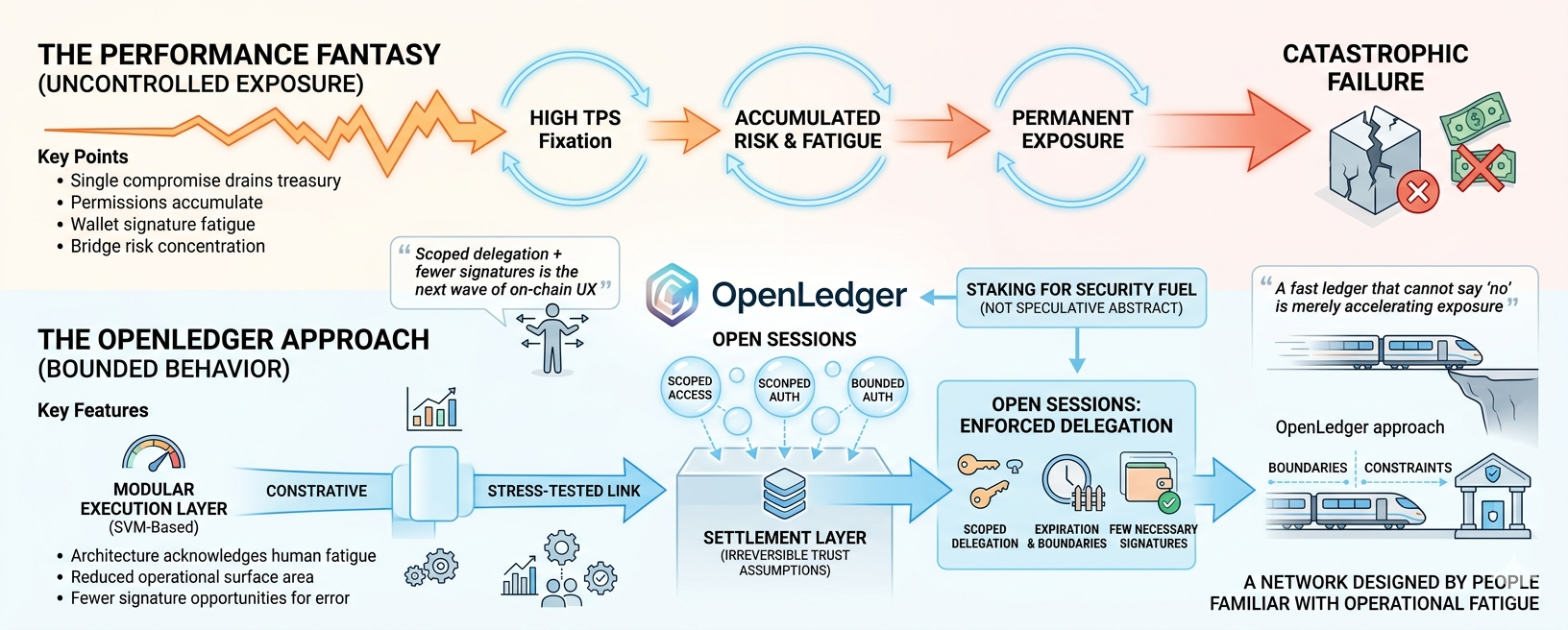
The fixation on TPS has always felt slightly adolescent. A benchmark war mistaken for systems engineering. Faster finality does not repair operational negligence. A chain processing one hundred thousand transactions per second still fails catastrophically if one compromised signer can drain treasury permissions across environments. Throughput is measurable, so the industry obsesses over it. Permission design is psychological, procedural, human. Harder to summarize in a chart. Harder to brag about during conference panels.
That is where OpenLedger becomes interesting—not as another performance narrative, but as a rejection of the assumption that speed alone represents maturity.
OpenLedger is structured as an SVM-based high-performance Layer 1, but the architecture matters less than the philosophy beneath it. The system treats execution speed as useful only when bounded by enforceable constraints. Modular execution operates above a more conservative settlement layer, creating separation between fast interaction and irreversible trust assumptions. That distinction matters. The industry spent years pretending every operation deserved equal permanence. In reality, most user activity is temporary intent wrapped in unnecessary authority.
OPEN Sessions addresses that directly. Not as a cosmetic wallet feature, but as enforced delegation with expiration, scope, and boundaries. A session can authorize only what it needs, for only as long as necessary, without repeatedly exposing the primary wallet to fresh signature requests. That changes the operational surface area entirely. The reduction is subtle until you understand what usually goes wrong in production systems. Fatigue goes wrong. Repetition goes wrong. Humans clicking “approve” at the end of long workdays go wrong.
“Scoped delegation + fewer signatures is the next wave of on-chain UX.”
Not because it feels smoother, although it does. Because every additional signature request is another opportunity for conditioned trust to override scrutiny. Security failures rarely emerge from a single catastrophic decision. They emerge from accumulated normalization. The harmless prompt. The familiar wallet popup. The approval request that resembles the last hundred approvals. Eventually someone stops reading carefully. Eventually a compromised interface inherits institutional trust.
Risk departments understand this instinctively. Auditors do too. They know the most dangerous phrase in infrastructure is “temporary exception.” It survives migrations. It survives reorganizations. It survives employee departures. Months later, an overlooked permission becomes an incident report.
The uncomfortable reality is that decentralization did not remove governance. It redistributed it into software pathways most users never inspect. The modern attack surface is no longer just consensus manipulation or chain halts. It is delegated authority leaking beyond intended boundaries. Session persistence without expiry. Cross-chain assumptions nobody can fully model. Bridges that function efficiently right until they don’t.
And bridges deserve particular honesty because the industry still discusses them with the language of inevitability instead of risk concentration. Every bridge expands composability while simultaneously multiplying trust assumptions. More validators. More relayers. More synchronization logic. More opportunities for asymmetric failure.
“Trust doesn’t degrade politely—it snaps.”
One compromised dependency is enough. One multisig exposed through operational laziness. One governance path left ambiguous during rapid scaling. Entire ecosystems have learned this the expensive way.
OpenLedger does not eliminate those realities. No serious infrastructure can promise that. What matters is whether the architecture acknowledges human behavior instead of fantasizing about its perfection. The emphasis on bounded delegation, modular execution, and constrained authority suggests a network designed by people familiar with operational fatigue rather than purely theoretical decentralization.
Even EVM compatibility is framed pragmatically here. Not as ideological allegiance, but as tooling friction reduction. Familiar developer pathways reduce migration cost and integration complexity. That is useful. But compatibility alone is not security, and mature systems stop pretending otherwise.
The native OPEN token appears inside this structure less as speculative abstraction and more as security fuel. Staking becomes responsibility before yield—a mechanism tying operational integrity to economic consequence. That framing matters because networks inherit the values embedded into their incentives. If participation rewards recklessness, recklessness scales. If infrastructure rewards bounded behavior, caution becomes economically rational.
Somewhere around dawn, after the incident calls end and the dashboards stabilize, the same realization tends to settle over everyone involved: catastrophic failures were usually predictable in retrospect. Not inevitable, but visible. The ignored audit comment. The unrestricted signer. The bridge assumption nobody stress-tested hard enough. Most disasters begin long before exploitation. They begin when systems lose the ability to refuse unsafe behavior.
A fast ledger that cannot say “no” is merely accelerating exposure.
A fast ledger that can enforce boundaries, expire authority, narrow permissions, and reject unnecessary trust may actually prevent the failures everyone already knows are coming.
