
Artificial intelligence is growing so fast that most people do not fully notice how deeply it is already shaping the internet around them. Search engines use it, businesses rely on it, financial systems analyze data with it, social media platforms organize content through it, and millions of people now interact with AI tools every single day. But beneath all this growth sits a question that the technology industry still struggles to answer clearly. Who actually owns the value created by AI?
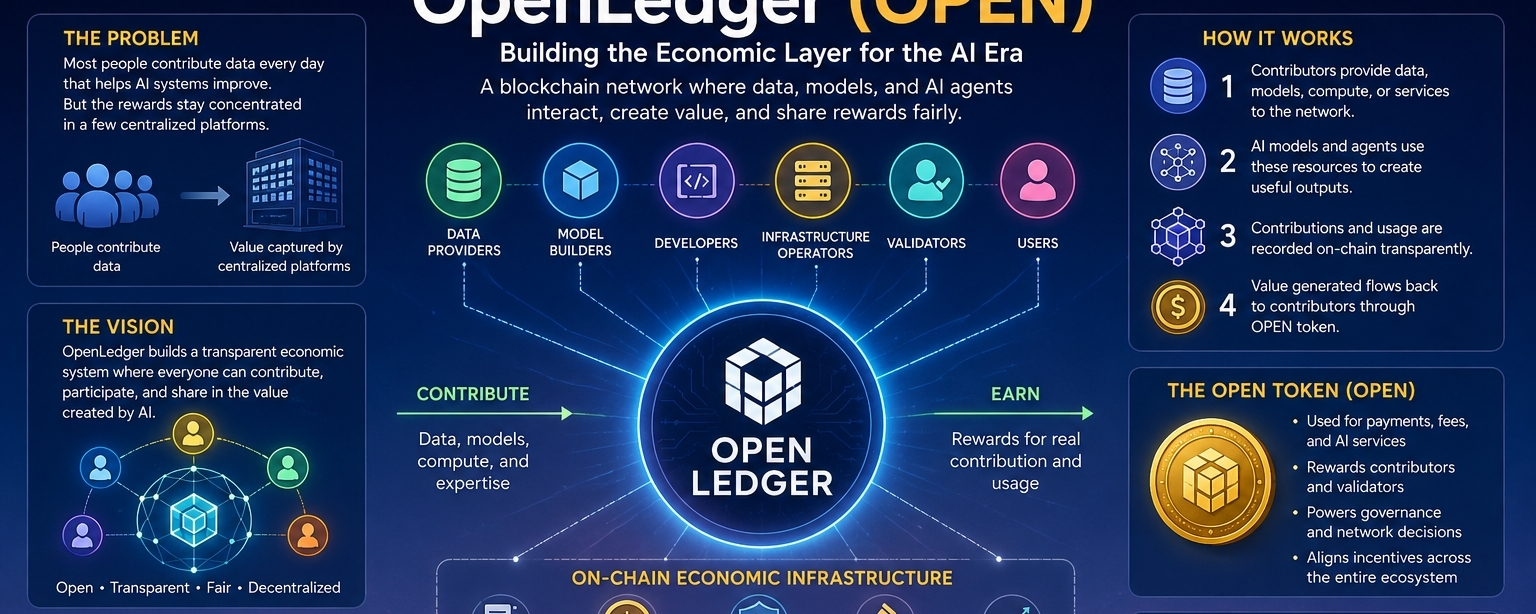
Most people contribute to AI systems constantly without realizing it. Every post, image, conversation, review, search, correction, and interaction becomes part of a larger stream of data that helps intelligent systems improve over time. AI models learn from human behavior, human language, and human knowledge. Yet when those systems eventually create economic value, most of the rewards usually remain concentrated inside a small group of companies that own the platforms, servers, and infrastructure. The people contributing information rarely participate in the upside, even though the systems themselves depend heavily on collective input from millions of users around the world.
OpenLedger was created around this imbalance. The project is trying to explore whether blockchain technology can create a different structure for the AI economy, one where data, models, and intelligent systems operate inside a shared economic network instead of closed corporate environments. Rather than treating AI only as software, OpenLedger approaches AI as a system built by many participants working together. Data providers, developers, model creators, validators, infrastructure operators, and users all contribute to the final product in different ways. The project attempts to create a blockchain based framework where those contributions can be tracked, coordinated, and rewarded more transparently.
What makes this idea important is not simply the combination of AI and crypto. Many projects already combine those words. The deeper issue is that AI itself is becoming infrastructure. Electricity became infrastructure. The internet became infrastructure. Financial networks became infrastructure. Artificial intelligence is slowly moving in the same direction. It is no longer just a niche technology. It is becoming part of the operating layer behind communication, business, education, healthcare, research, logistics, and digital interaction. Once something becomes infrastructure, questions about ownership, incentives, access, reliability, and control become much more serious.
Right now, the AI industry is highly centralized. A small number of companies control enormous amounts of computing power, training data, and deployment infrastructure. From a business perspective, this concentration makes sense because centralized systems are usually faster and more efficient. But over time, concentration creates pressure. People begin asking who controls the information systems shaping society, who benefits economically, who decides the rules, and whether contributors are being treated fairly. OpenLedger is part of a broader attempt to explore whether AI coordination can become more open and economically distributed.
This is why the project focuses heavily on attribution. In most traditional AI systems, once data enters the training process, it becomes almost invisible. A model may learn from millions of pieces of information, but contributors usually cannot trace how their input influenced the final system. OpenLedger is trying to change that relationship by building mechanisms that attempt to connect contribution with reward. The idea is that if data helps create useful AI outputs later, then contributors should theoretically receive economic participation connected to that value creation.
Whether this works perfectly at scale remains uncertain, but the direction itself matters because it changes how people think about AI economies. Instead of intelligence being owned entirely by centralized platforms, OpenLedger imagines AI as something more collaborative, where value flows through networks of participants rather than only upward toward platform owners.
The blockchain layer matters here because blockchains are fundamentally coordination systems. Many people reduce crypto to speculation and token trading, but underneath all the market noise, blockchain technology mainly exists to help strangers coordinate around shared rules without depending entirely on one central authority. In decentralized finance, blockchains coordinate money and financial transactions. In OpenLedger’s vision, blockchain coordinates intelligence production itself. That means tracking contribution, settling rewards, managing incentives, and creating transparent systems where multiple participants can interact economically.
The OPEN token acts as the economic layer connecting these activities together. It is designed to support network transactions, governance participation, contributor rewards, and AI related payments inside the ecosystem. But the larger idea behind the token is more important than the token itself. OpenLedger is attempting to transform AI contribution into something measurable and economically recognized.
This concept could become increasingly important in the future because AI is gradually evolving from software into an economic resource. The internet organized information. AI may organize intelligence itself. If machine intelligence becomes deeply integrated into industries like finance, healthcare, manufacturing, logistics, legal systems, and education, then societies may eventually need more transparent systems for coordinating ownership and participation around those networks.
This is also why OpenLedger appears focused on modular AI systems and specialized communities rather than directly competing with giant general purpose AI companies. The future of AI may not belong entirely to one massive universal model controlling everything. In practice, many industries require smaller and more specialized systems trained around particular forms of expertise. A healthcare research network has different requirements from a logistics company. A legal analysis model requires different knowledge from a manufacturing system. OpenLedger seems to believe these specialized ecosystems should eventually be able to coordinate and monetize their own AI infrastructure without surrendering all ownership to centralized intermediaries.
That is where the project starts feeling less like a typical crypto experiment and more like an attempt at infrastructure design. Instead of only asking how to build better AI models, OpenLedger is asking how to organize the economic relationships surrounding those models.
At the same time, the risks are very real. One of the biggest challenges is attribution accuracy itself. AI systems are extremely complex. Measuring exactly how much influence a dataset or contributor had on a model output is incredibly difficult. Attribution systems may become noisy, inaccurate, or vulnerable to manipulation. If contributors stop trusting the fairness of reward distribution, the coordination model could weaken quickly.
There is also the issue of data quality. Open contribution systems often attract spam, duplicated information, and low quality submissions because people naturally optimize around incentives. Designing reward structures that encourage meaningful contributions instead of exploitation is one of the hardest problems in crypto and decentralized systems generally.
Infrastructure cost creates another major challenge. AI systems require expensive computing power, storage, bandwidth, and operational maintenance. Centralized companies have strong advantages here because they can scale infrastructure efficiently. Decentralized systems often sacrifice efficiency in exchange for openness and distributed participation. OpenLedger will eventually need to prove that the value created through transparency and coordination is large enough to justify those tradeoffs.
Governance introduces another layer of uncertainty. Many blockchain projects begin with decentralization goals but gradually become concentrated around large token holders or insider groups. OpenLedger faces the same risk. Building a genuinely balanced governance structure is far more difficult than simply promising decentralization.
Regulation may also become increasingly important over time. Governments are becoming more aggressive about AI accountability, copyright issues, data ownership, and privacy protection. Open AI coordination systems may eventually face difficult legal questions that the broader industry still does not fully understand. Questions around responsibility, ownership, and liability could become major pressure points for decentralized AI ecosystems.
Even with these uncertainties, the deeper reason OpenLedger matters is because the underlying problem it addresses is real. AI is becoming one of the most powerful infrastructures in the modern world, yet the economic systems surrounding it remain heavily concentrated and opaque. Most users contribute passively while ownership and financial upside stay centralized elsewhere.
OpenLedger represents part of a broader shift happening inside crypto itself. Earlier blockchain systems focused mostly on money, payments, trading, and financial coordination. Projects like OpenLedger suggest the industry is slowly moving toward something larger, coordination of data, computation, governance, digital ownership, and increasingly, intelligence itself.
That shift matters because in the long run, the biggest challenge around AI may not simply be building smarter systems. The larger challenge may be building systems that remain economically trustworthy, socially sustainable, and structurally balanced once AI becomes deeply embedded inside everyday life.
The real test for OpenLedger will not happen during speculative market excitement. The real test will happen under pressure, when data ownership becomes contested, when centralized systems become restrictive, when infrastructure concentration creates fragility, and when contributors begin demanding more transparency around how AI economies actually function.
If OpenLedger can survive and remain useful under those conditions, then it becomes more than another crypto project connected to AI narratives. It becomes part of a much larger conversation about who participates in the economic systems built around machine intelligence, and whether the future of AI remains concentrated inside a handful of powerful institutions or slowly evolves into something more open, collaborative, and economically shared over time.