
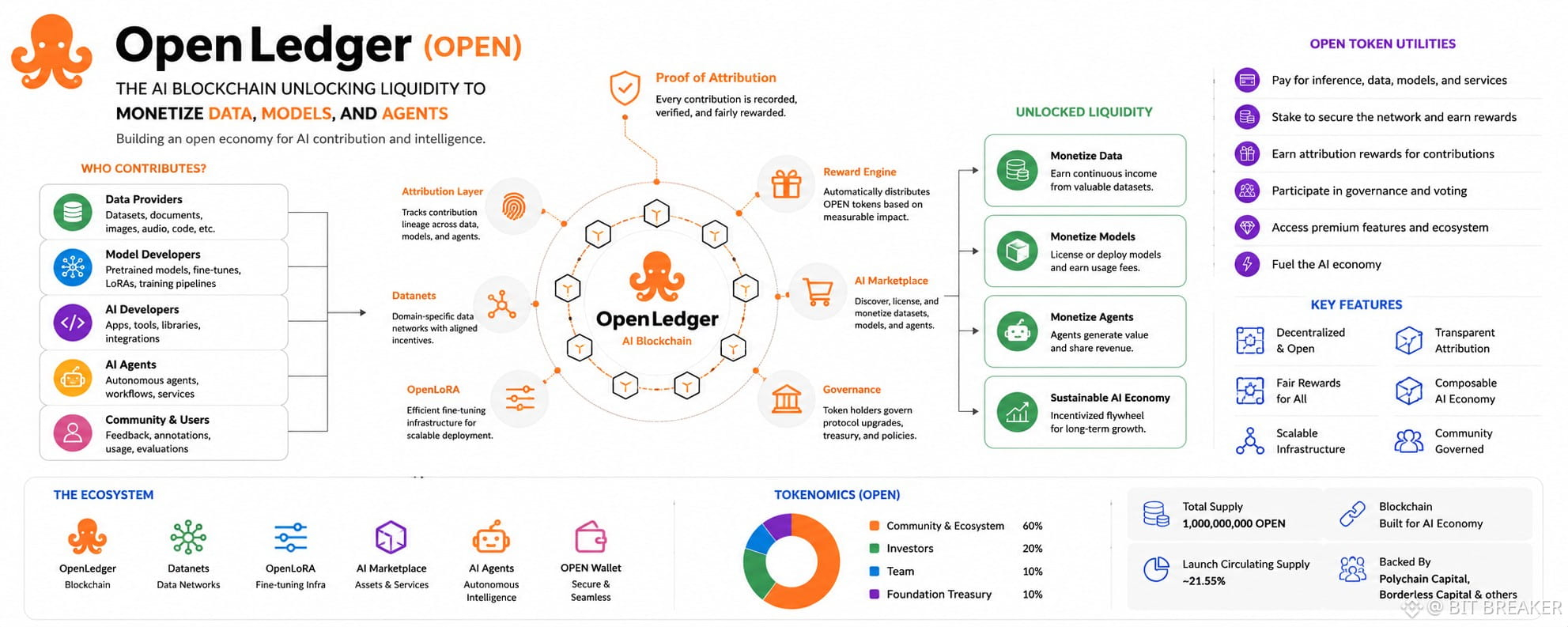
Artificial intelligence has become the fastest wealth creation engine of the modern internet, yet there is something strangely invisible at the center of it. Every AI system is built from millions of human fingerprints — researchers writing papers nobody noticed for years, open-source developers experimenting late at night, artists unknowingly shaping datasets, niche online communities documenting obscure knowledge, and ordinary people feeding algorithms through their daily digital lives. But when the value finally emerges, almost none of those contributors participate in the upside. The machine remembers patterns, but the economy forgets people.
That contradiction is where OpenLedger began.
Most people describe OpenLedger as an “AI blockchain,” but that description feels too small for what the project is actually attempting. Underneath the technical language and token structures lies a much more radical ambition: building an economic memory system for artificial intelligence. OpenLedger is trying to answer a question that the modern AI industry has largely ignored — if intelligence is created collectively, should the value generated by that intelligence also flow collectively?
That single question changes how the entire project should be viewed.
The current AI boom appears decentralized on the surface. Open-source models spread globally within hours. Independent developers collaborate across continents. Communities improve models together faster than many corporations can. Yet economically, the system is becoming more centralized than ever before. A small number of companies control the compute, the distribution, the cloud infrastructure, and the monetization channels. Everyone contributes to intelligence creation, but only a few entities capture the majority of the value.
OpenLedger emerged directly from that imbalance.
The project is built around the belief that data, models, and AI agents should not exist as isolated digital objects trapped inside corporate ecosystems. Instead, they should function like living economic assets that can generate value continuously for the people who helped create them. This is why OpenLedger talks so much about liquidity — not merely financial liquidity, but liquidity of contribution itself.
Most people still think of data as something passive. A spreadsheet. A collection of files. A training resource. OpenLedger treats data differently. It treats data as productive capital. That distinction sounds subtle at first, but it changes everything. In traditional AI systems, data disappears into opaque training pipelines forever. Contributors lose visibility, ownership, and economic participation once the model is trained. OpenLedger attempts to reverse that disappearance by building systems of attribution directly into the infrastructure.
Its central idea, called “Proof of Attribution,” is less technical than philosophical. The system attempts to answer a deeply human question: who actually helped create this intelligence? Modern AI systems are astonishingly powerful, but they are terrible historians. A model can produce brilliant output while having no transparent memory of the datasets, communities, or individuals that shaped its behavior. OpenLedger is trying to build attribution trails into AI systems themselves, allowing value to flow back toward contributors whenever intelligence is used.
In many ways, the idea resembles music royalties more than traditional software. A song continues generating income long after its release because ownership and attribution remain connected to usage. OpenLedger is trying to apply a similar logic to machine learning. If a model generates value using specific datasets, specialized fine-tuning, or agent contributions, the protocol attempts to distribute rewards back through that network of contributors.
That may sound idealistic, but there is a deeper economic logic underneath it. Open-source AI ecosystems struggle with sustainability. People love contributing to collaborative intelligence systems, but passion alone rarely sustains infrastructure forever. Eventually, communities need ownership, incentives, and durable economic participation. OpenLedger’s architecture appears designed around the idea that attribution creates sustainability.
The timing of this project is not accidental. Five years ago, OpenLedger would have sounded premature. But the AI industry itself has changed dramatically. Large general-purpose models are increasingly expensive to train and operate, which has created growing demand for specialized intelligence. Suddenly, niche datasets have become economically valuable — legal corpora, healthcare annotation layers, scientific datasets, regional languages, financial intelligence, domain-specific fine-tuning systems. Intelligence is becoming fragmented into thousands of specialized micro-economies.
OpenLedger’s concept of “Datanets” emerges from this shift. Instead of centralized monolithic datasets controlled by single entities, the project imagines domain-specific economic networks where contributors provide data, models train on that data, usage generates value, and rewards circulate back proportionally. A healthcare Datanet, for example, could theoretically function as a living economy rather than a static dataset repository.
This transforms the role of data itself. Data stops being passive raw material and starts behaving like yield-bearing infrastructure.
That idea has enormous implications that extend far beyond crypto speculation. Most of the internet monetizes attention. OpenLedger is attempting to monetize contribution. Those are fundamentally different economic philosophies. Attention economies reward visibility. Contribution economies reward participation in value creation.
The deeper significance of OpenLedger becomes clearer when viewed against the broader cultural mood surrounding AI. People increasingly distrust opaque systems. Models train on unknown datasets. Outputs emerge from black boxes. Ownership structures remain hidden. Economic extraction flows upward invisibly. OpenLedger exists inside this growing discomfort. Its obsession with attribution is ultimately an obsession with legitimacy.
In the future, trust may become more valuable than raw intelligence itself.
That possibility matters because AI is moving into industries where provenance cannot remain optional forever. Healthcare systems, financial platforms, legal infrastructures, and scientific research environments will eventually require transparent lineage around AI outputs. Questions about where intelligence came from, which datasets shaped it, and who holds responsibility may become unavoidable. OpenLedger appears to be anticipating that world before it fully arrives.
Its token, OPEN, reflects this broader vision. Unlike many crypto assets designed primarily around speculation, OPEN functions more like accounting infrastructure within the ecosystem. It facilitates inference payments, staking mechanisms, validator incentives, governance participation, and contributor rewards. The token is less interesting as a meme asset than as an attempt to build a settlement layer for machine economies.
That distinction is important because OpenLedger is not merely asking how to create a valuable token. It is asking how intelligence itself can transact economically.
This becomes especially fascinating when considering the long-term implications. Traditionally, software has been sold through licenses or subscriptions. But AI systems are increasingly autonomous, adaptive, and continuously productive. What happens when datasets earn perpetual royalties? When AI agents transact independently? When models generate continuous economic output? When contributors receive ongoing revenue from systems they helped shape years earlier?
At that point, intelligence itself begins behaving like a financial asset class.
This is where OpenLedger quietly becomes one of the more philosophically ambitious projects in the AI blockchain landscape. It is experimenting with the idea that cognition can become economically composable. Datasets become capital. Models become businesses. Agents become autonomous economic participants. Intelligence stops being static software and starts behaving like infrastructure that continuously generates value.
Of course, the project faces enormous challenges. Attribution itself is technically brutal. AI systems do not think linearly, and determining precisely how much influence a dataset had on a particular output is incredibly difficult. Even partial attribution systems may become computationally expensive, politically controversial, or vulnerable to manipulation.
There is also the broader risk that many crypto ecosystems eventually drift away from productive contribution and toward speculative behavior. OpenLedger’s long-term survival depends heavily on whether real AI builders, researchers, and developers continue participating once hype cycles cool down.
Regulation could become another major obstacle. Once AI outputs generate traceable economic flows tied to contributors, the entire system begins intersecting with copyright law, licensing disputes, intellectual property frameworks, and jurisdictional conflicts. Ironically, transparency may expose decentralized AI systems to greater legal scrutiny than opaque centralized models.
Yet even if OpenLedger itself never becomes dominant, the direction it represents still matters historically.
The internet evolved through several economic stages. First, information became digital. Then attention became monetized. Now intelligence itself is becoming financialized. That transition could reshape labor, ownership, creativity, software economics, and digital collaboration over the next decade.
Most AI companies today are obsessed with making machines smarter. OpenLedger is asking a different question entirely: what happens after the intelligence is created? Who gets paid? Who gets remembered? Who owns the upside? Who disappears from the economic story?
Those questions may ultimately become more important than the models themselves.
Because the future battle in artificial intelligence may not be about who builds the most powerful systems. It may be about who builds the fairest economies around them.
And OpenLedger is one of the first serious attempts to imagine what that future could look like.