

The intersection of Artificial Intelligence and Blockchain technology has historically been dominated by transient trends. For the past few years, the Web3 landscape has been flooded with "AI tokens" that, under close inspection, amount to little more than sleek landing pages, basic ChatGPT wrappers, or vague governance tokens looking for a purpose.
But as the initial wave of speculative hype cools down, a fundamental shift is occurring. The market is beginning to distinguish between short-term narrative tokens and genuine infrastructure.
Sitting directly at the center of this evolution is OpenLedger ($OPEN).
Rather than building surface-level applications like AI image generators or chat assistants, OpenLedger is tackling the structural, deep-layer vulnerabilities of the modern AI economy: data provenance, contribution tracking, privacy, and fair value distribution.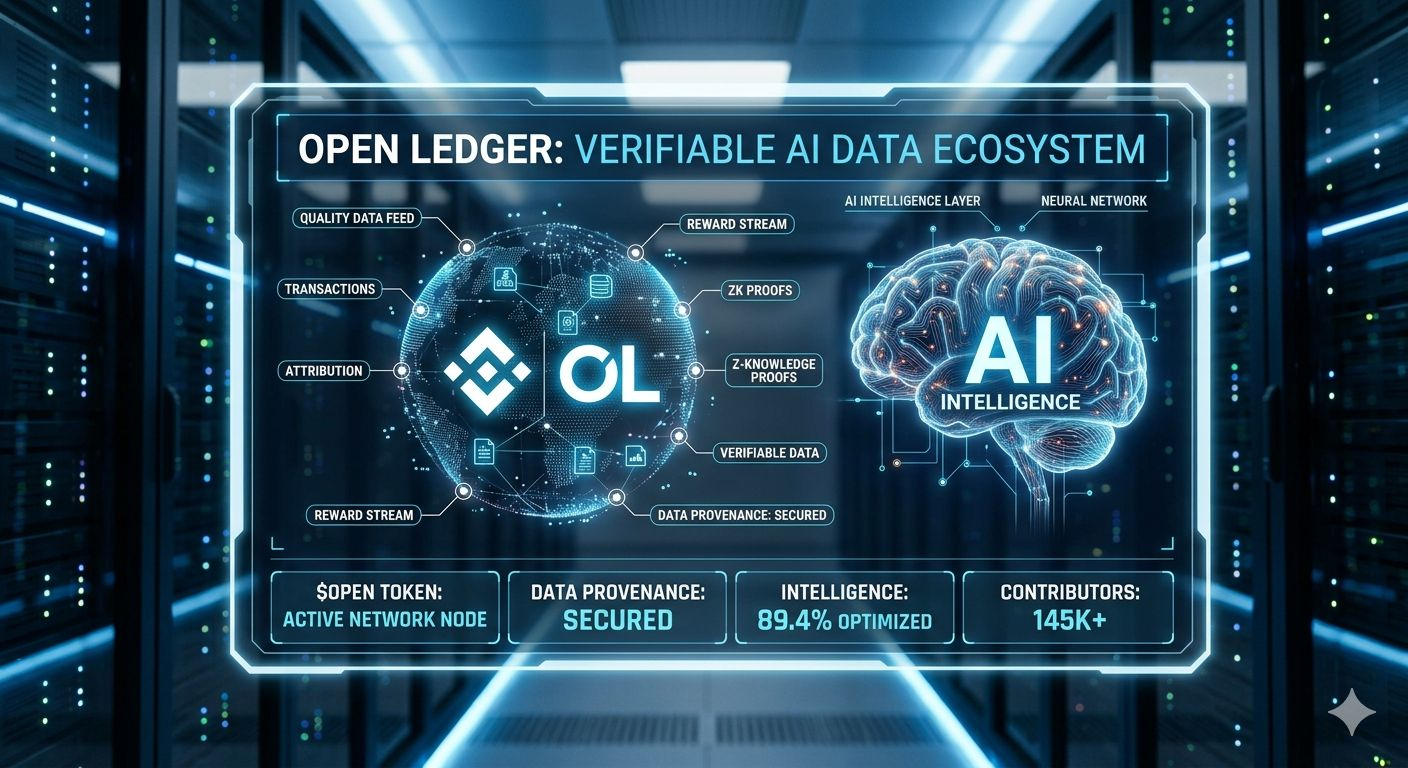
## The Core Crisis of Modern AI: The Data Exploitation Model
To understand why OpenLedger's architecture is gaining massive traction on Binance Square, one must first look at the deeply unbalanced reality of how traditional AI is built.
Artificial Intelligence models do not develop intelligence in a vacuum. They require billions of high-quality data points to learn, refine, and optimize. The current AI landscape is built on a foundation of uncompensated human contribution. Every blog post, open-source code repository, digital artwork, scientific paper, and forum discussion uploaded to the internet over the last two decades has been scraped to train massive, centralized models.
The economic reality of this model is stark:
*Centralized Extracted Value:** The creators, researchers, and everyday internet users who provided the fundamental fuel (the data) receive zero financial return or attribution.
*Monopolistic Control:** The multi-billion-dollar corporations providing the compute power and hosting the models capture 100% of the monetization and equity.
*The "Black Box" Problem:** Modern AI models operate as absolute black boxes. Once data enters a centralized system, it becomes impossible to track where it went, how it was weighted, or exactly which piece of data contributed to a specific intelligent output.
This model is structurally unsustainable. As data creators demand compensation and data privacy regulations tighten globally, the AI industry is facing a massive bottleneck. AI cannot scale further without a transparent coordination layer.
## What is OpenLedger?
OpenLedger is a decentralized data and infrastructure layer designed to turn data, algorithms, and AI models into secure, programmable, and liquid on-chain assets.
Instead of allowing data to vanish into a corporate black box, OpenLedger provides a decentralized ledger that records precisely who contributed what data, how that data was utilized in model training or inference, and how rewards should be programmatically distributed back to those contributors when the AI generates value.
By introducing a tokenized framework powered by the OPEN utility token, OpenLedger aligns the incentives of data contributors, developers, compute providers, and end-users into a self-sustaining decentralized ecosystem.
## The Three Pillars: Why OpenLedger Stands Out
A deep analysis of OpenLedger’s architecture reveals three fundamental innovations that separate it from typical Web3 AI projects.
### 1. Transparent Data Provenance and Verifiable Attribution
In traditional AI, data quality is an afterthought for the end-user, who simply trusts the output. However, garbage data results in garbage outputs. If an AI model bases its financial, medical, or legal analysis on biased or manipulated data, the consequences are severe.
OpenLedger utilizes blockchain technology to create an immutable audit trail for data. When a dataset is contributed to OpenLedger, its origin, structure, and quality are verified and indexed on-chain. This creates a transparent supply chain for AI. For the first time, users and developers can trace the evolutionary pathway of an AI’s intelligence, ensuring that the underlying data pipelines are clean, verified, and free from hidden manipulation.
### 2. Radical Privacy via Zero-Knowledge Architecture
One of the main reasons mainstream institutions and enterprises hesitate to adopt public blockchain infrastructure for AI data pipelines is the issue of total transparency. A default public blockchain exposes every transaction and wallet address permanently. For corporate data, medical records, or proprietary research, this exposure is a non-starter.
OpenLedger resolves this conflict by engineering a hybrid Layer 1 and Layer 2 architecture that leverages Zero-Knowledge (ZK) proofs. ZK technology allows the system to prove that a dataset is valid, high-quality, and accurately formatted without actually revealing the underlying sensitive data to the public. This enables strict data compliance and absolute privacy while maintaining the security and trustless verification of a decentralized network.
### 3. Turning AI Contributions Into Liquid Assets
Through OpenLedger, datasets, localized models, and autonomous AI agents are tokenized. This means intellectual property that was once completely illiquid can now be fractionalized, traded, or leased on an open market.
If a specialized research group spends months curating a pristine dataset for climate modeling, they can tokenize that asset on OpenLedger. AI developers can purchase or rent access to that tokenized dataset, with smart contracts automatically routing the payments directly back to the original researchers. This replaces corporate gatekeepers with a fluid, peer-to-peer data economy.
## Analyzing the OPEN Token Dynamics
At the core of this ecosystem sits the Open token. Rather than functioning purely as a speculative asset or a basic voting token, OPEN is deeply integrated into every operational layer of the network:
## The Reality Check: Navigating Risks and Adoption Obstacles
While the architectural blueprint of OpenLedger is incredibly compelling, a mature evaluation requires looking closely at the practical hurdles the project must overcome to achieve global scale.
*The Developer Convenience Barrier:** AI developers are fundamentally driven by speed, raw compute power, and processing efficiency. They are accustomed to the seamless, hyper-fast pipelines provided by centralized clouds like AWS or Google Cloud. OpenLedger must prove that its decentralized coordination layer can offer competitive speeds and seamless SDK integrations so that developers do not feel they are sacrificing performance for the philosophy of decentralization.
*The Centralized Resource Monopoly:** Centralized tech conglomerates hold massive structural advantages, specifically billions of dollars in liquidity and direct access to cutting-edge hardware (GPUs). OpenLedger is competing not just against other Web3 protocols, but against the deeply entrenched infrastructure of Silicon Valley.
*Sustaining Genuine Utility Over Hype:** As many Binance Square analysts have noted, the AI + Web3 narrative is highly susceptible to short-term speculative volatility. OpenLedger’s long-term survival relies entirely on its ability to transition from an incentivized ecosystem (airdrops and campaigns) into a utility-driven environment where external, non-crypto businesses actively purchase OPEN to utilize its data pipelines.
The Long-Term Outlook
The true value of an infrastructure project is realized when the underlying technology becomes invisible because it is embedded beneath everything else. If OpenLedger succeeds, it will not be remembered simply as an "AI token"—it will function as the quiet, foundational framework that guarantees data rights, transparency, and equity for the next generation of decentralized intelligence.
As artificial intelligence continues its exponential expansion throughout 2026, the demand for verifiable, clean, and ethical data structures will only grow. For investors, builders, and creators on Binance Square keeping a close eye on the future of Web3, OpenLedger (OPEN) represents a shift away from flashy applications and a step toward the serious, systemic infrastructure required to build a fair and decentralized digital economy.
