
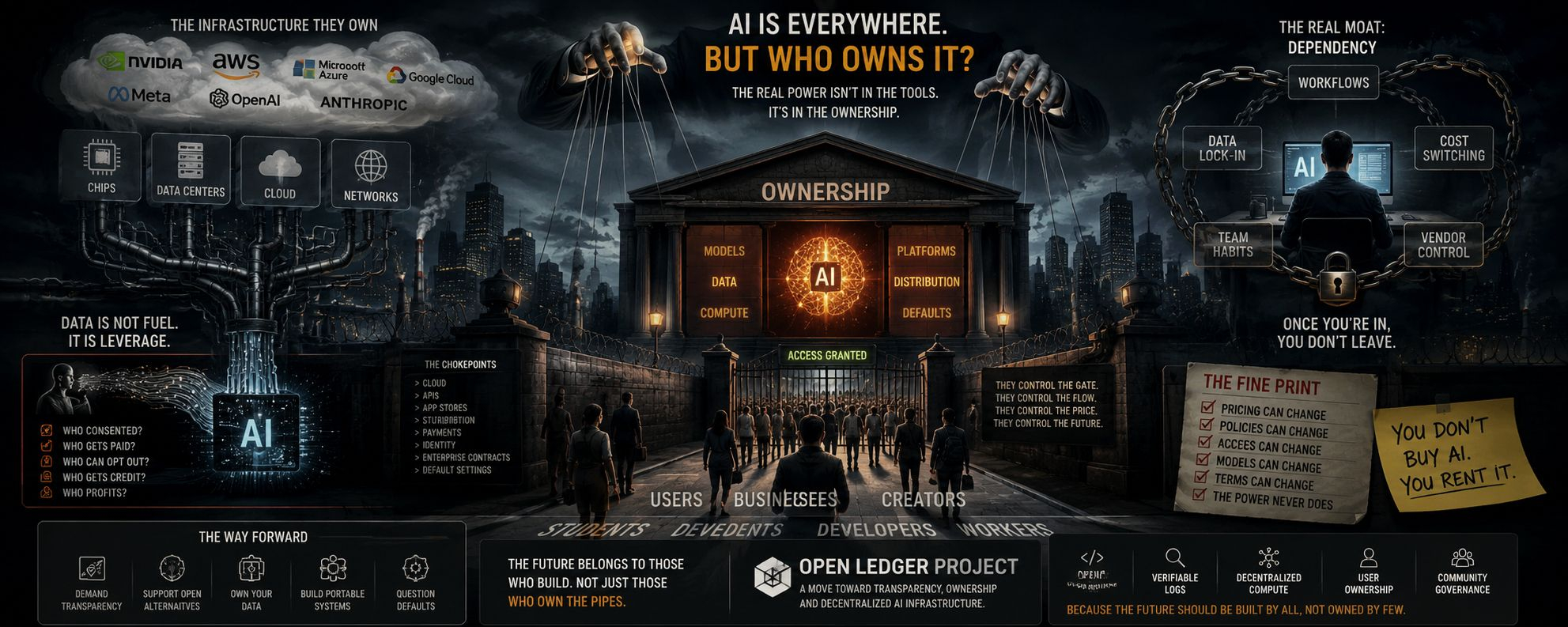

The first clue is always the same.
A company starts talking about AI like it found religion. The deck gets shinier. The language gets loose. Everyone says “smart” a lot. Nobody says “rent.” Nobody says “dependency.” Nobody says “who actually owns this thing when the music stops?”
That’s the part I care about.
I’ve seen this movie before. Different year, different costume. Same old hustle. A new layer of tech shows up, people mistake access for power, and the folks holding the keys quietly move in behind the curtain. They always do.
AI is no different.
It smells like a trap if you stare at it long enough.
Not because the tools are fake. They are not. Some of them are useful. Some are impressive in a dry, clinical sort of way. They shave hours off work. They spit out passable code. They summarize the sludge. They make the inbox less ugly.
Fine.
But here’s the thing. The real question is not what the machine can do.
It is who gets to own the machine, the data, the cloud, the distribution, the defaults, and the customer once everyone gets used to the new toy.
That is the business.
Everything else is theater.
The demo is clean. The plumbing is not.
I never trust a demo.
A demo is a clean shirt on a dirty body. It hides the sweat. It hides the mess behind the wall. It hides the vendor contracts, the compute bills, the fine print, the uptime guarantees, the usage caps, the small print that turns into a knife when the customer is already hooked.
AI demos are especially slick. They have to be. The whole category runs on spectacle. A neat interface. A confident answer. A little automation. A little flourish. Everybody nods. The room gets hopeful.
Then reality walks in.
Reality is slower. Messier. More expensive. It asks who pays for the inference. Who stores the data. Who handles the liability when the model makes stuff up with a straight face. Who cleans up the output when it leaks garbage into a real workflow. Who owns the logs. Who gets the training signal. Who can change the terms later.
That last one matters more than people want to admit.
Because if you do not own the stack, you are not really in control. You are renting a seat at someone else’s table.
And tables get cleared.
“Open” sounds nice until you read the license.
Open is one of those words that gets used like a smoke bomb.
Open model. Open weights. Open ecosystem. Open access. It all sounds democratic. Feels clean. Smells like participation. Everybody gets to imagine they are part of a commons.
Sometimes that is real. Mostly it is partial.
You can hand people a model and still keep the useful choke points locked up. The cloud. The API. The deployment pipeline. The model updates. The training data. The enterprise integrations. The distribution channels. The thing that turns a toy into a business.
That’s the trick.
I’ve watched “open” become a costume for control. The label gives people a warm feeling while the infrastructure stays fenced off and monetized. You can inspect the model all you want. You can fine-tune it, poke it, even host it if you have the money and the patience. But if every serious use case still depends on somebody else’s servers, somebody else’s pricing, and somebody else’s policy changes, then the ownership story is mostly fiction.
Not all fiction is bad. This one is just expensive.
People love to say AI will be democratized. That word gets tossed around like confetti.
Let’s be real. Access is not ownership. Usage is not control. A million users with a free account still means the rent is being collected somewhere.
The real money sits in the boring parts.
Nobody cheers for infrastructure.
Nobody posts a victory lap about the data center, the chip supply, the cloud contract, the default setting, or the enterprise procurement deal that quietly locks a whole organization into one vendor for three years.
But that is where the leverage is.
I’ve spent enough time around tech to know the glamorous layer is usually where the least durable power lives. The flash gets attention. The pipes get paid. The people who control the boring stuff often end up steering the whole market.
AI makes that more obvious, not less.
If you own the chips, you shape the pace. If you own the cloud, you shape the bill. If you own the interface, you shape the user. If you own the platform, you shape the path. If you own the defaults, you shape the habit.
And habit is everything.
Once a company, a school, a newsroom, or a legal team gets used to one AI layer, the switch starts to hurt. Not because the old thing was perfect. Usually it was clunky. But because replacement means retraining, rewriting workflows, rebuilding trust, and maybe explaining to the CFO why the “smart” system just turned into a six-figure headache.
That’s when the vendor stops being a vendor and starts acting like a landlord.
And landlords never forget to collect.
Data is not fuel. It is leverage.
People love the fuel metaphor.
It’s neat. Easy. Data goes in. Intelligence comes out. Very industrial. Very tidy. Very wrong, or at least incomplete.
Fuel gets burned. Data gets absorbed, recombined, inferred, and turned into something else. A model does not just eat data. It learns patterns, styles, structures, habits, rhythms, and odd little fingerprints from millions of people who never agreed to become raw material for a machine.
That’s not a small distinction. That is the whole argument.
Who owns the source material? Who had consent? Who gets paid? Who gets credit? Who gets to opt out after the fact? Who can even tell whether their work ended up inside the box?
These are not abstract ethics questions for conference panels. They are the actual fault line.
I do not buy the lazy line that “it was on the internet anyway.” That line is the tech equivalent of a pickup artist saying “you were friendly.” It’s cheap. It’s sloppy. It tries to turn context into permission.
The internet is not one giant free-for-all. People publish for different reasons. Under different terms. With different expectations. A public page is not the same thing as an open invitation to turn someone’s work into a commercial machine.
The industry knows this. The industry also knows that if it can blur the boundary long enough, it gets to build the market first and argue about the ethics later.
That’s not a mistake.
That’s strategy.
The feature is never the full story.
This is where the pitch gets slippery.
AI can draft. AI can summarize. AI can answer. AI can automate. AI can personalize. All true. But every feature drags a trade-off behind it like a dead weight in a trench coat.
Speed? You lose time to verification.
Convenience? You lose control.
Personalization? You hand over more data.
Automation? You create dependency.
Free? You are probably the product, or at least the input.
That’s the part the glossy marketing leaves in the dark.
I’ve seen companies sell “efficiency” and quietly build lock-in. I’ve seen them sell “intelligence” and quietly build surveillance. I’ve seen them sell “help” and quietly build a toll road.
Same old move. New vocabulary.
The point is not that every AI product is a scam. That would be childish. Some are genuinely useful. Some make work less miserable. Some let smaller teams punch above their weight. Good. That matters.
But usefulness is not innocence.
A tool can help you today and corner you tomorrow.
That is the deal.
The moat is not the model. It is dependency.
I used to think the big competition was quality.
Better outputs. Fewer hallucinations. Better reasoning. Better code. Better workflow integration. That stuff still matters, obviously. But I have grown more interested in the uglier part.
Dependency is the real moat.
Once an AI system is embedded into a company’s habits, the company starts changing around it. People adjust their workflows. Managers build reports around it. Teams depend on it to get through the week. The machine stops being a tool on the shelf and becomes part of the operating rhythm.
Then the vendor has leverage.
Pricing changes start to sting. Policy shifts start to matter. Model updates start to break things. A feature removed in San Francisco becomes a five-person fire drill in Cincinnati. Someone says “just migrate,” and nobody laughs because everybody knows migration means time, money, and pain.
This is how rent gets extracted in modern tech.
Not with one big dramatic takeover. With a thousand small dependencies.
I’ve seen it in cloud software. I’ve seen it in social platforms. I’ve seen it in mobile ecosystems. AI is just the latest layer of the same old control game.
The machine does not need to be perfect.
It only needs to become annoying to leave.
The owners of the chokepoints do not need to own everything.
That’s the part most people miss.
The biggest player in AI does not have to own every model, every app, every use case. It just has to own the chokepoints. The place where people enter the system. The place where the data moves. The place where the compute runs. The place where business decisions get made.
Cloud. Devices. Search. Productivity software. App stores. Enterprise distribution. Payment rails. Identity layers.
That’s the map.
If you control the gate, you do not need to own the entire city. You just collect from the traffic.
Very elegant. Very old. Very profitable.
People talk about ecosystems like they’re natural habitats. They are not. Most of them are walled gardens with nicer lighting. The walls matter. The lighting is just there to keep everyone calm.
And calm is useful when you want the customer to stop asking where the power comes from.
The winners may not be the inventors.
Tech culture likes its origin myths.
A small team. A breakthrough. A garage. A genius. A perfect product. A clean ascent. It makes for a good story and a bad analysis.
I’ve watched enough cycles to know the person who invents the thing is not always the one who owns the future it creates.
Sometimes the winner is the cloud provider. Sometimes it is the platform. Sometimes it is the device maker. Sometimes it is the company with the enterprise contract. Sometimes it is the one with the distribution and the patience to let everyone else do the hard, noisy work of adoption.
That is how tech power often works.
Not flashy. Not romantic. Just effective.
AI is likely to follow that pattern. The people building the model are important. The people hosting the model may be more important. The people owning the customer relationship may be more important still. The people who control the deployment layer, the update cadence, the terms, the logs, and the defaults may be the real adults in the room.
It’s not glamorous.
It is also not optional.
I do not trust “empowerment” when the contract says otherwise.
There is a certain vocabulary that makes my skin crawl.
Empower. Enable. Unlock. Transform. Optimize.
That language usually arrives right before somebody gets squeezed.
A platform says it empowers creators, then changes the rules and takes a bigger cut. A model says it helps workers, then gets used to trim headcount. A tool says it saves time, then becomes mandatory. A vendor says it improves productivity, then you discover the productivity came with a quiet downgrade in autonomy.
The trade-off is always there. The fine print is the story.
I am not saying the tools are useless. I’m saying every feature has a shadow.
Faster drafting? More dependence on vendor infrastructure.
Cheaper content? More pressure on original creators.
Smarter search? Less direct traffic to the source.
Personalized assistance? More surveillance.
The seller usually talks about the benefit. The buyer usually inherits the risk.
That arrangement is not new. It is just dressed in better UI.
What comes next will be a fight over control, not just capability.
I don’t think the next phase is going to be decided by whoever builds the prettiest model demo.
The real fight will be over standards, portability, data rights, auditability, and local control. Who can move their information without getting trapped. Who can inspect what the model is doing. Who can host something private without sending everything to a giant cloud empire. Who can switch vendors without torching the workflow.
That is where the real battles are going to happen.
There will be pushback. Some of it already exists. Companies are getting more careful. Regulators are sniffing around. Smaller, local, and open systems are improving. Private deployments are getting more realistic. Good. They should. The first wave of AI adoption was too naive. People gave away too much because the UI was pretty and the pilot project looked harmless.
It wasn’t harmless. It never is.
Still, I do not think the big players go quietly. Why would they? They own the roads. They own the clouds. They own the defaults. They own the places where people already live online. They do not need total dominance. They only need enough dominance that everyone else ends up renting.
That is the real endgame.
Not a total lockup. A profitable one.
The question is simple. The answer is not.
I keep coming back to one ugly question.
Who owns this?
Not who built the demo. Not who wrote the blog post. Not who got the round. Who owns it when the tool is inside the workflow, inside the budget, inside the habit, inside the institution, inside the culture.
That’s the question that matters.
Because once a technology becomes ordinary, ownership stops being a side note. It becomes destiny. The owners set the terms. The users live with them. The creators get squeezed. The institutions adapt. The market shrugs and calls it progress.
Maybe some of it is progress. Maybe.
But I’ve seen enough cycles to know the real danger is not the shiny new thing. It is the quiet consolidation that follows the applause.
AI is a tool, sureIt is also a land grab.
And the people shouting the loudest about the future usually want you looking at the skyline while they fence off the ground beneath your feet.