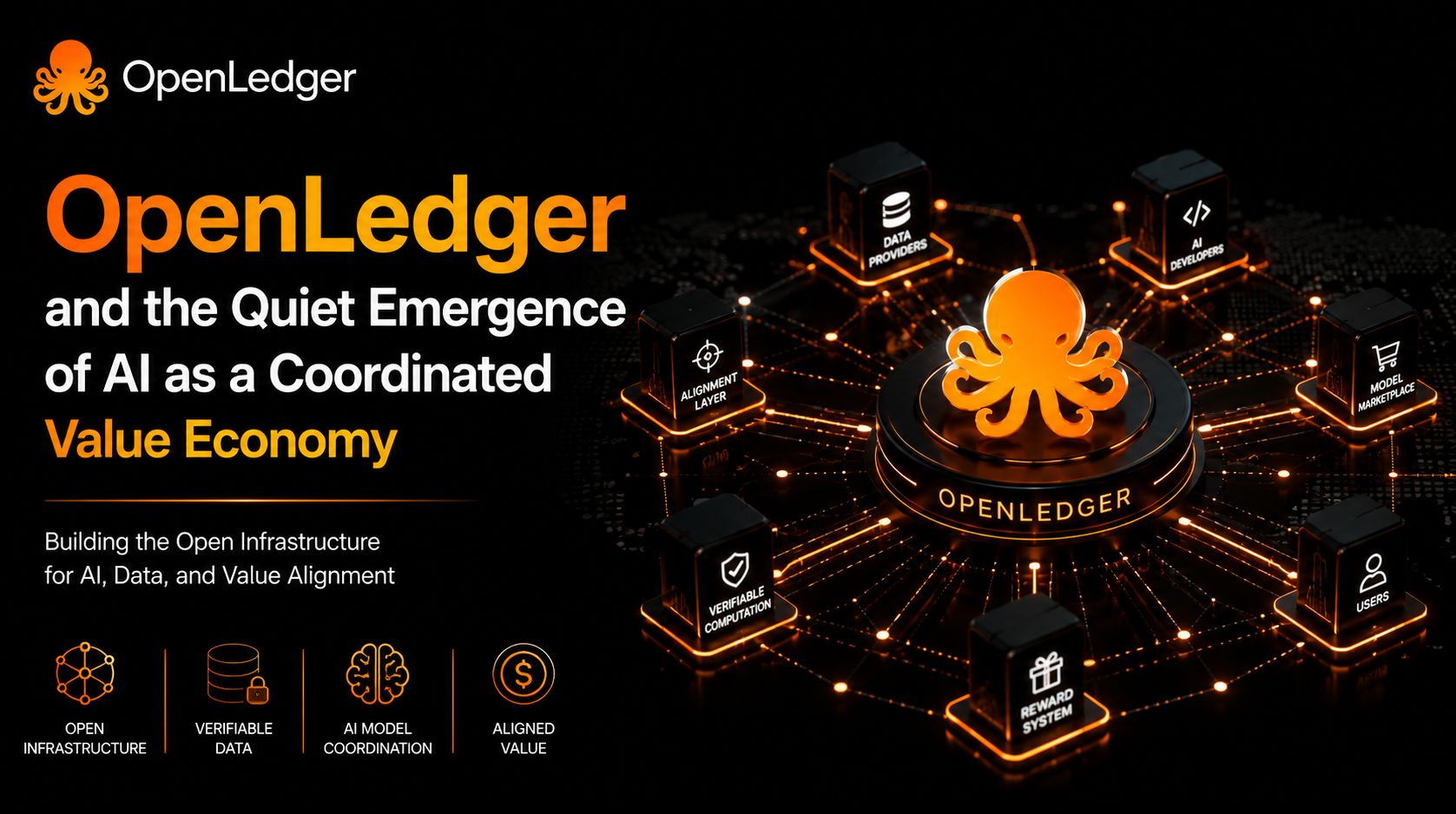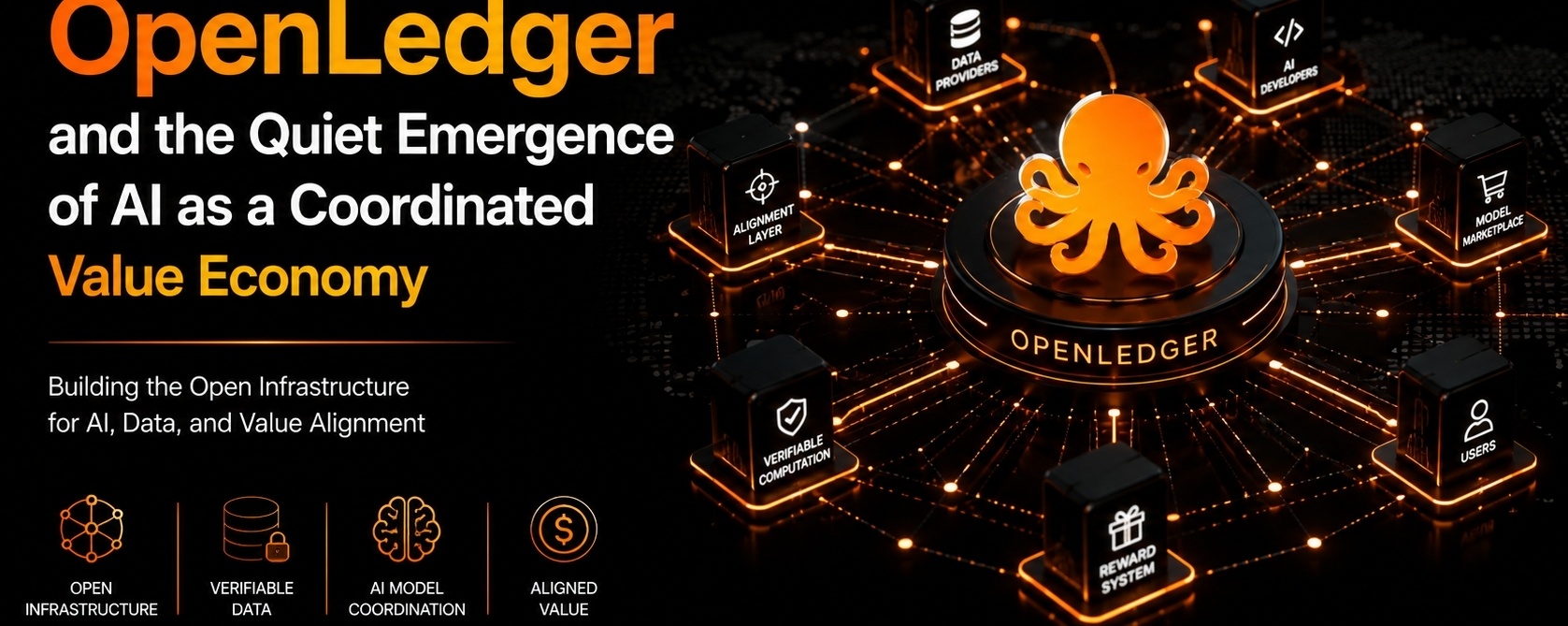
There’s something slightly odd about OpenLedger that I couldn’t shake at first. Not odd in a dramatic way. More like that small feeling you get when a project says one thing on the surface, but something deeper is moving underneath it. At first, it looks easy to place it in a box: AI blockchain, data monetization, models, agents, liquidity. The kind of words the market has already learned to repeat quickly. But the longer I sat with it, the less those words felt like branding and the more they felt like clues.
Especially liquidity.
That word keeps bothering me a little. Usually, liquidity feels like a market word. Tokens moving. Buyers and sellers. Capital finding an exit. But with OpenLedger, it starts to feel like liquidity is being applied to something stranger: intelligence itself. Not just the token around the system, but the things that make AI valuable in the first place. Data. Models. Agents. Human feedback. Tiny contributions that usually disappear into the background.
And once you start seeing it like that, OpenLedger stops feeling like only another AI project. It starts feeling like a question.
For a long time, AI has been presented to people as software. You type something, it responds. You ask, it helps. The screen makes the whole thing feel clean and simple. But of course it is not simple. Behind every answer there is some long, hidden chain of inputs. Someone’s data. Someone’s correction. Someone’s model. Someone’s behavior. Someone’s work that may never be named.
Most users never feel that part. They just use the tool.
But the system feels it.
That is what makes OpenLedger interesting to me. It seems to begin from the idea that AI is not just software anymore. It is becoming an economy. And economies need coordination. They need ways to know where value came from, who added to it, who should benefit from it, and how all these invisible pieces should move together without being swallowed by one closed machine.
This is where blockchain enters the picture in a more serious way. Not as a shiny add-on. Not just as a way to make an AI project sound more decentralized. But as a coordination layer for a world where intelligence is made from many different sources.
A dataset is no longer just a dataset. A model is no longer just a model. An agent is no longer just a tool running in the background. Each of them becomes part of a larger system where value can be traced, priced, rewarded, and moved. That sounds fair on paper. Maybe even necessary. If people and builders are helping create intelligence, why should their contribution disappear into a black box? Why should all the upside move upward while the inputs remain invisible?
But this is also where the idea becomes a little uncomfortable.
Because when something becomes liquid, people start behaving differently around it. They do not only use it. They position around it. They optimize for it. They try to be seen by it. Data becomes something to hold. Models become something to monetize. Agents become workers inside machine economies. Contributors begin wondering whether their activity will be counted, whether their input will matter, whether the system will reward them or simply absorb them.
That is the quiet shift I keep thinking about.
No one has to announce it. No one has to force it. The incentives do the work slowly. People begin arranging themselves around the system because the system starts deciding what has value. A user may think they are only interacting with AI. A builder may think they are only improving a model. A community member may think they are only giving feedback. But inside a network built around attribution and liquidity, these small actions begin to look different.
They become signals. They become proof. They become economic material.
And that changes the feeling of participation. It becomes harder to know whether you are using the machine or quietly becoming part of it.
This is why OpenLedger feels bigger than the phrase “AI blockchain.” That phrase is too neat. Too easy. What OpenLedger is really pointing toward is a future where AI needs a coordination engine because intelligence is no longer created in one place. It comes from many places at once. From data owners, model builders, agent developers, users, contributors, validators, and all the strange human behavior that gathers around intelligent systems.
The real problem is not only how to build better AI. It is how to organize the value around it.
That is a much deeper problem. And maybe a more dangerous one too.
Because attribution sounds beautiful when it means people finally get credit. Liquidity sounds powerful when it means hidden value can finally move. But these same ideas can also turn human activity into inventory. They can make every contribution feel measurable. They can push people to produce for the system instead of simply creating, exploring, or participating naturally.
That tension is hard to ignore.
OpenLedger may be trying to build a fairer path for AI value. It may be trying to make sure data, models, and agents do not remain trapped inside closed platforms. That matters. But at the same time, any system that turns contribution into an asset also changes the contributor. It teaches people to see their own activity through the eyes of the network. Is this useful? Is this counted? Is this valuable? Can this be owned? Can this become liquid?
That is where the human part starts to feel strange.
Because people are not used to thinking of their actions this way. Most of us do not feel like we are feeding machine economies when we write, search, test, correct, share, or interact. We feel like we are just doing things. But AI systems do not see it that casually. They see patterns. Inputs. Training material. Demand. Improvement. Value.
OpenLedger’s thesis seems to pull that hidden reality into the open.
Maybe that is why it feels important. Not because it gives a perfect answer, but because it sits close to a question that will only become louder: if AI becomes infrastructure, who coordinates it? If intelligence becomes an economy, who owns the pieces that make it work? If data, models, and agents become liquid, what happens to the people whose behavior helped create that value in the first place?
I do not think there is a clean answer yet.
Maybe there should not be one.
The more I look at OpenLedger, the more it feels like a system standing between two futures. In one future, blockchain helps AI become more open, more traceable, more fair to the people and builders behind it. In the other, the same machinery gives extraction better accounting and makes every hidden contribution easier to package into value.
And maybe the unsettling part is that both futures can exist inside the same system.
That is what stays with me. Not the branding. Not the category. Not even the market narrative.
Just this quiet realization that intelligence is slowly becoming something coordinated, measured, owned, and moved.
And once thinking itself becomes liquid, the real question is not only who profits from AI.
@OpenLedger #OpenLedger #OpenLedger # $OPEN