I was scrolling through crypto today and honestly had the same thought again:
How many AI projects do we actually need before people start asking what problem they’re solving?
Everywhere I look right now its: AI agents. AI automation. AI copilots. AI infrastructure. AI everything.
At this point some projects barely even explain themselves anymore. They just add AI somewhere in the branding and the market instantly pays attention.
And yeah… I get it. That is where attention is flowing this cycle.
But I think most people are looking at the AI narrative from the wrong angle.
Everyone is obsessed with what AI can produce.
Faster answers. Smarter models. Better automation. More autonomous systems.
Almost nobody is talking about whether the foundation underneath those systems can actually be trusted.
That is the part I keep coming back to.
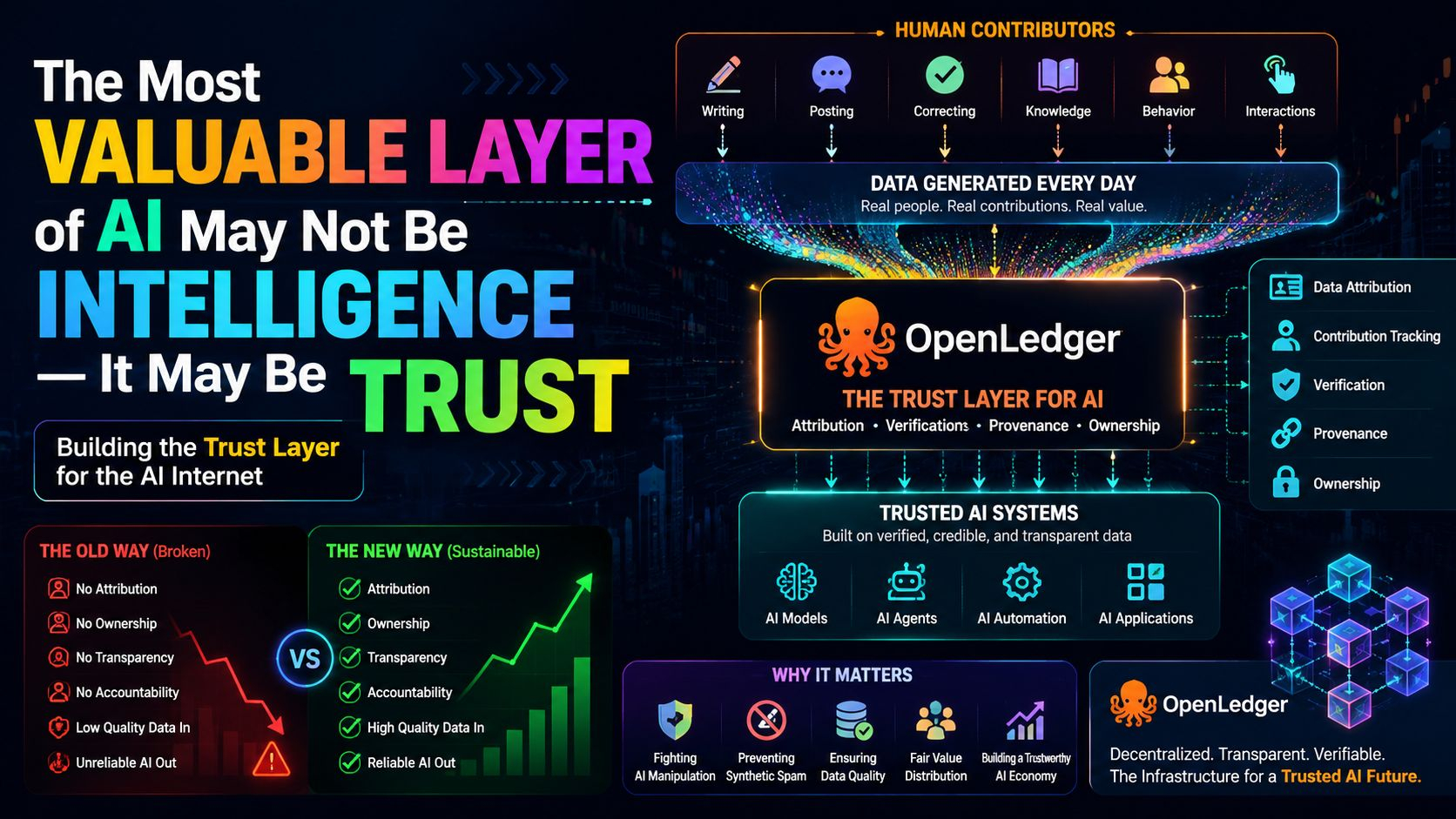
Because AI models don’t magically wake up intelligent one day. They’re trained on data. Massive amounts of data. And that data comes from real people constantly interacting with the internet every single day.
People writing. People posting. People correcting mistakes. People sharing knowledge. People generating behavior patterns without even realizing it.
Human input is everywhere inside AI.
But once the machine gets smarter, most of those people basically disappear from the equation.
The company scales. The model improves. The valuation explodes.
Meanwhile the contributors who indirectly trained the system usually get nothing back.
No ownership. No visibility. No attribution. Sometimes not even awareness that their data helped build the product in the first place.
And honestly, I think this becomes one of the biggest long-term issues in AI.
Not intelligence.
Trust.
That’s the real bottleneck.
Because we are entering a weird phase of the internet where AI is increasingly training on content generated by other AI systems. You can already feel it happening sometimes. Recycled information. Synthetic articles. Fake engagement. Low quality datasets being copied over and over again.
The internet is slowly filling with machines talking to machines while the humans who trained them disappear economically.
That sentence sounds dramatic lol, but I genuinely think there is truth in it.
And this is why OpenLedger caught my attention.
Not because it is trying to make another flashy chatbot or another revolutionary AI assistant.
What is interesting to me is the focus on the trust layer behind AI itself.
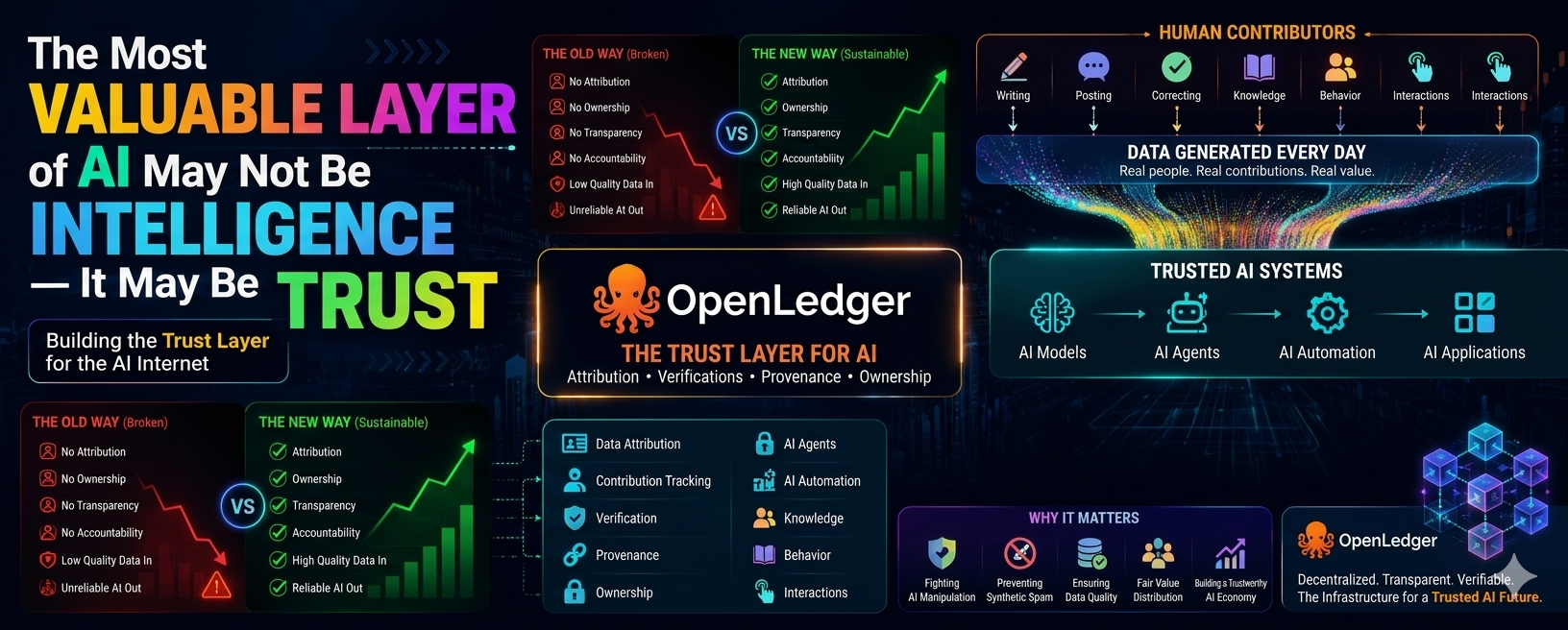
Data attribution. Contribution tracking. Verification. Provenance.
Most people skip over these topics because they sound less exciting than viral AI demos. But infrastructure usually looks boring before it becomes important.
The more I think about it, the more I believe future AI systems won’t just compete on intelligence.
They’ll compete on credibility.
Can the data source be verified? Can contributors be tracked? Can manipulation be identified? Can value distribution actually make sense?
Those questions matter a lot once AI starts becoming deeply integrated into finance, research, business, communication, and decision-making systems.
Because if the underlying data is weak, manipulated, or completely synthetic, then eventually the output becomes unreliable too.
An AI model can sound extremely confident and still be wrong.
That’s the dangerous part.
And honestly, this is where blockchain starts making way more sense to me in AI.
Not the buzzword version of blockchain.
I mean the actual useful side of it: transparent records, verifiable contribution, ownership trails, economic accountability.
If data is valuable, then the source of that data should matter too.
And if someone contributes to improving an AI system, I don’t think that contribution should disappear forever into a black box while only centralized platforms capture the upside.
That model probably works early on.
I’m not sure it works forever.
I think the next stage of AI becomes less about who can generate the most content and more about who can preserve trust inside a world flooded with synthetic information.
That’s a much harder problem.
And honestly, probably a much bigger one too.
Now obviously vision alone means nothing in crypto. I have seen plenty of projects with beautiful narratives completely collapse once execution starts. Building attribution systems at scale is hard. Verifying data quality is hard. Incentive systems are hard.
So OpenLedger still has a lot to prove.
But at least the problem feels real.
That’s what stands out to me.
Most projects chase attention. Very few try solving structural problems before the market fully understands them.
And I think trusted AI infrastructure becomes one of those structural problems over time.
Especially once AI content becomes impossible to separate from human content online.
At that point, trust itself becomes valuable.
Maybe even scarce.
That’s why I don’t really see OpenLedger as just another AI narrative play.
I see it more like an attempt to build infrastructure for a future internet where authenticity, attribution, and contributor ownership actually matter.
And if that future arrives the way many people expect…
then the trust layer behind AI could end up being way more valuable than the market currently realizes.
Hype gets attention for a season.
Infrastructure usually survives much longer.