
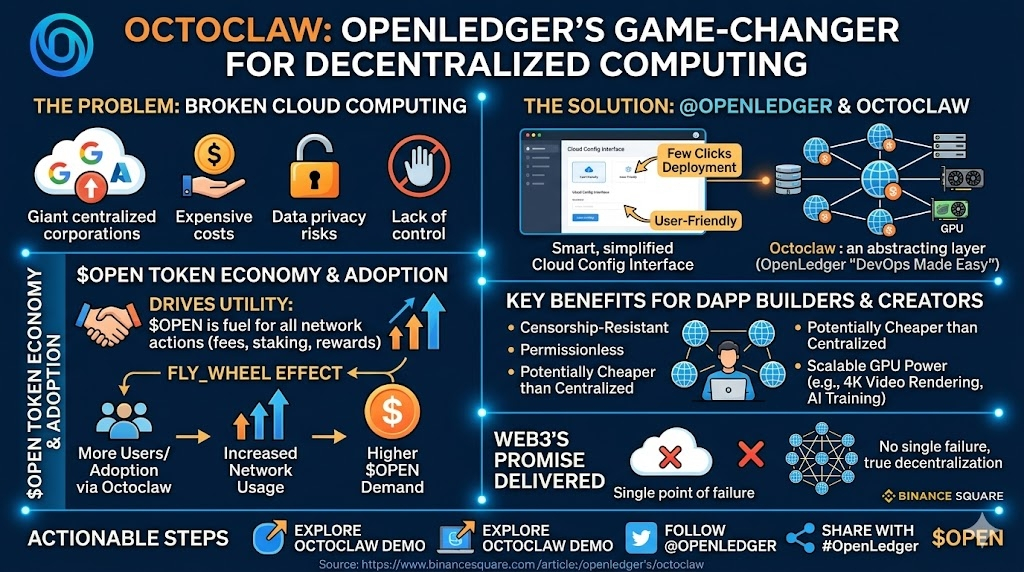
 Have you ever felt that cloud computing is broken? You pay a giant corporation like Amazon or Google, hand over your data, and just hope they don’t read it, lose it, or hike prices overnight. I’ve been there. That’s why I’ve been watching @OpenLedger closely, and their latest move – the Octoclaw launch – is genuinely exciting.
For those new to the project, OpenLedger isn't just another DeFi protocol. It’s building a decentralized ecosystem where everyone can contribute computing power (like GPU resources) and get paid in $OPEN. But Octoclaw? That’s the part that makes it usable for normal people, not just developers.
So what is Octoclaw? Think of it as a "cloud config" layer – a smart, user-friendly interface that sits on top of OpenLedger’s decentralized network. Instead of needing to be a DevOps engineer to spin up a virtual server, Octoclaw allows you to configure, deploy, and scale decentralized applications (dApps) with just a few clicks. It’s like going from command-line DOS to a beautiful graphical interface.
Why does this matter for $OPEN holders? Simple: Adoption.
Up until now, decentralized computing was powerful but painful. You had to manually find providers, negotiate deals, and handle complex wallets. Octoclaw abstracts all that away. A game developer needing rendering power, an AI researcher training models, or a startup avoiding AWS fees – they can now use Octoclaw to tap into OpenLedger’s global network as easily as they would use traditional cloud. But with one huge difference: it’s censorship-resistant, permissionless, and often cheaper.
The Octoclaw cloud config launch isn't just a technical update. It’s the bridge that connects mainstream users with the $OPEN ecosystem. Every time someone deploys a config through Octoclaw, they interact with $OPEN – paying fees, staking tokens, or rewarding node operators. That creates real, sustainable demand for the token, not just speculation.
I also want to highlight how this aligns with Web3’s original promise. Centralized cloud has become a single point of failure – one outage at AWS can take down half the internet. Octoclaw on OpenLedger distributes risk. Your application runs on dozens of independent nodes worldwide. If one goes down, others pick up the slack. No permission needed, no "we noticed unusual activity" emails.
For content creators, AI artists, and even DeFi traders, this is freedom. Imagine rendering a 4K video using spare GPU power from Seoul, Santiago, and Stockholm – all coordinated via Octoclaw and settled in $OPEN. That’s not science fiction; it’s what OpenLedger is shipping right now.
Check the source link they shared (https://tinyurl.com/4kypcxcm) – the official X post from @OpenLedgerHQ shows they’re already live with Octoclaw. The team isn’t just talking. They’re delivering configurable tools that lower the barrier to entry.
Now, let’s talk about the token itself. $OPEN isn’t just a governance token. It’s the fuel for every action on OpenLedger. With Octoclaw making it easy for developers and enterprises to join, the velocity of $OPEN could increase significantly. More users → more transactions → more value captured by the token. That’s the flywheel we want.
Of course, there’s always competition. Other projects try to do decentralized compute. But most are either too slow, too complicated, or lack a real config tool. Octoclaw gives OpenLedger a clear edge: usability. The team understood that the best tech in the world is useless if no one can figure out how to turn it on.
My honest take? If you believe that Web3 needs real infrastructure – not just memes and yield farming – then OpenLedger deserves your attention. The Octoclaw launch proves they’re moving beyond promises to practical, everyday tools. And as a bonus, the daily task to post about them on Binance Square keeps our community engaged and learning. That’s smart.
So next time you see #OpenLedger trending, don’t scroll past. Take a minute to explore Octoclaw. Try their cloud config demo. And consider how $OPEN fits into your portfolio – not as a short-term flip, but as a bet on decentralized computing becoming the norm.
We’re early. Most people still don’t realize that cloud centralization is a risk to their own projects. OpenLedger, with Octoclaw, offers an alternative. And every new config launched brings us one step closer to an internet that belongs to everyone.
What do you think – is decentralized compute finally ready for mass adoption? Drop your thoughts below. And don’t forget to follow @OpenLedger, keep an eye on $OPEN, and spread the word with #OpenLedger. Let’s build this together.