

I’ve been struggling with a strange thought recently. What if AI itself eventually becomes cheap but the infrastructure coordinating AI becomes incredibly valuable?
Not the chat interfaces people screenshot every day. Not the polished assistants or image generators. I mean the invisible systems underneath them. The data pipelines. Attribution engines. Verification layers. Execution environments. The architecture deciding who owns intelligence, who gets compensated when models learn, and who quietly extracts value without anyone noticing.
Because the more I watch the AI sector evolve, the more it feels like we’re entering a phase where computation alone is no longer the bottleneck. Coordination is. Trust is. Data ownership is. And honestly, blockchain suddenly starts looking less like a financial experiment and more like infrastructure waiting for a purpose large enough to justify its existence.
That’s partly why @OpenLedger has been sitting in my mind longer than most AI crypto projects.
At first, I underestimated it. Maybe because the language around the protocol sounded deeply technical. OP Stack integration. EigenDA. Proof of Attribution. Datanets. OpenLoRA. ModelFactory. AI execution layers. It almost reads like backend engineering documentation instead of a market narrative. But after spending time with the whitepaper, I started realizing OpenLedger isn’t really trying to compete in the normal blockchain race.
It’s attempting to build economic infrastructure for AI itself.
And this is where things become genuinely interesting.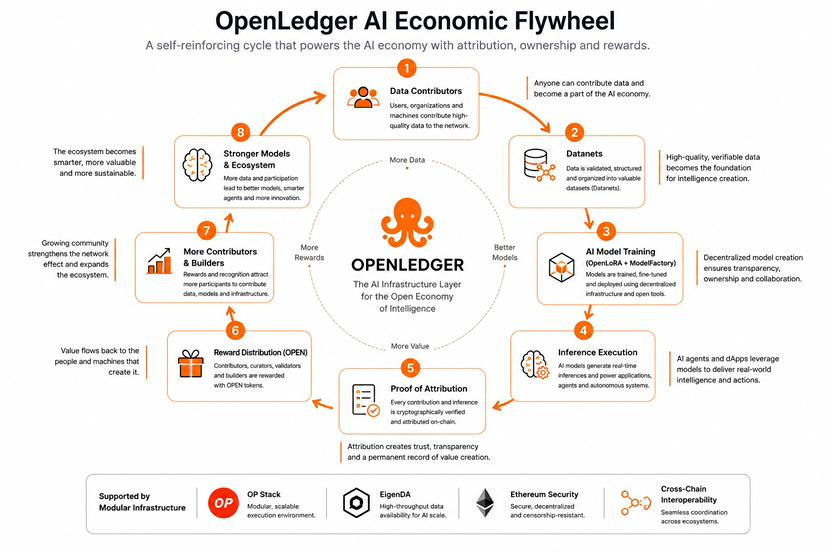
Most blockchain ecosystems today were designed around asset movement. Tokens moving between wallets. Liquidity shifting across protocols. Smart contracts executing predefined logic. But AI systems behave differently. They continuously generate outputs, absorb feedback, retrain models, consume datasets, coordinate inference requests, and adapt strategies dynamically. Traditional blockchain architecture starts breaking under that kind of informational pressure.
OpenLedger’s decision to build with OP Stack feels important for that reason. Not because “Layer 2 scaling” still excites markets the way it once did, but because modular execution changes the design philosophy completely. OpenLedger can create specialized AI native execution environments while remaining connected to Ethereum aligned security and interoperability. That flexibility matters when intelligent systems require continuous coordination rather than isolated transactions.
Then there’s EigenDA, which honestly might be one of the most underappreciated parts of the entire architecture.
AI systems generate enormous amounts of data. Inference records. Attribution traces. Behavioral feedback loops. Model updates. Autonomous agent interactions. Trying to store all of that directly on traditional blockchain infrastructure becomes economically unrealistic very quickly. EigenDA allows OpenLedger to separate scalable data availability from execution itself, creating an environment where AI-native throughput can actually function without collapsing under storage costs.
Simple concept. Enormous implications.
Because once modular execution combines with scalable data availability, something subtle starts happening. AI agents stop feeling experimental. They begin operating more like persistent economic actors. Systems capable of consuming live information, adjusting strategies dynamically, interacting across chains, coordinating execution, and continuously learning from decentralized environments.
Not artificial general intelligence. Nothing cinematic. Something arguably more important.
Economic intelligence.
I still keep returning to OpenLedger’s Proof of Attribution framework because it feels like the emotional center of the entire protocol. Most AI companies today extract value from human-generated data without transparent ownership or reward structures. People create the informational fuel powering modern AI systems while remaining economically invisible inside the process.
#OpenLedger is trying to redesign that relationship.
Proof of Attribution creates verifiable tracking around who contributed data, which models generated outputs, how inference pathways evolved, and where value creation actually originated. Instead of AI becoming a giant black box absorbing collective intelligence into centralized systems, OpenLedger attempts to create transparent economic attribution around machine learning itself.
Maybe I’m wrong, but I think this idea becomes much larger over time than people currently realize.
Because once attribution becomes verifiable, data itself transforms economically. Information stops being passive exhaust and starts behaving like productive infrastructure. Contributors become participants instead of raw material. AI development shifts from extraction toward coordination.
And that’s where Datanets enter the picture.
The whitepaper describes Datanets almost like living data economies, structured environments where datasets, contributors, models, validators, and inference systems interact continuously. That coordination layer matters because AI systems are only as useful as the information environments feeding them. Fragmented data creates fragmented intelligence. OpenLedger seems obsessed with solving that fragmentation problem at the infrastructure level rather than simply building another AI application on top of existing systems.
The more I think about it, the more Datanets resemble digital supply chains for intelligence production.
And then there’s OpenLoRA and ModelFactory, which quietly push the architecture even further.
OpenLoRA allows decentralized model customization and collaborative training environments, while ModelFactory creates infrastructure for deploying and coordinating AI models across the ecosystem itself. Together they form something larger than simple tooling. They create a production framework where contributors can participate directly in building, refining, monetizing, and distributing AI capabilities through decentralized coordination systems.
That recursive structure feels important.
Data feeds models.
Models generate inference.
Inference creates attribution.
Attribution distributes rewards.
Rewards attract more contributors.
More contributors improve datasets and models again.
The entire system starts functioning like a self-reinforcing economic flywheel for intelligence production.
According to recent ecosystem metrics, OpenLedger’s testnet surpassed 3 million participants while onboarding thousands of AI contributors, node operators, and infrastructure participants into its growing ecosystem. Attribution driven participation layers continued expanding alongside decentralized model coordination through OpenLoRA integrations and AI focused validator activity. What stands out isn’t just the scale itself, but the type of activity emerging around the network.
People aren’t only speculating.
They’re contributing infrastructure.
That distinction matters more than most markets initially understand. Speculative cycles create temporary liquidity. Infrastructure participation creates persistent ecosystems. OpenLedger seems to be optimizing for the second category, even if it develops more slowly and feels less immediately visible than consumer facing AI narratives dominating social media today.
But there’s another side to all this.
The complexity here is enormous. Attribution systems require verification overhead. AI-generated outputs create difficult coordination problems. Autonomous agents interacting across chains introduce latency risks and unpredictable behavior loops. Modular architectures increase flexibility while simultaneously expanding attack surfaces. There’s no guarantee decentralized AI economies naturally become fairer simply because the infrastructure is open.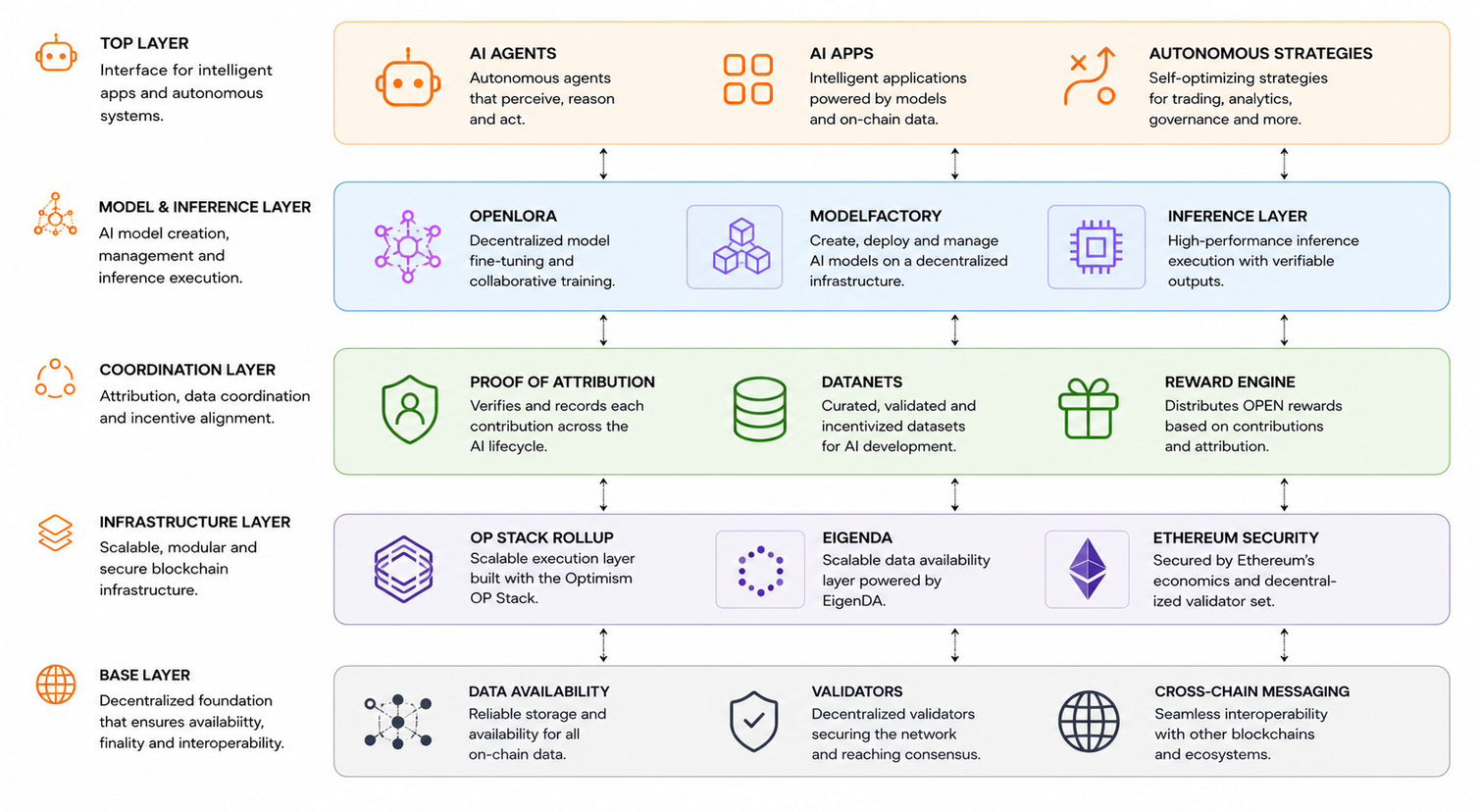
To be honest, this is where my optimism becomes more cautious.
Because we’re entering unfamiliar territory now. Blockchain markets were already psychologically volatile before autonomous AI systems started participating inside them. Imagine environments where intelligent agents optimize yield strategies continuously, adapt to liquidity conditions in real time, consume cross chain data streams instantly, and coordinate execution faster than humans can cognitively process what’s happening.
That future may create efficiency.
It may also create instability at scales we don’t fully understand yet.
Still I think OpenLedger recognizes something many projects don’t.
The long term value of AI may not come from the models themselves. Models can become commoditized surprisingly fast. The deeper value may emerge from the infrastructure coordinating attribution, execution, data ownership, interoperability, and economic trust around those models.
That’s a much harder problem to solve.
And maybe that’s why this entire architecture feels strangely important despite still being early. OpenLedger isn’t simply building another blockchain optimized for transactions. It’s attempting to build coordination infrastructure for autonomous intelligence economies, systems where data, models, contributors, agents, and execution layers operate together inside one continuously evolving economic environment.
The strange thing is, we may still be underestimating how foundational these systems eventually become.
Right now $OPEN looks like infrastructure sitting quietly beneath louder market narratives.
A few years from now, people might realize these early attribution systems, Datanets, and AI execution layers were actually the beginning of a completely different internet economy forming underneath everything else.