
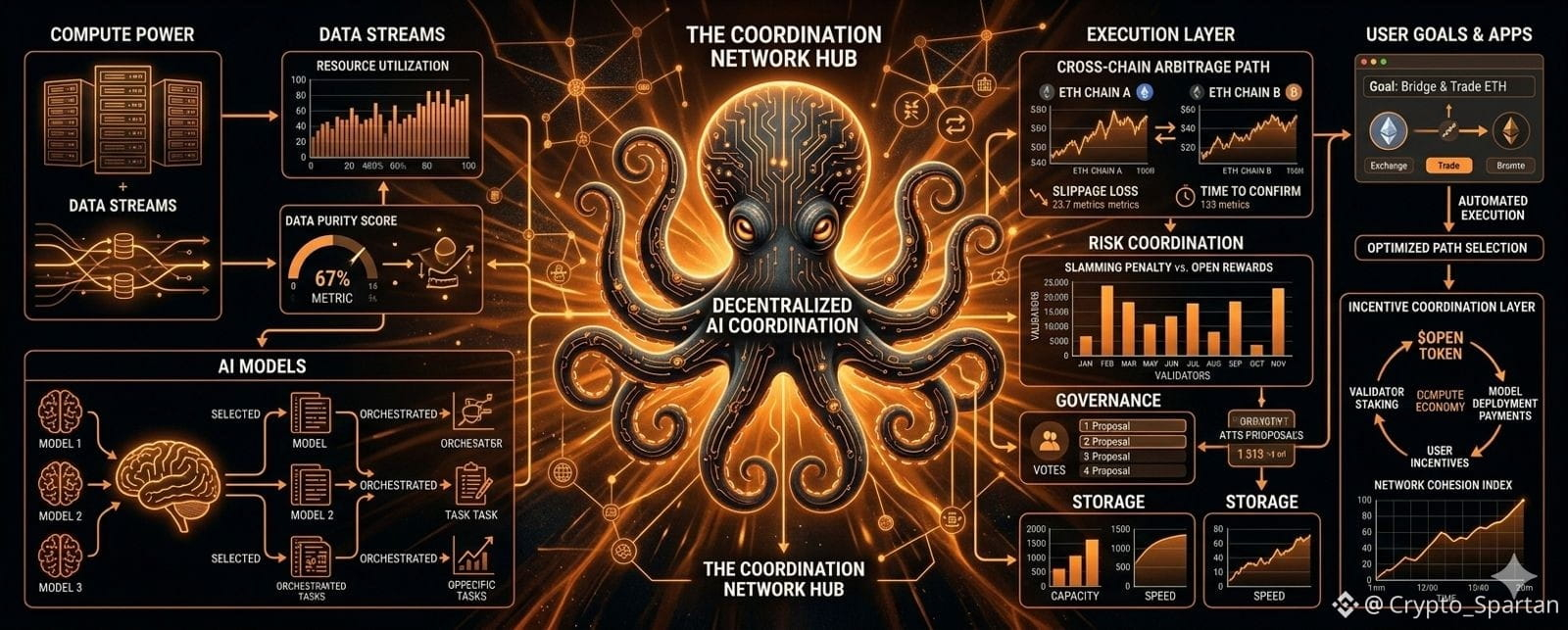
A lot of people in crypto know this feeling already. You find the perfect trade setup, timing looks great, market moves exactly how you expected… and then the infrastructure completely ruins it.
The bridge takes forever. Gas suddenly spikes for no reason. Slippage destroys your entry. Maybe your route gets sandwiched, or your funds are stuck moving between chains while the market already repriced without you. It’s honestly frustrating because sometimes the strategy was actually right. The execution just failed.
That’s kinda why I stopped ignoring OpenLedger.
At first I thought it was just another AI + crypto project throwing around words like autonomous agents, decentralized intelligence, smart execution and all the usual buzzwords. After seeing so many projects, everything starts sounding the same honestly.
But then I looked deeper into what Octoclaw is trying to do, and it felt a bit different.
Most AI projects in crypto focus only on making the model smarter. Bigger models, faster agents, more automation. But maybe intelligence was never the main problem in the first place. Maybe coordination is the actual bottleneck.
Right now crypto infra is super fragmented. Every chain works differently. Every bridge has different risks. Liquidity changes fast, latency changes fast, and humans are basically forced to manually manage everything themselves. You keep checking routes, changing positions, adjusting transactions, watching fees. It works for small scale maybe, but it gets messy very fast when real capital is moving around.
That’s where OpenLedger started making more sense to me.
People keep talking about “vibecoding” there and honestly the interesting part is that it doesnt even feel like traditional coding anymore. Instead of writing strict instructions step by step, you kinda define goals and boundaries. Like your risk limits, routing preferences, liquidity conditions, maybe stuff you want the agent to avoid. Then the AI handles most of the complicated execution stuff itself.
And thats actually a pretty big shift.
The edge in trading may stop being who clicks the fastest or who monitors 20 tabs all day. The edge could become who designs better constraints and better systems for these autonomous agents to operate inside.
Sounds good in theory. But also kinda dangerous too.
Because in normal DeFi, even though everything is fragmented, at least you can SEE the fragmentation. You know when you’re bridging. You know which protocol you’re trusting. You know where risk exists at every step.
But once AI abstracts all that into one smooth flow, visibility starts disappearing.
And thats the part people dont talk enough about.
Crypto infra already breaks under pressure all the time. Bridges freeze. Smart contracts fail. Liquidity disappears during volatility. Oracle assumptions collapse exactly when markets become stressful. Now imagine adding another AI coordination layer on top of all that complexity. Thats where the skepticism comes from honestly.
Maybe traders still prefer manual control when markets get scary. Maybe automation only feels safe during calm conditions.
Still, I think the core idea behind OpenLedger is interesting.
They arent saying intelligence itself is rare. They’re basically saying coordination is the scarce thing. Coordination between liquidity, execution, incentives, data, infrastructure and AI systems.
That framing actually changes how you look at the whole space.
Once AI becomes more like a supply chain instead of just a product, different questions start mattering more. Who verifies outputs? Who provides liquidity? Who pays for latency? Who owns inference? Who gets rewarded when systems improve from shared behavior?
Suddenly the infrastructure matters more than the shiny interface.
That’s also why I started thinking about $OPEN differently. Less like a random speculative AI token, more like infrastructure trying to reduce fragmentation between execution, incentives, and data flows.
I still have concerns though.
One big issue is opacity. The more abstract execution becomes, the less users understand where failures are actually happening. Thats risky during major volatility.
The second problem is fake activity.
The moment rewards exist around AI coordination or data contribution, people will obviously optimize for rewards instead of authentic behavior. Systems always get flooded with noise eventually. Distinguishing real signal from economically-generated spam is extremely hard and honestly most projects massively underestimate this problem.
But even with all that, I’m still watching OpenLedger closely for one simple reason.
Most AI crypto projects feel like they invent fake problems just to justify a token narrative. OpenLedger and Octoclaw atleast seem focused on a real issue — fragmented execution across crypto infrastructure.
It’s not a flashy problem. Its actually pretty boring compared to most AI marketing narratives. But it’s real.
Will they solve it? I honestly dont know.
Coordination at scale is difficult. Verification costs are high. Governance slows everything down. And crypto infrastructure is already chaotic enough.
But the question they’re asking feels correct:
What if intelligence becomes cheap, but coordination is the thing that stays valuable?
And honestly, thats a much more interesting thesis than most AI projects are talking about right now.#OpenLedger $OPEN
