
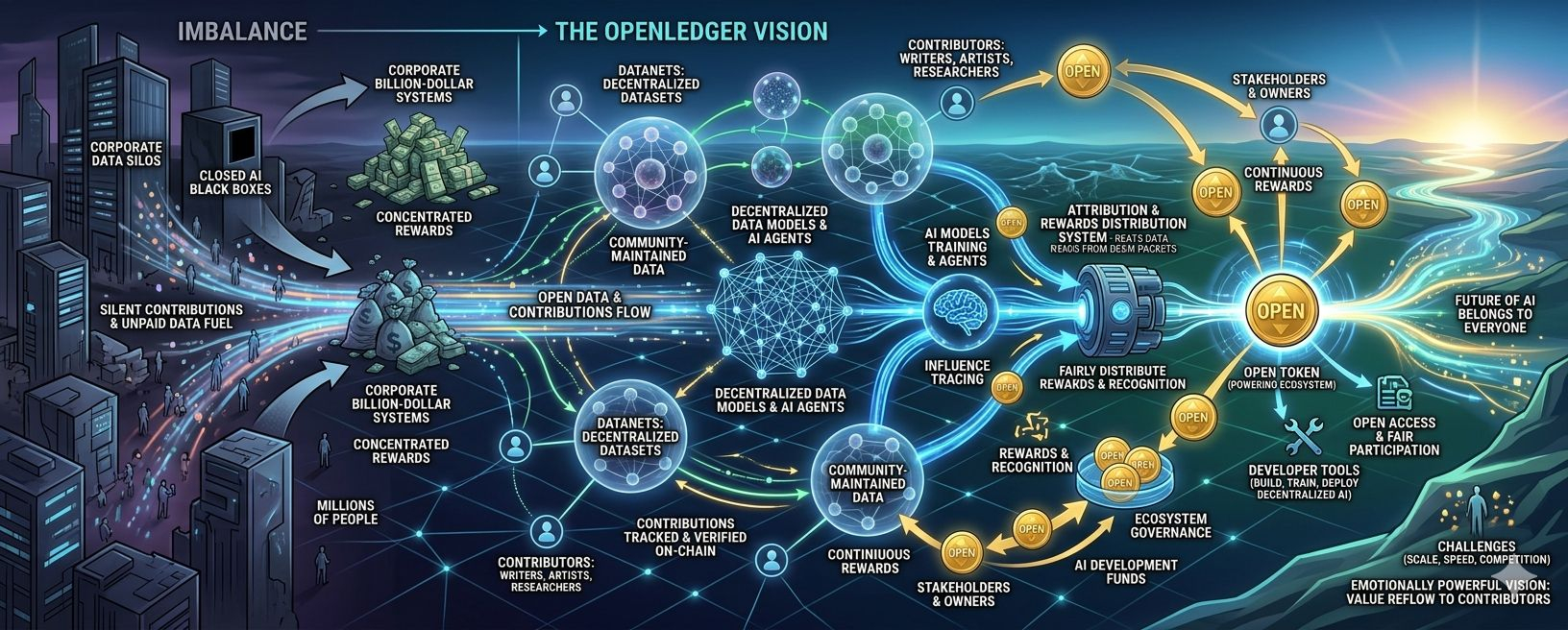
Most AI systems today are built on silent contributions
Millions of people spend years sharing ideas experiences creativity and knowledge online yet the biggest rewards usually flow to a handful of powerful companies. The people helping shape artificial intelligence are often left invisible while billion dollar systems are built on top of their data.
That quiet imbalance is exactly why OpenLedger feels different.
OpenLedger is not just another blockchain trying to ride the AI wave. It feels more like an attempt to give ownership back to the people behind the intelligence powering the internet. The project is built around a bold idea that data models and AI agents should not only exist inside closed corporate walls. They should become part of an open economy where every meaningful contribution has value.
At the center of OpenLedger is a simple but powerful belief. If your data helps train an AI model you deserve a share of the value it creates. If your ideas improve a system your contribution should not disappear into the shadows. In a world where artificial intelligence is growing faster every day OpenLedger wants people to stop being unpaid fuel for machines.
That emotional shift is what makes the project stand out.
Most AI platforms today operate like black boxes. People upload content share conversations and unknowingly feed systems that eventually become worth billions. OpenLedger is trying to break that pattern by creating a transparent network where contributions can be tracked verified and rewarded openly on chain.
The vision behind it feels deeply connected to the original spirit of crypto itself. Open access fair participation and ownership that belongs to communities instead of gatekeepers.
One of the most interesting ideas inside OpenLedger is the creation of Datanets. These are decentralized datasets built and maintained by communities. Instead of data being quietly collected and monetized behind closed doors contributors can actually become part of the economy their information helps create.
And this changes everything emotionally.
For the first time people are not just giving away data and walking away empty handed. Their contributions can continue generating rewards if they help models perform better over time. That turns data from something exploited into something owned.
OpenLedger also focuses heavily on attribution which may become one of the most important conversations in the entire AI industry. Right now nobody truly knows how much of the internet has been absorbed into AI systems. Artists writers researchers and everyday users are all asking the same question
Who really benefits from our knowledge
OpenLedger is trying to answer that by building systems that trace influence and distribute rewards more fairly. If successful it could reshape how people think about ownership in the age of artificial intelligence.
The ecosystem also gives developers tools to build train and deploy AI models without relying completely on centralized tech giants. Instead of intelligence being controlled by a few companies OpenLedger imagines a future where builders communities and even autonomous AI agents participate together in a shared economy.
That future sounds futuristic but it also feels strangely inevitable.
As AI grows stronger the demand for transparency accountability and ownership will only become louder. People are beginning to realize that intelligence itself is becoming one of the most valuable resources in the world. And whenever something becomes valuable the question of who controls it becomes impossible to ignore.
The OPEN token powers this entire ecosystem. It fuels transactions governance staking rewards and AI activity across the network. But beyond utility the token represents something larger. It represents participation in a new kind of economy where value flows back toward contributors instead of remaining trapped at the top.
Of course the road ahead is not easy.
OpenLedger faces enormous challenges. The AI industry moves at brutal speed and competition is everywhere. Building decentralized AI infrastructure at scale is technically difficult financially demanding and incredibly complex. The project will need real adoption strong execution and constant innovation to survive.
But despite the risks there is something emotionally powerful about what OpenLedger is trying to build.
It speaks to a growing frustration people feel online today. The feeling that platforms profit from users while users themselves remain disposable. The feeling that creativity knowledge and human contribution are endlessly extracted without recognition.
OpenLedger taps into that frustration and turns it into a vision.
A vision where intelligence becomes shared instead of hoarded. Where contributors become stakeholders instead of invisible labor. Where AI does not simply consume human value but redistributes it.
Maybe that is why so many people are paying attention.
Because beneath all the technology charts and token discussions OpenLedger is really asking a much deeper question
What if the future of AI could belong to everyone not just the companies powerful enough to control it