
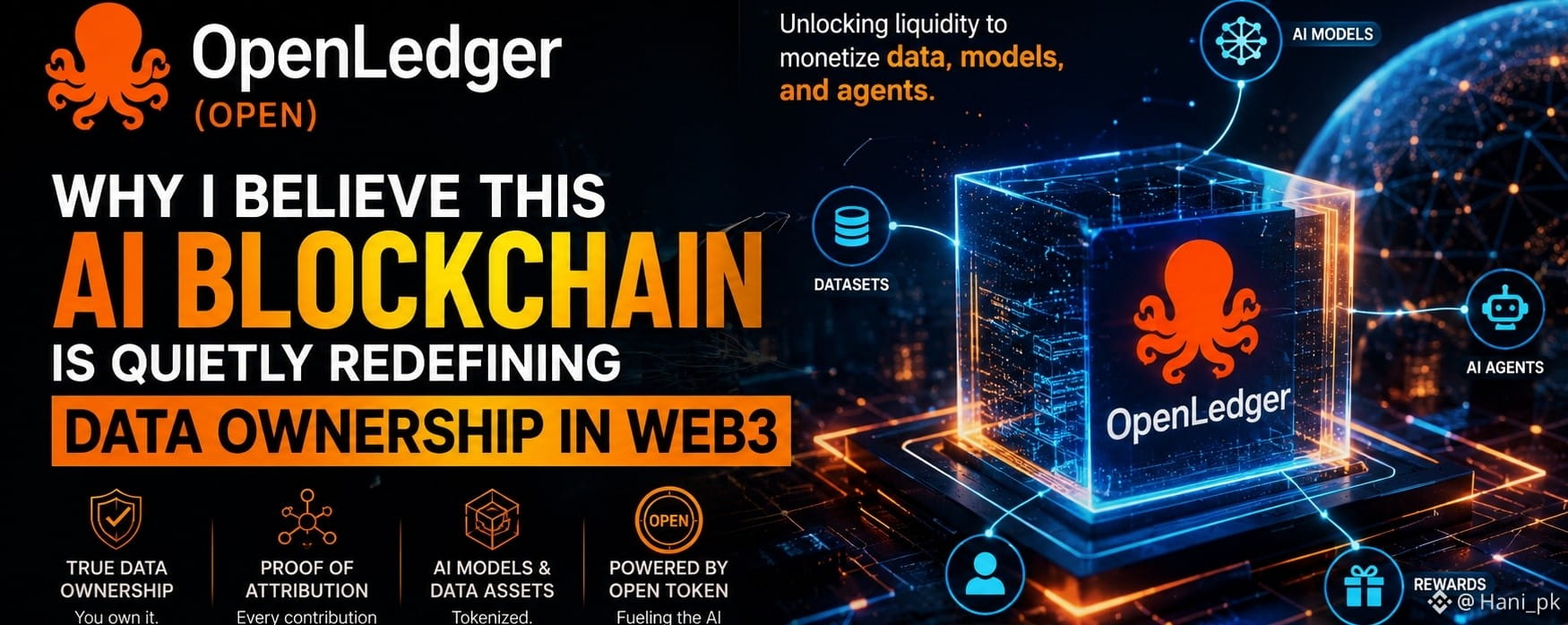
There’s a quiet but powerful shift happening in crypto right now—moving from pure finance to real utility—and OpenLedger sits exactly at that intersection. It doesn’t try to be just another Layer-1 or AI narrative token. It’s attempting something much more structural: turning data, AI models, and even autonomous agents into on-chain economic assets that can be owned, traced, and monetized in a transparent way.
At its core, OpenLedger is built around a simple but unresolved problem in today’s digital economy: data creates massive value, but the people who generate it rarely get paid. Traditional AI systems are centralized black boxes—companies collect data, train models, and capture all the upside. OpenLedger flips that model by embedding attribution directly into blockchain infrastructure, so every contribution can be tracked and rewarded.
This is where its positioning becomes unique in Web3. It’s not just about decentralization—it’s about verifiable contribution economics.
The architecture behind OpenLedger reflects this vision. Instead of generic smart contracts, it introduces purpose-built layers like Datanets, ModelFactory, and OpenLoRA. Datanets act as decentralized data markets where contributors upload datasets; ModelFactory allows users to train AI models without deep technical barriers; and OpenLoRA optimizes deployment so multiple models can run efficiently on limited hardware.
Everything—from data upload to model training and even inference—is recorded on-chain. That means when an AI model produces output, the system can trace which data influenced it and distribute rewards accordingly. This mechanism, often referred to as “Proof of Attribution,” is the backbone of OpenLedger’s economic design.
From a blockchain perspective, OpenLedger operates as an Ethereum-compatible infrastructure layer, which allows it to inherit smart contract flexibility while specializing in AI workflows.
So while many projects debate Layer-1 vs Layer-2 scalability, OpenLedger is more focused on application-specific Layer-1 design, optimized for AI computation, attribution, and data flow rather than generic DeFi throughput.
In the broader Web3 stack, this positions OpenLedger as a bridge between three major narratives: decentralized AI, tokenized data economies, and real-world asset integration. Data itself becomes a form of tokenized asset here. Instead of tokenizing real estate or commodities, OpenLedger tokenizes something more abstract but arguably more valuable—information and intelligence.
This opens a new category of Real World Assets (RWA) that are not physical but digital-native. For example, a medical dataset, financial model, or even behavioral data stream can be contributed, verified, and monetized. Each contribution gains economic weight through on-chain attribution, effectively turning data into a yield-generating asset.
Privacy is another critical layer in this design. In traditional AI systems, data sharing often conflicts with privacy. OpenLedger attempts to balance this by enabling controlled data contribution within decentralized frameworks, where usage is transparent and traceable rather than hidden behind centralized APIs. While full privacy-preserving AI remains a broader industry challenge, OpenLedger’s approach reduces blind trust by replacing it with cryptographic accountability.
Tokenization within the ecosystem revolves around the OPEN token. It isn’t just a speculative asset—it functions as gas, governance, and reward distribution. Users pay in OPEN to access AI services like training or inference, contributors earn OPEN based on the measurable impact of their data or models, and token holders participate in governance decisions.
This creates a circular economy where value flows continuously between builders, users, and data providers instead of being extracted by a central authority.
When viewed through a Binance Square lens, the real narrative here isn’t just “AI + crypto”—it’s ownership of intelligence. OpenLedger is trying to answer a question that hasn’t been solved yet: who should own and profit from AI outputs? The platform’s answer is simple but ambitious—everyone who contributed to it.
That idea, if it scales, changes everything. It means AI stops being a closed system and becomes a shared economy. It means contributors—from individuals to institutions—can finally capture value from the data they generate. And it means blockchain evolves from financial rails into a coordination layer for intelligence itself.
But the reality is, execution will define everything. OpenLedger’s success depends on attracting real datasets, active developers, and meaningful AI applications. Without adoption, even the best attribution model remains theoretical.
Still, the direction is hard to ignore. In a market full of recycled narratives, OpenLedger feels like a bet on where the next cycle of value will actually come from—not speculation, but utility.
And if Web3 truly aims to decentralize ownership, then OpenLedger isn’t just another project—it’s an attempt to decentralize intelligence itself.