Everyone keeps talking about models getting smarter, chips getting faster, inference becoming cheaper, agents becoming autonomous… but almost nobody talks about where all the raw intelligence feeding these systems actually comes from.
And honestly, that part matters more than people think.
Because AI does not magically appear out of nowhere.
It learns from data.
From human behavior.
From communities.
From researchers.
From creators.
From millions of people constantly generating information online every single day.
Yet somehow, most contributors sit completely outside the value loop.
The systems get smarter.
The companies get bigger.
The models become more valuable.
But the people helping train and improve these systems usually have no ownership, no attribution, and no visibility into where the value goes after their contribution disappears into the machine.
That’s probably why @OpenLedger has been catching my attention more recently.
At first glance, OpenLedger sounds like another AI + blockchain project. The market has seen hundreds of those already, so I understood why people initially brushed past it.
But the deeper I looked into the idea, the more it started feeling less like a hype narrative and more like infrastructure for a future AI economy that probably needs to exist.
And I think the market is slowly starting to understand that too.
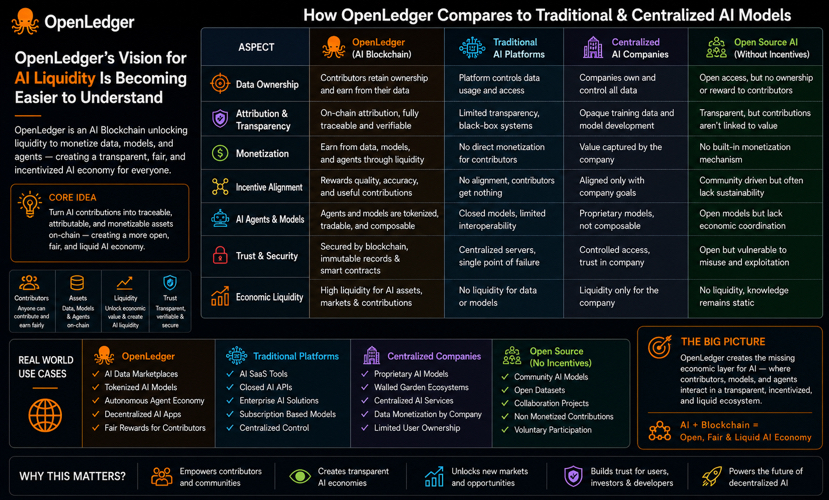
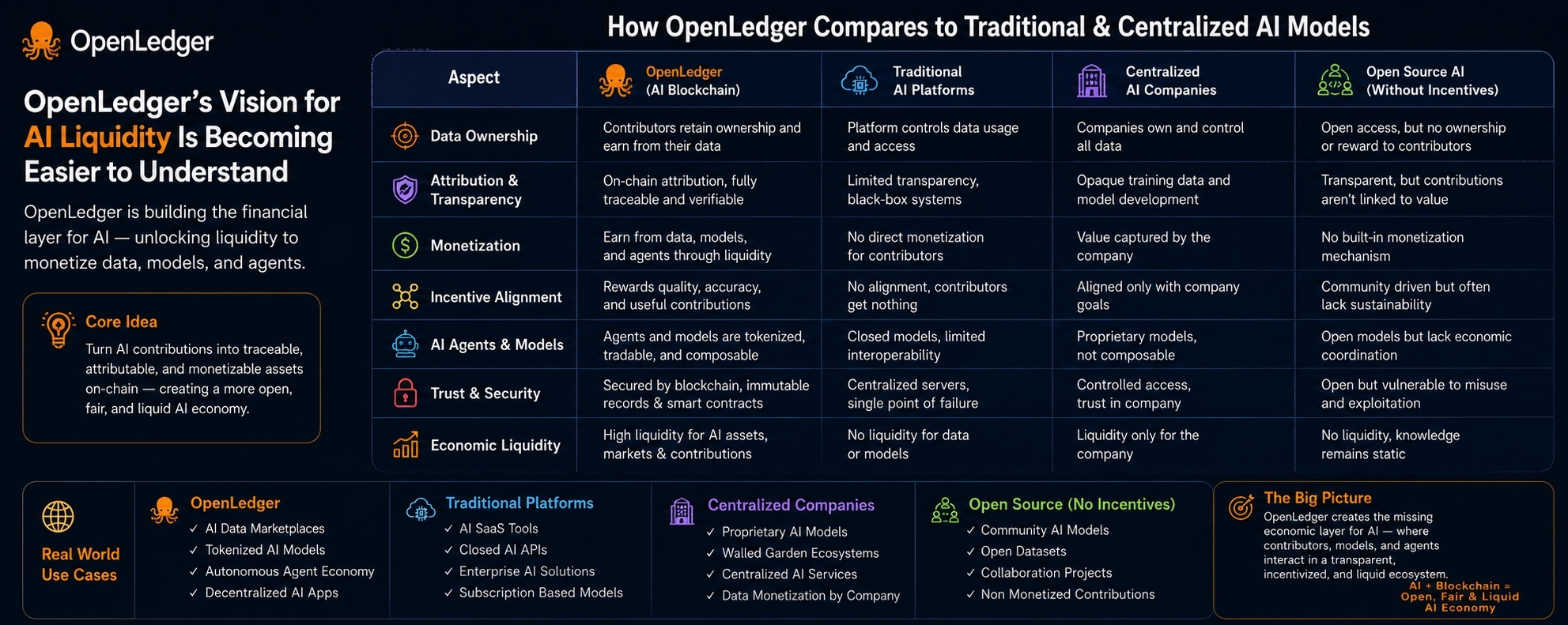
OpenLedger focuses on monetizing data, models, and agents.
Simple sentence.
But there’s actually a lot packed inside it.
Because once you say “monetize,” you immediately enter a completely different conversation around AI.
Now you’re not just talking about technology anymore.
You’re talking about incentives.
Ownership.
Coordination.
Attribution.
Economic flows.
Basically, you start asking questions most AI companies still avoid.
Who owns the data?
Who gets rewarded when a model becomes valuable?
How do contributors prove their input mattered?
Can intelligence itself become economically trackable?
That last one is where things start getting really interesting.
The idea of “AI liquidity” sounded abstract to me at first. I’ll be honest about that.
But over time it started clicking.
Liquidity doesn’t only mean trading volume or token markets.
It can also mean making something economically usable that previously wasn’t.
And right now, huge amounts of valuable intelligence are basically trapped inside closed systems.
Think about it.
A researcher uploads specialized data.
A developer improves a model.
A community contributes niche knowledge.
A creator produces useful informational content.
That value enters AI systems… but the connection between contribution and reward usually disappears forever.
OpenLedger seems to be trying to fix that missing layer.
And honestly, that feels more important over time than most people realize today.
Because AI is eventually going to have the same problem the internet had early on:
Trust and coordination at scale.
The internet exploded because open protocols allowed information to move freely.
AI may need similar infrastructure for value and intelligence coordination.
Otherwise the entire ecosystem becomes increasingly concentrated inside a few closed platforms.
And maybe that works for a while.
But long term, people usually want visibility into systems that shape economic outcomes.
Especially when those systems are training on public behavior, public data, and collective intelligence.
That’s why attribution matters so much here.
One thing I noticed while reading deeper into OpenLedger’s structure is that it keeps circling back to traceability.
Not just AI outputs.
But where intelligence came from in the first place.
That changes incentives completely.
If contributions become visible and economically linked to outcomes, then higher quality data becomes more valuable.
Reputation matters more.
Accuracy matters more.
Coordination matters more.
Suddenly the system rewards useful participation instead of invisible extraction.
And honestly… I think the market is heading toward that direction whether people realize it yet or not.
Right now most AI conversations are still stuck in the “bigger model wins” phase.
But eventually the conversation shifts.
People start asking harder questions.
Where did the training data come from?
Can the outputs be trusted?
Who owns the underlying intelligence?
How are contributors rewarded?
How do autonomous agents interact economically?
Those questions become unavoidable once AI starts touching larger parts of finance, work, media, healthcare, education, and decision-making.
That’s why infrastructure projects around AI coordination feel important to watch early.
Not because they create flashy demos.
But because they’re trying to solve backend problems most people haven’t fully noticed yet.
And honestly, crypto fits naturally into this conversation.
For years crypto has basically been building systems for transparent coordination between strangers.
That’s what blockchains do best.
Ownership tracking.
Settlement.
Incentive alignment.
Programmable economic rules.
Now imagine those same systems interacting with AI models and autonomous agents.
Suddenly the overlap becomes obvious.
AI creates intelligence.
Blockchain creates coordination.
Put both together and you start getting entirely new economic structures.
That’s the part I think people are slowly beginning to price in.
Not every AI project needs a token.
Not every model needs blockchain rails.
But large-scale open AI economies probably do need transparent infrastructure somewhere underneath.
Especially if multiple agents, applications, datasets, and contributors are interacting across ecosystems.
Traditional backend systems were never really designed for open AI economies.
They were designed for centralized platforms.
That distinction matters.
Because over time, AI may become less about single applications and more about networks of interoperable intelligence.
And networks need rules.
Settlement layers.
Identity.
Attribution.
Economic coordination.
That’s where OpenLedger’s positioning starts making more sense.
It’s not really trying to compete with ChatGPT or Claude or Gemini directly.
It’s trying to build infrastructure around the economic layer of AI itself.
Different category entirely.
I also think timing matters here.
A year ago the market mostly cared about AI hype.
Now people are starting to care about sustainability.
Real utility.
Real ownership structures.
Real monetization layers.
The conversation is maturing.
And honestly, that usually happens before sectors become much bigger.
First the market gets distracted by shiny narratives.
Then eventually attention shifts toward infrastructure because infrastructure is what actually survives.
Nobody cared about cloud infrastructure early either.
Until the internet economy started depending on it.
AI infrastructure may follow a similar path.
Most people still focus on the visible layer today because that’s easier to understand.
The chatbot.
The assistant.
The interface.
But underneath all of that, there’s an invisible economic system forming around data, compute, coordination, and intelligence flows.
That backend layer might end up becoming one of the biggest markets in the entire AI sector.
And that’s probably why OpenLedger feels more relevant now than it did a few months ago.
The market itself is slowly asking the same questions OpenLedger has already been building around:
How do we make AI contributions visible?
How do we distribute value fairly?
How do we create open coordination around intelligence?
How do we stop all AI value from concentrating into completely closed systems?
Those questions are getting bigger now, not smaller.
And honestly, I think that’s why the OpenLedger narrative is starting to feel easier for people to understand.
It’s no longer just “AI blockchain.”
It’s infrastructure for turning intelligence into an open, traceable, and economically connected system.
That’s a much deeper idea than most people initially assumed.