
Most people see artificial intelligence as something futuristic. Faster tools. Smarter systems. Bigger models. But underneath all the noise, there is another side of the story that rarely gets enough attention.
Every AI system is built from human traces.
Someone wrote the articles. Someone shared the experiences. Someone created the images, answered questions, solved problems, labeled data, tested systems, and spent years building knowledge online without ever imagining it would eventually train machines. Modern AI did not appear from thin air. It grew from millions of invisible human contributions layered together over time.
That is why projects like OpenLedger feel different.
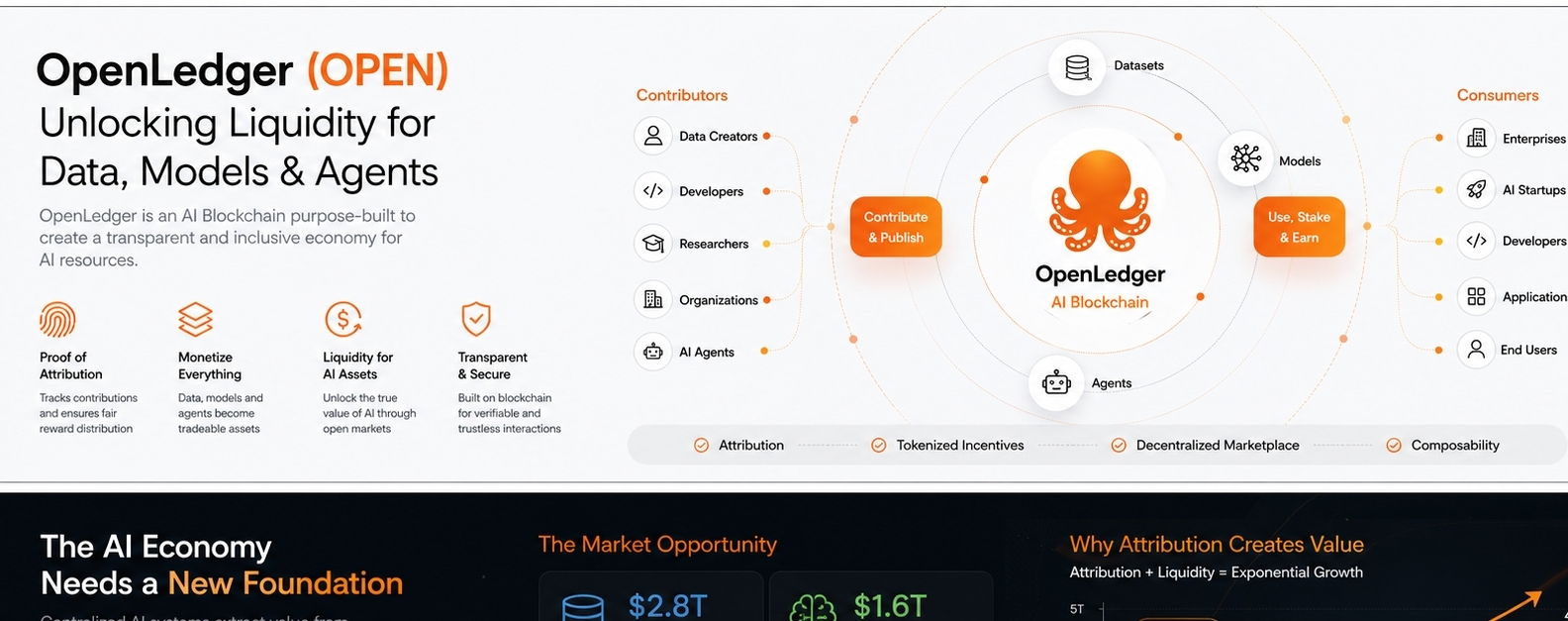
It is not only trying to build around AI. It is trying to protect the value behind the people and information that make AI possible in the first place. In a world where large platforms quietly absorb data and turn it into enormous businesses, OpenLedger pushes toward a future where contributors are not erased once their knowledge enters the system.
There is something deeply important about that idea.
The internet has already shown what happens when value becomes concentrated in too few hands. People create the activity. Platforms collect the rewards. Communities build culture while corporations build ownership around it. Over time, many creators began feeling like passengers inside systems they helped shape.
AI could easily repeat that cycle on an even larger scale.
The difference now is that knowledge itself has become the raw material. Conversations, expertise, creativity, research, personal insights, professional workflows, all of it feeds machine intelligence. And once those systems become profitable, the original contributors are usually nowhere to be found in the economic picture.
OpenLedger seems built around the belief that this should not become normal.
Instead of treating data like something disposable, the network focuses on attribution and transparency. The idea is simple but powerful. If people contribute value to AI systems, there should be a visible connection between contribution and reward. Not hidden extraction. Not silent ownership transfers. Something traceable. Something fairer.
That changes the feeling around AI completely.
Suddenly the conversation becomes less about giant corporations racing for dominance and more about creating systems where participation actually matters. Developers, researchers, communities, and smaller creators are no longer pushed to the edge of the ecosystem. They become part of the foundation itself.
And honestly, that matters more than many people realize.
There is growing exhaustion around technology that constantly takes without giving much back. People are becoming more aware of how often their time, creativity, and information are monetized behind closed doors. Trust is thinner now. Users are asking harder questions. Where is my data going? Who benefits from it? Why does ownership always disappear once platforms become powerful enough?
OpenLedger enters the conversation right at that moment.
The project also feels aligned with where AI is naturally heading. The future probably will not revolve around one giant universal model controlling everything. It is more likely to become a network of specialized systems trained for specific industries, communities, and real world tasks. Healthcare models. Financial agents. Research assistants. Regional knowledge systems. Smaller intelligence layers solving focused problems with greater precision.
That is where decentralized infrastructure starts making real sense.
OpenLedger supports the idea of community driven datasets and independent AI models rather than forcing everything into one closed environment. It creates room for smaller contributors to build meaningful systems without needing the resources of trillion dollar companies.
There is something refreshing about that approach because it feels grounded in reality instead of fantasy.
The project is not pretending that decentralization magically solves every problem. The technical challenges are still massive. AI infrastructure is expensive. Compute power is unevenly distributed. Attribution itself is incredibly difficult because machine learning systems absorb information in messy and complex ways.
But at least OpenLedger is trying to confront real problems instead of hiding behind marketing language.
That alone separates it from many projects in the space.
Another thing quietly happening in AI is the rise of autonomous agents. Not just chatbots answering questions, but systems capable of handling tasks, coordinating workflows, making decisions, accessing services, and interacting with other systems continuously. Once that becomes normal, entirely new digital economies begin to form.
Agents will need data. Models. Verification. Reputation. Payment systems. Identity layers. Shared infrastructure.
OpenLedger seems designed for that future.
Not in a loud dramatic way, but in the background, where the actual architecture matters most. The project focuses on building the rails underneath intelligent systems rather than chasing temporary hype cycles.
And maybe that is why it feels more believable.
There is a quieter kind of ambition here. Less obsession with headlines. More attention on ownership, transparency, and long term structure. In technology, those details often end up mattering far more than the loud promises people remember at the beginning.
No one can say for certain where OpenLedger will stand years from now. The AI industry is still changing almost monthly. Many projects will disappear. Others will evolve into something completely different.
But the deeper questions behind OpenLedger are not going away.
Who owns intelligence once machines learn from humanity at scale?
Who deserves value when human knowledge becomes infrastructure?
Can AI grow without repeating the same patterns of extraction the internet already normalized for decades?
Those questions feel bigger now than they did even a year ago.
And maybe the most interesting thing about OpenLedger is not the technology itself, but the fact that it is trying to answer those questions before the future becomes too centralized to change.
