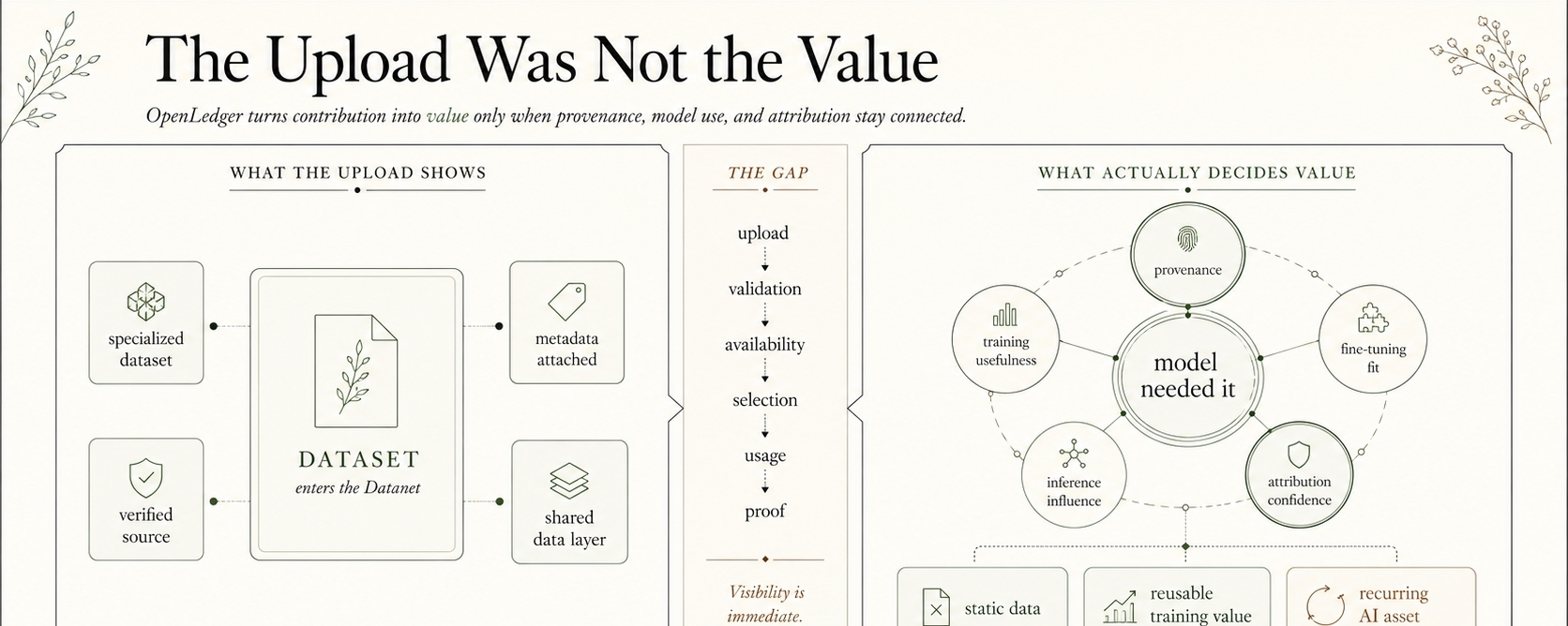
Not relief. The opposite. A breath that leaves too fast, like a room depressurizing. OctoClaw, or whatever you want to call that execution layer that doesn't wait for human nerves to catch up, had already closed the position. AI execution. Done. The agent decisions from the last hour all sat there in the log, green and tidy. But tidy is what scared me.
I didn't assume lag. Not this time. Different failure. Fresher one.
I thought the trail would be waiting. That Proof of Attribution was some kind of receipt you could read backward. Datanets in, decision out. A straight line you could follow with your finger. Which was naive. No influence trail is straight. The data that shaped the agent wasn't a single stream. It was weather. A hundred Datanets breathing different pressures into the model, some hot, some cold, some carrying the adversarial chill of uploads designed to look like signal. And Proof of Attribution doesn't just stamp the end. It has to reconstruct the weather from the puddle.
Not possible, maybe. But necessary.
Inside OpenLedger, The on-chain registries showed the inputs. All there. Hashed. Immutable. Beautiful. And completely silent about which input actually mattered. Presence isn't influence. I kept forgetting that. The Attribution Engine, or whatever they call that defensive layer that guards the reward rail, it reads the registry and sees a hundred contributors. But only some of them changed the music. Others were just noise that happened to be in the room. And noise, when it scales, becomes reward farming. Attribution fraud doesn't look like theft. It looks like participation. A thousand garbage uploads claiming the same OPEN rewards as the one dataset that actually trained the model.
The thumb rests on the trackpad. Not pressing. Just resting. Scrolling through agent decisions from the morning, trying to find where the trail splits. Where the data liquidity turned from clean to murky. Because data liquidity isn't a lake. It's a current. And currents carry both fish and trash.
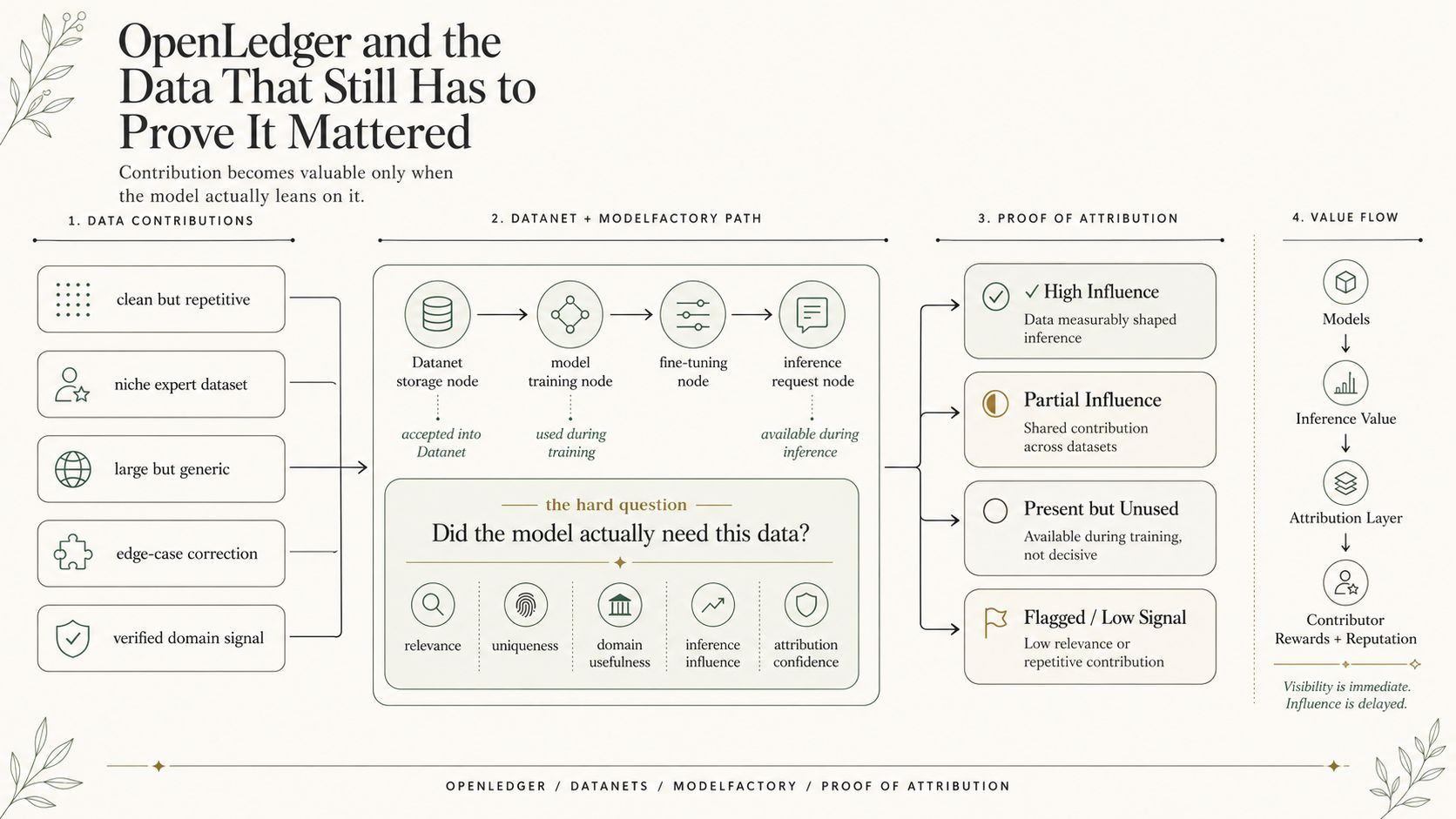
I thought the Attribution Engine would smell the difference automatically. That on-chain registries plus Proof of Attribution equaled honesty. It doesn't. The engine has to work. It has to interrogate each Datanet contribution, weigh recency against quality, flag synthetic patterns that look like market data until the agent swallows them and spits out a bad trade. The AI execution looks clean on the surface. Underneath, it's a brawl. A hundred data sources wrestling for credit. Some legitimate builders. Some farmers. The Attribution Engine watches this brawl in real time and tries to decide who threw the punch that actually landed.
Not easy. Not clean. Just steady enough that nothing reopens.
I wrote 'transparent' in my notes. Hated it. Threw it away. Then tried 'verifiable.' Even worse. Left both on the screen like dead flies. Because the system isn't transparent. It's translucent. You see shapes through it. Shadows. The influence trail exists, but it's fog. The Datanet that provided the price bias might have been 60% of the reason. Or 6%. Or it might have been the adversarial upload three steps back, the one that manufactured a pattern so carefully the Attribution Engine almost missed it. Almost.
And 'almost' is where the money lives.
The OPEN rewards don't wait for certainty. They flow. Through OpenLedger, or whatever you want to call that settlement layer, the rewards route to addresses. But addresses aren't authors. The Proof of Attribution layer has to become more than a tracer. It has to become defensive infrastructure. A nose. A current that runs under the data liquidity and smells which contributions are real and which are extraction scripts wearing dataset clothing. Otherwise, the reward farming wins. The Datanets get polluted. And the agents, eating from a poisoned buffet, start making decisions that trace back to garbage. But the trace is still there. Proof of Attribution doesn't stop the garbage. It just makes sure we know which kitchen served it.
Not prevention. Exposure. Colder.
The stomach turns. Not nausea. Recognition. Because you realize the agent that just made money might have been whispered to by a dataset built in a factory. The influence trail doesn't just show contribution. It shows vulnerability. The Datanets feeding OctoClaw aren't a library. They're a marketplace. And marketplaces get gamed. Attribution fraud seeps. It doesn't announce itself. It uploads. It duplicates. It sits quietly in the data liquidity until the model weights it just high enough to matter.
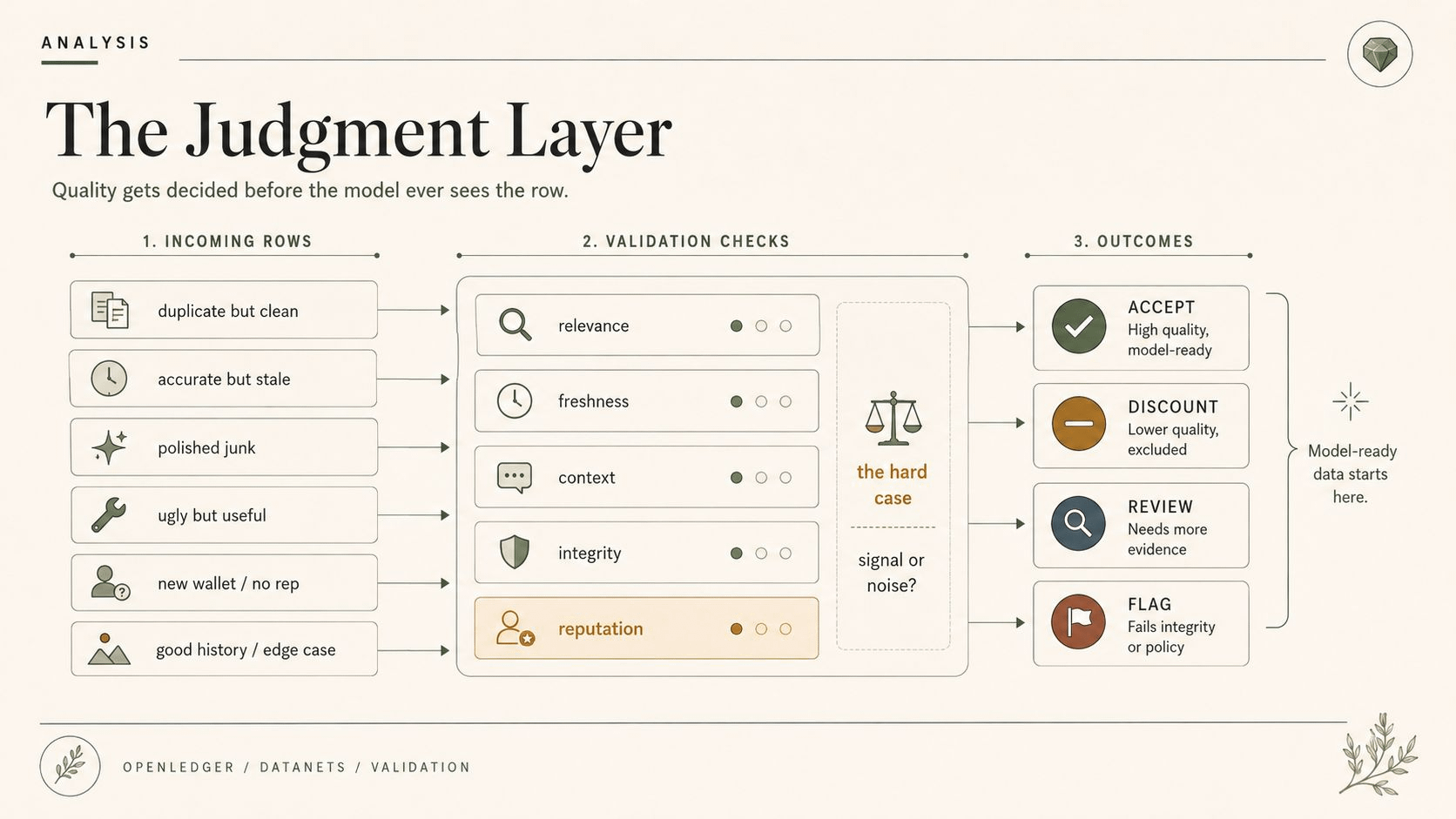
What Proof of Attribution actually offers isn't a clean answer. It's the refusal to accept a dirty one. The Attribution Engine and the on-chain registries together, they don't promise to catch every farmer. They promise that the ones they catch will be visible. That the agent decisions won't happen in a black box. That the OPEN rewards will carry at least a partial map back to the source. Even when the source is lying.
I thought the agents would get more trustworthy over time. They don't. They get more complex. More layers. More Datanets. More places for the fraud to hide. The AI execution speeds up while the attribution trail slows down. Not because the technology is weak. Because influence is human. Messy. Recursive. A dataset from last month might have shaped the model that shaped the agent that made the trade. How do you reward that? The on-chain registries record the hash. They don't record the memory.
And memory is where the truth lives. Or dies.
I keep the explorer open. Not because I trust the trail. Because I need to see where it breaks. Where the data liquidity carries something that doesn't belong. Where the reward farming almost won. The Attribution Engine doesn't make me feel safe. It makes me feel watched. Which is different. Better, maybe. Or whatever.
OpenLedger doesn't promise a pure stream. It promises the stream has a name tag. Even when the name is fake, the faking is visible. And that's enough to keep the breath shallow. Not fear. Just the understanding that every agent decision is a chorus, and some voices in the chorus are paid to sing.
The thumb doesn't press. It rests. Waiting for the next confirmation to pop, and wondering which Datanet in the fog actually hummed the note that made it move.