
A lot of stablecoins talk about “growth.”
But very few actually grow while staying crypto-backed.
That distinction matters more than people realize.👇
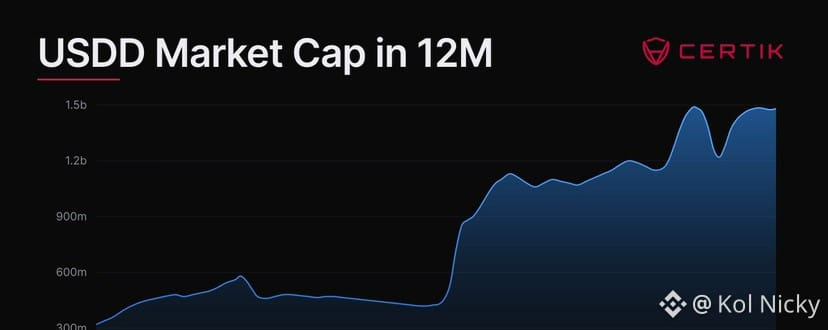
Over the last 12 months, USDD’s market cap moved from:
$369M → $1.51B.
That’s not just growth…
that’s a 4x expansion during a period where most of the stablecoin market remained dominated by fiat-backed models.
Today, USDD sits as:
⇛ the 14th largest stablecoin globally,
⇛ and the 2nd largest stablecoin on TRON after USDT.
Now here’s the part I find more interesting:
USDD didn’t grow by moving away from crypto collateral.
It leaned further into it.
Most large stablecoins today depend heavily on:
• bank-held reserves,
• treasury products,
• or centralized custody systems.
USDD took a different direction.
Its collateral structure includes:
⇛ TRX
⇛ sTRX
⇛ USDT
⇛ and now WBTC.
That makes it one of the very few crypto-backed stablecoins above the $1B mark in a market largely controlled by fiat-backed giants.
And honestly…
this says something bigger about where DeFi is heading.
Because after previous stablecoin failures, the market became extremely skeptical of crypto-backed systems.
People started assuming:
“Crypto-backed stablecoins can’t scale safely.”
But USDD’s expansion suggests the conversation may be shifting.
The key difference is structure.
A lot of weaker models depended too heavily on:
• reflexive minting,
• unsustainable incentives,
• or pure market confidence.
USDD appears to be pushing toward a more defensive architecture:
⇛ over-collateralization,
⇛ transparent reserves,
⇛ liquidation systems,
⇛ Peg Stability Modules,
⇛ and diversified collateral layers.
That layered approach matters because stability in crypto usually fails when a system relies on only one line of defense.
And the addition of WBTC is especially important.
For a long time, USDD’s collateral base leaned heavily toward the TRON ecosystem.
Adding Bitcoin-backed collateral changes the profile entirely.
Why?
Because Bitcoin liquidity behaves differently from ecosystem-native assets.
WBTC introduces:
• deeper global liquidity,
• broader market trust,
• and lower correlation risk during stress periods.
That’s not just expansion…
that’s infrastructure strengthening.
What I personally think makes this interesting is that USDD is slowly positioning itself between two worlds:
The transparency and composability of DeFi…
with the growing stability expectations users now demand from stablecoins.
And balancing those two things is not easy.
Because in crypto, growth alone means nothing if the structure underneath cannot survive pressure.
That’s why market cap numbers only matter when paired with:
• reserve quality,
• liquidity depth,
• collateral transparency,
• and system resilience.
And honestly…
that’s probably the real story behind USDD’s recent growth.
Not just becoming bigger.
But attempting to become structurally stronger while scaling at the same time.