
most people still choose ai models based on hype.
that is becoming increasingly ineffective.
because once you use AI in real production environments, model selection becomes less about branding and more about workflow fit.
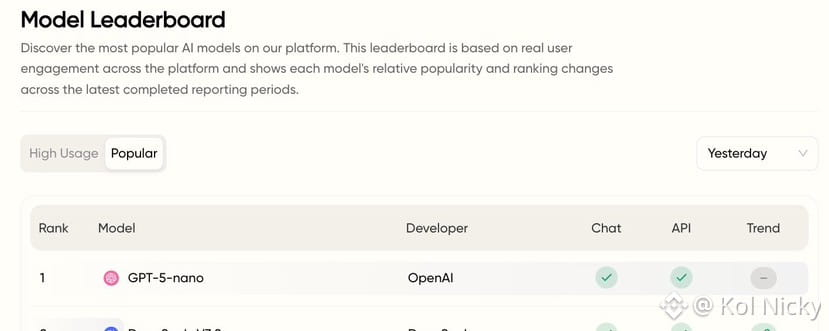
that is why the AINFT leaderboard is more useful than people realize.
it exposes something most users never see:
real usage behavior under actual workloads.
and the rankings already reveal an important shift.
models like:
• GPT-5-nano
• DeepSeek-V3.2
• DeepSeek-V4-Flash
• DeepSeek-V4-Pro
are climbing because users optimize differently depending on the task.
some prioritize:
• reasoning depth
• context handling
• reliability
others prioritize:
• speed
• concurrency
• low-cost execution
• high-frequency throughput
there is no universal “best model” anymore.
the real advantage comes from understanding:
which model fits which workflow.
that is why platforms like AINFT matter.
instead of forcing users into one ecosystem, the platform exposes multiple frontier models through a single interface, allowing users to compare real-world adoption patterns directly.
and that changes how people interact with AI infrastructure.
rather than blindly following benchmarks or marketing narratives, users can now observe:
• what developers actually deploy
• which models retain usage
• where momentum is forming
• how workload preferences evolve over time
that creates a more transparent AI environment.
because in practice, the most powerful model is often not the one with the biggest benchmark score.
it is the one that consistently performs well under your specific operational conditions.
the leaderboard essentially turns collective platform activity into market intelligence.
and over time, that data becomes extremely valuable for:
• workflow optimization
• cost efficiency
• routing decisions
• agent architecture
• scalable AI deployment
the future of AI usage may look less like:
“pick one model forever”
and more like:
“dynamically route intelligence depending on the task.”