
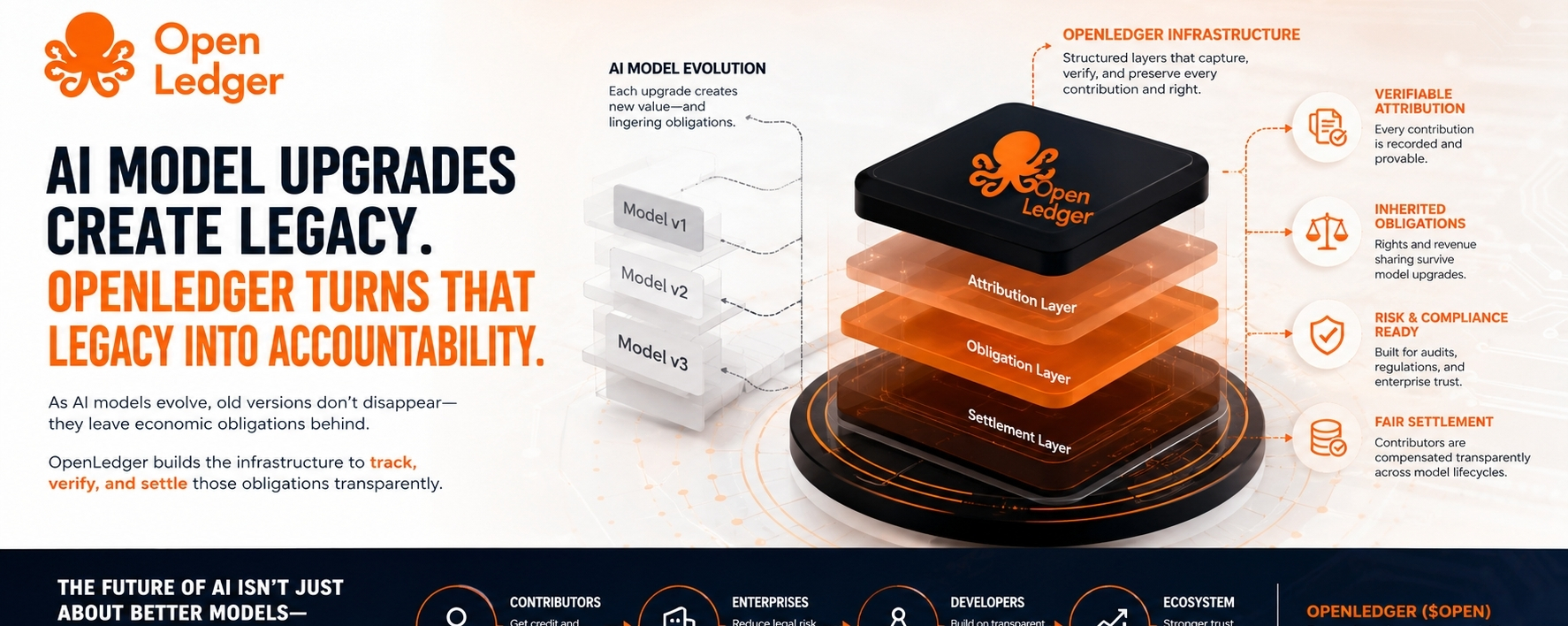

I think the market is still using the wrong mental model for AI infrastructure.
Most discussions reduce the stack to compute, inference demand, model performance, or data ownership. Faster chips, bigger context windows, cheaper queries. That framing makes sense if AI behaves like software with clean version replacement. Build version one, improve it, deprecate the old model, move forward. But real commercial systems rarely work that neatly. Legacy systems do not disappear just because something technically better exists. They leave obligations behind.
That is where OpenLedger started looking more interesting to me.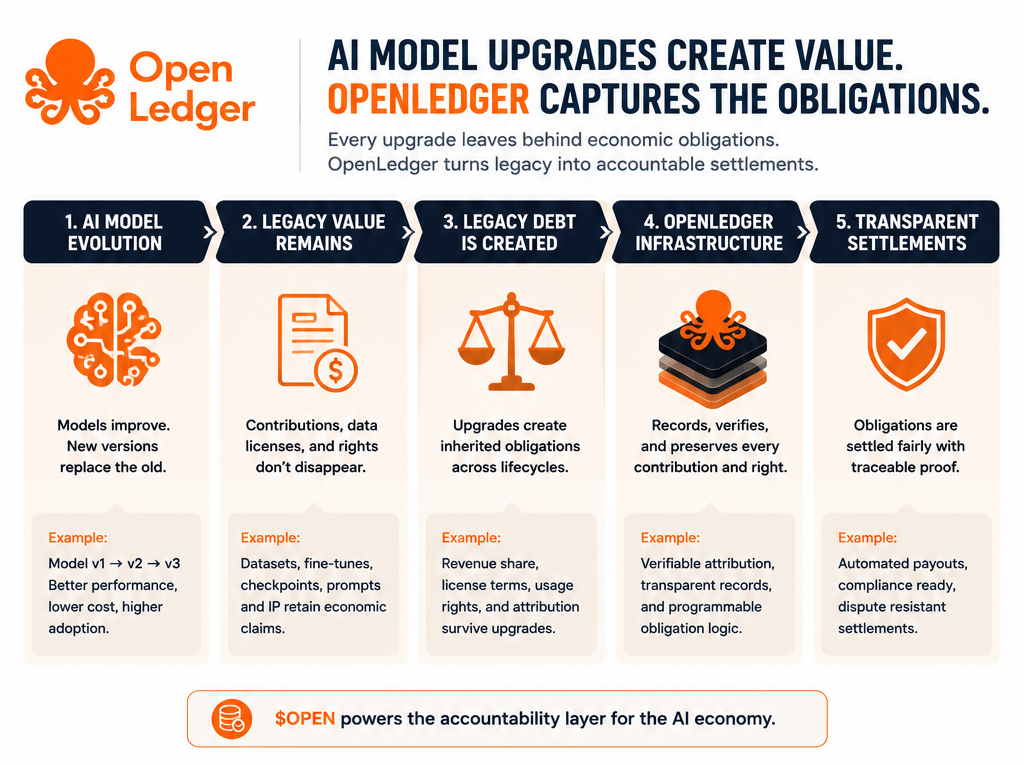
The hidden issue in AI may not be training cost. It may be inherited economic liability.
Imagine an enterprise AI model trained using multiple licensed datasets, proprietary partner contributions, specialized model checkpoints, external fine tuning, and third-party retrieval infrastructure. A newer version gets deployed six months later because performance improves. The surface assumption is simple: the old stack is obsolete.
But economically, maybe it is not.
Some contributors may still have usage-linked compensation rights. Some licensing agreements may survive model retirement if derivative outputs still depend on earlier training lineage. Certain jurisdictions increasingly care about provenance, which in plain language means proving where information came from and whether it was legally usable. Internal compliance teams care even more. A model upgrade does not automatically erase inherited permission structures.
That starts to resemble debt.
Not financial debt in the traditional balance-sheet sense. More like embedded obligation chains attached to AI memory.
The analogy matters because markets price systems differently when obligations persist after utility changes. Old bonds can remain economically relevant long after the original transaction. Structured liabilities continue existing after the asset that created them changes hands. Software vendors know this too. Enterprises still pay maintenance contracts for systems nobody likes because replacement does not remove operational dependency.
AI may be heading toward something similar.
OpenLedger becomes interesting if it is not simply monetizing AI creation, but organizing AI obligation settlement.
Its visible narrative is easier to understand. Data attribution. Contributor rewards. AI collaboration infrastructure. Specialized data networks. Those are intuitive. But infrastructure value often hides one layer deeper than the public story.
The harder question is this: what happens when AI systems inherit economic claims across versions?
If an AI product continuously absorbs contributed intelligence, licensed datasets, model improvements, and agent interactions, somebody eventually needs an auditable record of who contributed what, under which terms, and whether those permissions remain valid. That is not just transparency theater. It becomes commercially necessary once money, enterprise distribution, or regulated workflows get involved.
OpenLedger’s relevance would come from turning that messy attribution history into machine-readable infrastructure.
A machine-readable ledger simply means rights, contribution records, and settlement conditions structured in a way software can verify rather than humans manually debating in spreadsheets and legal inboxes.
That matters because manual reconciliation does not scale.
Picture a healthcare assistant model updated quarterly. Version three contains architectural improvements from internal teams, retraining from licensed medical datasets, synthetic augmentation, and external specialist model inputs. A hospital deploying that system does not just care whether outputs are accurate. Procurement teams may eventually ask whether deployment creates unresolved licensing exposure. Regulators may ask about explainability. Legal teams may care whether historical training rights survived architectural modification.
Now multiply that by autonomous agents interacting with other models.
The accounting gets ugly quickly.
If OpenLedger can create standardized attribution rails where contribution history remains verifiable across upgrades, $OPEN starts looking less like a speculative AI utility token and more like settlement infrastructure for inherited AI obligations.
That is a stronger thesis than generic usage demand.
Usage narratives are fragile because inference gets cheaper over time. Competition compresses margins. Open-source models reduce monetization leverage. Pure compute stories often race toward commoditization.
Obligation infrastructure behaves differently.
Financial infrastructure survives because coordination costs remain expensive. Clearing systems matter because trust, verification, and settlement are operational bottlenecks. AI may develop similar bottlenecks if provenance becomes economically binding rather than optional metadata.
There is also a practical adoption path here.
Startups may not care initially. Most early AI builders move fast and tolerate ambiguity. Enterprises behave differently. Insurance providers, financial institutions, healthcare operators, and infrastructure vendors prefer systems with auditable accountability. Not because they love compliance. Because uncertainty becomes expensive.
That creates a real buyer class.
The token question is harder.
A good infrastructure thesis does not automatically produce token demand.
$OPEN only matters structurally if settlement, staking, verification, or access coordination genuinely require the token. If attribution records can be mirrored off-chain, if enterprise actors prefer private contractual settlement, or if legal agreements bypass network economics entirely, token capture weakens fast.
Privacy adds another friction.
Enterprises rarely want full public disclosure of commercially sensitive training relationships. Privacy-preserving verification becomes essential. That means proving rights or attribution validity without exposing underlying proprietary data. Zero-knowledge architectures could help here, though implementation complexity rises quickly.
Then there is jurisdictional fragmentation.
AI governance is not globally consistent. European compliance expectations differ from US enforcement behavior, which differs again from emerging-market commercial norms. Infrastructure designed around universal attribution assumptions may discover that legal obligations are annoyingly local.
And maybe the biggest risk is behavioral.
Markets assume technical possibility becomes economic necessity. That leap often fails.
Yes, inherited AI obligation chains are plausible. Yes, attribution infrastructure makes conceptual sense. But do builders actually feel enough pressure to pay for formal settlement rails before a major legal or commercial failure forces the issue?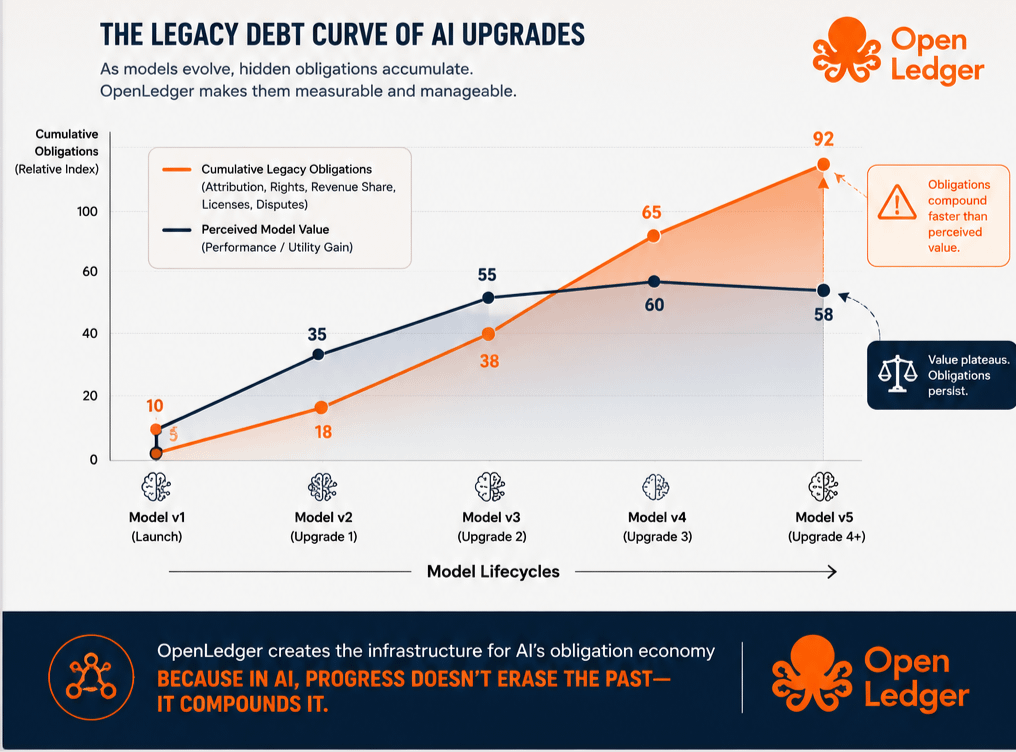
That timing question matters.
Infrastructure is often early right and commercially early wrong.
Still, I keep coming back to the same thought. AI upgrades are usually framed as progress stories. Better models replacing weaker ones. Cleaner performance curves. Forward motion.
But complex systems rarely leave clean exits.
Sometimes what survives is not the model.
It is the obligation history attached to what the model remembers.
If that becomes true at scale, OpenLedger may not be building AI collaboration infrastructure at all.
It may be building the debt market nobody realized AI was creating.