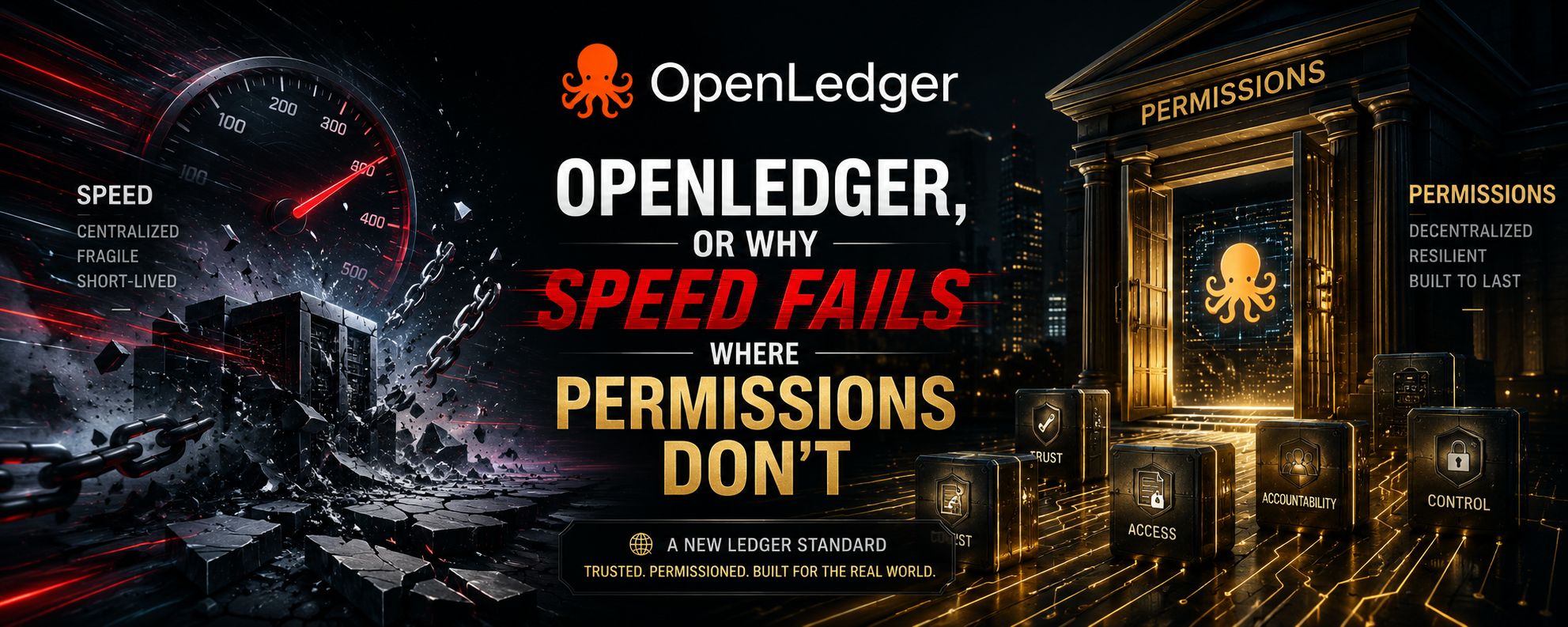

I don’t think most systems fail where people expect them to. The narrative usually starts with performance ceilings, congestion charts, and throughput debates as if collapse arrives gradually through slowness. In practice, it rarely does. When I trace incident timelines backwards through audit logs, escalation threads, and post-mortem notes the failure point is almost always quieter. A permission that was broader than intended. A signing path that stayed active longer than anyone remembered. A wallet approval granted once and never revisited. The system does not degrade politely. Trust doesn’t degrade politely it snaps.
OpenLedger, viewed through that lens, feels less like a speed story and more like an architecture of restraint wrapped inside performance. It is an SVM-based high-performance Layer 1, but the important detail is not the execution layer itself. It is what sits above it: guardrails that assume users, agents, and integrations will eventually drift beyond their original intent. That assumption changes everything about how safety is enforced.
I’ve sat through enough 2 a.m. alerts to recognize the pattern. The room is always the same quiet, over-lit, half a dozen risk dashboards flickering with state changes nobody planned for. The discussion rarely centers on latency. It centers on exposure. Which key signed what. Which session expanded scope. Which approval chain was too permissive under stress. The real debate is never “was it fast enough,” but “why was it allowed at all.”
This is where OpenLedger Sessions become more than a feature. They behave like enforced, time-bound, scope-bound delegation layers. Instead of permanent trust, they create bounded trust contextual permission that expires, narrows, and forces re-validation. In environments where agents act on behalf of users or systems interact autonomously, that boundary is not cosmetic. It is structural.
“Scoped delegation + fewer signatures is the next wave of on-chain UX.”
Underneath that is a more conservative settlement philosophy. Execution can be modular, flexible, and fast, but finality is not treated as something to optimize aggressively at the expense of clarity. The system allows high-performance computation at the edge while keeping settlement disciplined at the base layer. EVM compatibility exists, but not as ideology—more as friction reduction, a way to make integration less expensive without making assumptions about trust inheritability.
I think this is where most TPS-centric narratives become misleading. Throughput is visible; permissions are not. Throughput gets benchmarked; exposure accumulates silently. A system can scale transaction capacity and still fail at the level that actually matters: who was allowed to act, under what scope, and for how long. The industry tends to optimize the easiest dimension to measure.
Bridge design is where that illusion becomes expensive. Cross-domain liquidity systems always inherit a delayed risk profile. They work until they don’t, and when they fail, the failure is rarely local. It propagates. This is why staking in OpenLedger is not just economic participation but security fuel an operational alignment mechanism that binds responsibility to system behavior rather than abstract ownership. It does not eliminate risk, but it forces it to be priced and acknowledged continuously rather than assumed away.
I’ve learned to treat bridges and external dependencies as delayed liability surfaces. They are not fragile in obvious ways; they are fragile in forgotten ways. Systems accumulate trust faster than they audit it. At some point, exposure becomes structural rather than accidental.
There is a moment in every post-mortem where language becomes unusually precise. People stop saying “bug” and start saying “scope mismatch.” That is usually the real diagnosis. OpenLedger Sessions, in that sense, feel like an attempt to move that diagnosis upstream into the design phase rather than the investigation phase. A controlled reduction of ambiguity before it becomes incident material.
The infrastructure argument here is not that everything should be slower. It is that everything should be accountable at the moment it is authorized. High performance execution is still essential, especially for agent-driven workloads and liquidity-intensive environments. But speed without containment is just accelerated uncertainty.
When I look at systems like this, I stop thinking in terms of peak capacity and start thinking in terms of failure containment radius. What happens when something goes wrong is more important than how fast it goes right. A system that can throttle itself, constrain delegation, and revoke authority without human latency is not anti-speed. It is anti-catastrophe.
OpenLedger ultimately sits in that tension. Fast execution above a conservative settlement layer. Delegated sessions that expire by design. Permissioning that assumes drift. A ledger optimized not just for throughput, but for reversibility of trust boundaries.
And in that framing, the most important feature is not how quickly it processes activity. It is whether it can say no when something no longer fits its intended scope.