

Most people still think crypto is only about coins.
But lately, it feels like the real battle is happening somewhere else entirely around data, intelligence, and ownership.
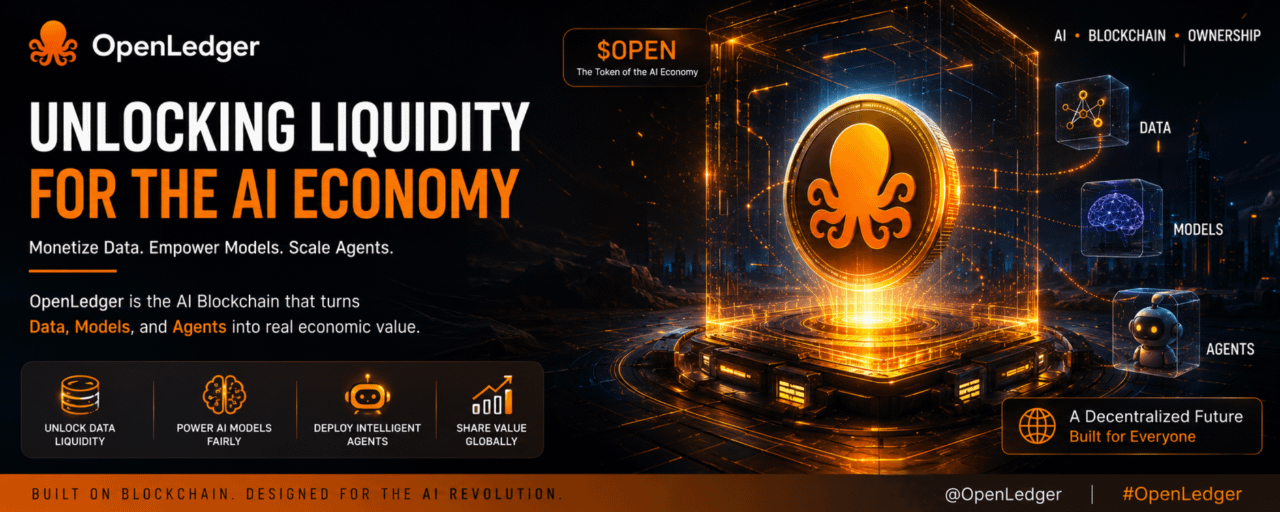
That’s why projects like $OPEN caught my attention.
Not because of hype. Not because of price action.
Because the idea behind it quietly touches one of the biggest shifts happening in tech right now.
Every day, people generate massive amounts of valuable data without realizing it. AI models learn from conversations, behaviors, images, decisions, and patterns created by ordinary users. Yet most of that value flows toward centralized companies while the people contributing the data receive almost nothing in return.
That imbalance is starting to feel impossible to ignore.
@OpenLedger seems to be building around a simple but powerful question:
What happens when data, AI models, and intelligent agents become assets people can actually own and monetize?
That changes the conversation completely.
For years, crypto focused heavily on financial ownership. Bitcoin challenged money. Ethereum expanded programmable assets. DeFi experimented with open financial systems.
But AI introduces a different layer entirely.
Now the scarce resource is not only capital.
It’s intelligence.
And intelligence depends on data liquidity.
That’s where the concept behind #OpenLedger becomes interesting. Instead of treating data as something trapped inside corporations, the project explores the idea of creating an ecosystem where datasets, AI models, and agents can move, interact, and generate value more openly.
In many ways, this feels like the next logical evolution of digital ownership.
A few months ago, I noticed something strange in crypto discussions. People were no longer only asking which token might pump next. More conversations started revolving around AI infrastructure, decentralized compute, agent economies, and data monetization.
At first, I thought it was just another narrative cycle.
Crypto moves fast. Narratives appear every few weeks.
But this one feels different because AI is already changing real-world behavior outside crypto. Developers are building AI agents. Businesses are automating workflows. Individuals are using models daily without even thinking about it anymore.
The adoption is already happening.
Crypto is now trying to figure out where decentralization fits into that future.
And honestly, that’s the difficult part.
Because AI today is becoming increasingly centralized. The largest models require enormous amounts of data, compute power, and infrastructure. Smaller creators contribute value but rarely share in the upside.
That creates tension.
The internet was originally supposed to distribute opportunity more equally, yet over time value concentrated around a handful of dominant platforms.
Many people inside crypto worry AI could repeat the same pattern.
Projects like $OPEN are interesting because they attempt to challenge that direction early.
The idea of unlocking liquidity around data and models may sound technical at first, but the human side of it is actually very simple:
People want ownership over the value they help create.
That’s a powerful psychological shift.
And markets often move toward systems that align incentives better.
One thing I appreciate about @OpenLedger is that the narrative connects multiple sectors together instead of isolating itself inside pure speculation. AI, blockchain, data economies, and autonomous agents are no longer separate conversations anymore. They’re slowly merging into one larger ecosystem.
That convergence matters.
Because the next generation of crypto winners may not just be “better blockchains.” They may become coordination layers for entirely new digital economies.
We’re already seeing early signs of that transition.
AI agents interacting with protocols. Models generating autonomous activity. Data becoming programmable. Machine-to-machine economies forming quietly in the background.
It sounds futuristic until you realize pieces of it already exist today.
The market usually underestimates slow transitions because they don’t feel dramatic in real time.
Then suddenly everyone notices at once.
I also think there’s an emotional layer behind the rise of AI-related crypto projects.
A lot of people feel conflicted about AI.
Excited about the possibilities. Concerned about control. Curious about opportunity. Uneasy about concentration.
Decentralized AI narratives tap directly into those emotions because they offer an alternative vision one where participation matters more than permission.
Whether every project succeeds is another question entirely.
Most won’t.
That’s the reality of emerging technology cycles.
But sometimes the important part isn’t predicting the exact winner immediately. It’s recognizing where attention, infrastructure, and long-term demand may eventually flow.
And right now, data ownership feels increasingly important.
Especially as AI systems become more integrated into everyday life.
One thing crypto repeatedly teaches us is that markets eventually assign value to overlooked digital resources.
First it was computation. Then liquidity. Then attention.
Now it may be intelligence itself.
That’s why I think people are paying closer attention to ecosystems like #OpenLedger.
Not only because of short-term momentum, but because the broader idea resonates with where technology seems to be heading.
If AI becomes one of the defining forces of the next decade, then the systems controlling data and intelligence may become just as important as the models themselves.
And decentralization could play a much bigger role there than most people currently expect.
The biggest takeaway for me is this:
The future of crypto may belong less to platforms that simply store value and more to networks that help create, distribute, and coordinate intelligence itself.
That possibility alone makes this space worth watching carefully.
Curious how others see it do you think decentralized AI ecosystems like $OPEN can genuinely compete with centralized AI giants over time, or will they mainly complement them?