
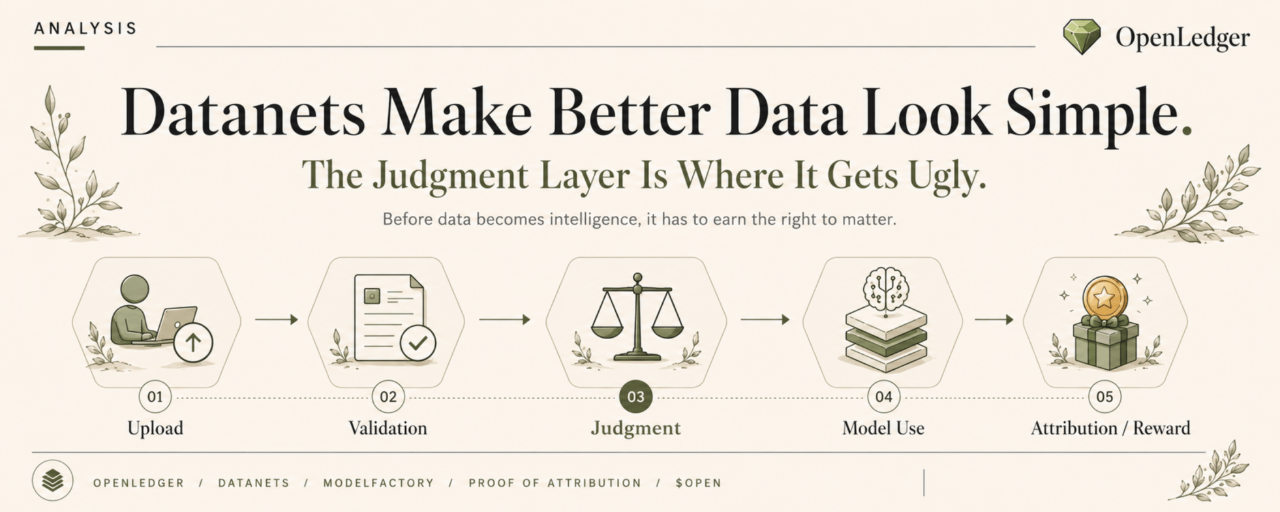
i keep getting stuck on inference inside OpenLedger (@OpenLedger ) and it’s not even a clean thought anymore, it just keeps coming back in small pieces like something i missed the first time, like the system is doing a lot but nothing is actually entering a path where attribution gets calculated yet.
because everything before it looks… done in a way that feels convincing at first.
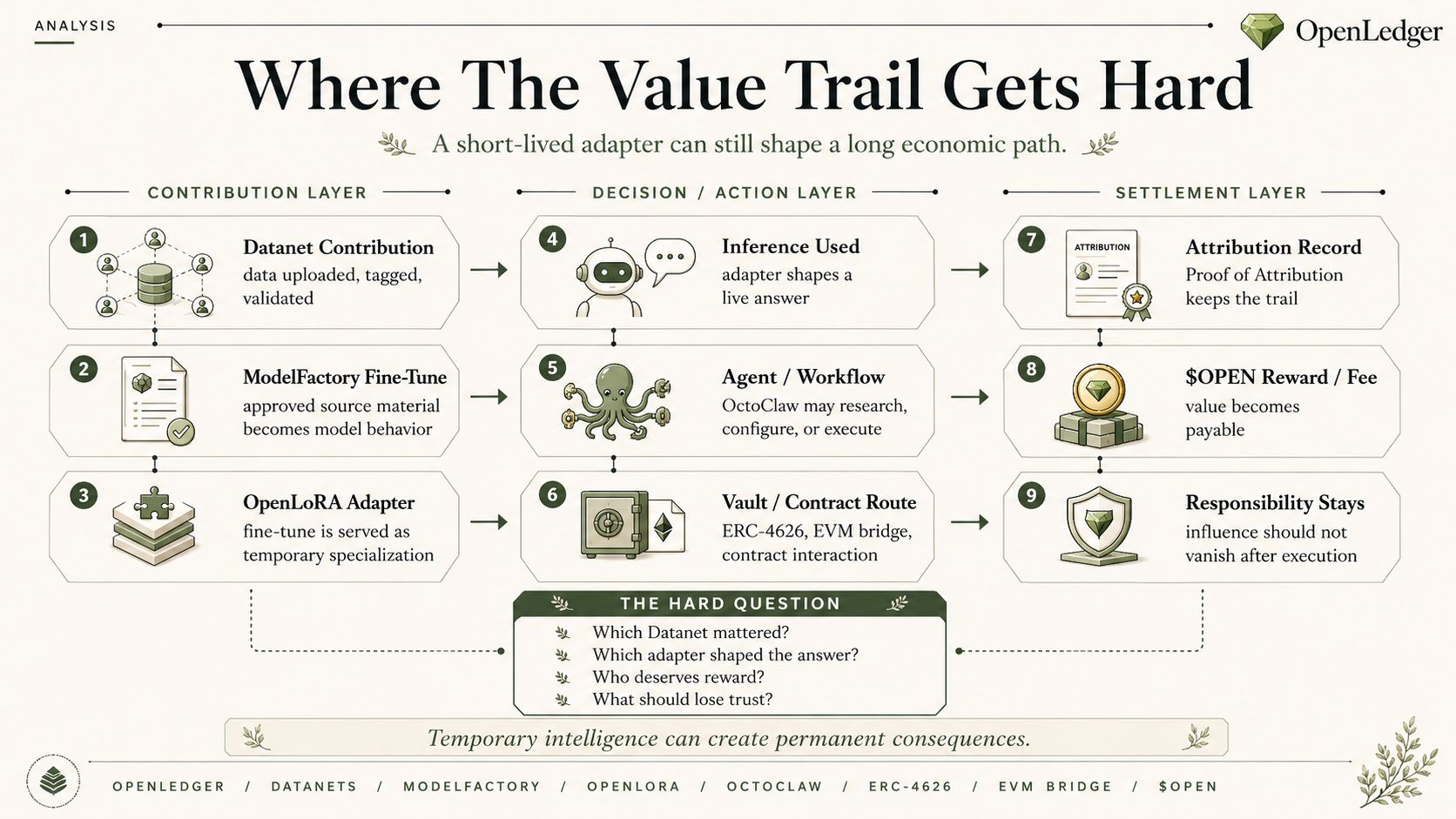
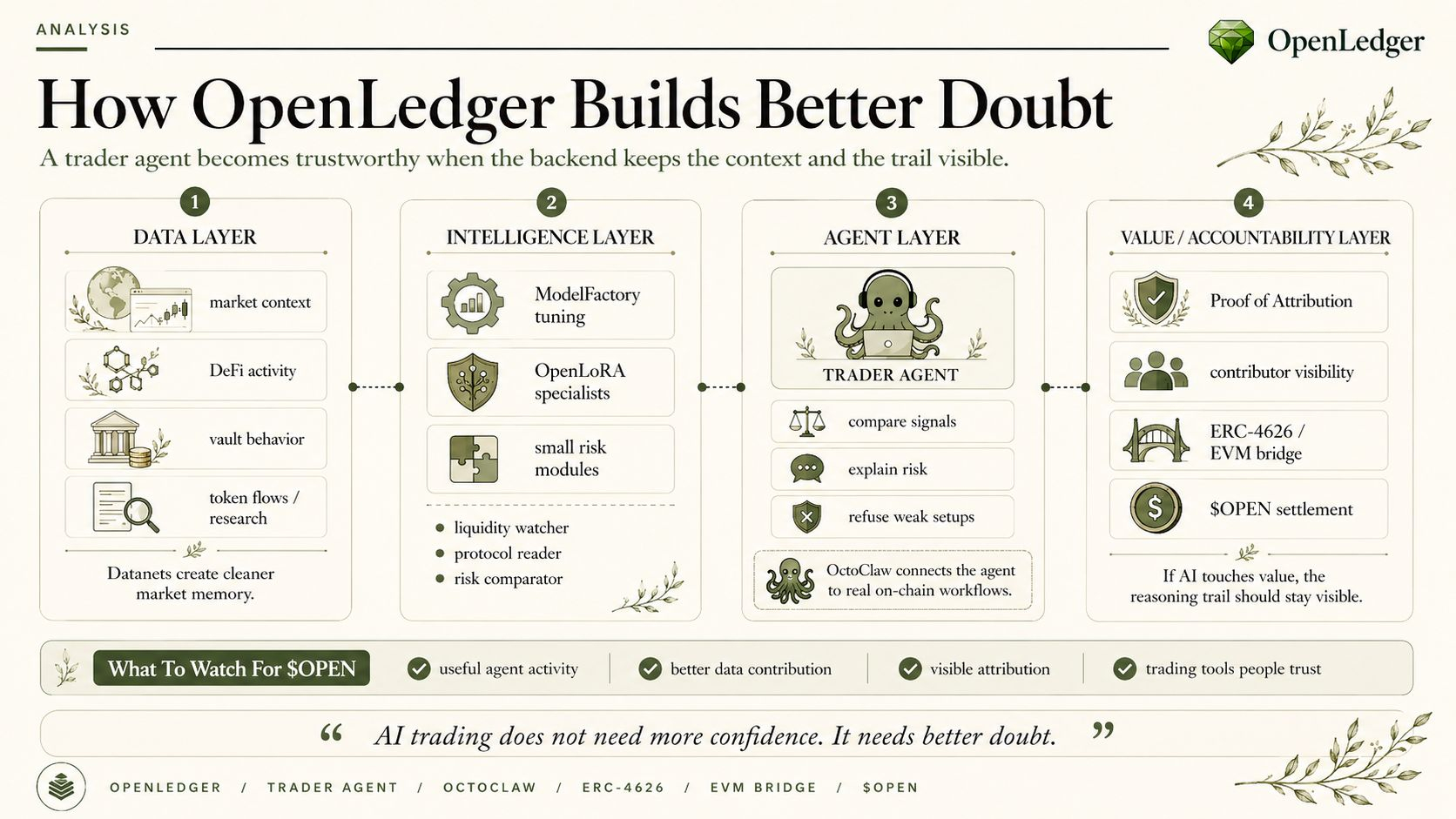
there’s Datanets sitting there, data cleaned, structured, someone probably spent hours making sure it’s “good data”, tagged it properly, pushed it on-chain like that was the moment it became valuable, like contribution itself already completed something instead of just preparing it for a path where it might actually be used and later traced.
but is that moment even real… or just recorded?
on OpenLedger, ModelFactory comes in, models getting built, fine-tuned, deployed, everything traceable in structure, everything looking real enough from the outside, like if you just glanced at it you would assume the system is already working and already producing something meaningful, even though nothing has actually entered a path where attribution is calculated or reward distribution even begins.
so what exactly exists at that point… a model, or just a candidate?
OpenLoRA sitting there too, adapters ready, like specialization is already solved, like the model can become anything it needs to be at any time, like intelligence is already assembled and waiting instead of something that only exists when forced into a task that produces an execution trace.
and inside OpenLedger, OctoClaw, agents, workflows, execution paths, automation layers… everything lined up like the system already knows what it’s doing, like it’s just waiting for volume to come in so it can start moving value across participants.
from a distance it really does feel like something exists.
but the longer i sit with OpenLedger the more it feels like nothing has actually happened yet, because nothing has been forced into a path where it becomes accountable, nothing has been selected under pressure, nothing has been reduced down to one sequence that produces an execution trace and triggers attribution.
and that’s where it starts feeling off.
because the OpenLedger system only becomes real at one point, and it’s smaller than everything else around it.
when a query hits and the OpenLedger system can’t stay neutral anymore, when it has to decide what to call, what to ignore, what to route, and that decision instantly compresses everything that looked large into a single attribution path that determines where value flows and who becomes part of that path.
one model gets selected, not ten.
one adapter loads, not thousands.
one slice of data influence actually survives into the output.
and everything else just stays where it was, untouched, unchanged, still technically existing but never entering a path where attribution is calculated, never appearing inside any execution trace, never reaching the point where rewards are distributed.
so what happens to everything that wasn’t selected… does it still matter?
or does it just exist without consequence.
“existence without selection is invisible here”
and the important part is not just that selection happens, it’s that value only starts moving after that selection, because Proof of Attribution doesn’t care about what exists, it only tracks what actually made it into that path and contributed to the output that triggered payment.
so all that data in Datanets is not valuable yet, all those models are not valuable yet, all those adapters are not valuable yet, they’re just positioned near a moment that might never include them, and if they never enter that path then no attribution is assigned to them, no execution trace includes them, and no OpenLedger ($OPEN ) ever routes in their direction.
and most of them won’t be included.
why does that feel harsher than it should.
maybe because we’re used to systems pretending everything counts.
that part keeps bothering me more than anything else, because it means OpenLedger is not rewarding contribution in the way people instinctively expect, it’s rewarding usage under inference where attribution can be proven and traced, and those are completely different things once you follow them to the end.
you can contribute something perfectly valid, perfectly structured, technically correct, something that should matter in theory, and still never get paid because nothing ever needed it, because no inference path ever passed through it, which means no attribution trail includes it, which means it never becomes part of any reward distribution.
so then what are you actually doing when you contribute… building value, or waiting for relevance?
and there’s no way to smooth that over, the system doesn’t convert presence into value just to keep things balanced, it waits until something actually depends on you inside a path where attribution is computed and value is split.
that waiting feels honest in a slightly uncomfortable way, like the OpenLedger system is quietly asking something most systems avoid asking.
prove that you matter, but prove it through usage that leaves a trace, not through existence that never gets referenced.
i keep thinking about someone uploading a dataset into a Datanet, doing everything right, cleaning it, formatting it, attaching metadata, pushing it into the network, maybe even feeling like they contributed to something meaningful, and then time passes and nothing ever calls it, no model pulls from it, no inference path touches it, no adapter reflects it.
so what did they actually contribute in that case.
something that never entered a path where attribution gets calculated, which means something that never enters the OpenLedger system’s economic layer at all, something that never becomes visible in any reward flow.
and OpenLedger doesn’t convert that into partial credit, it leaves it there as unrealized potential, which makes Datanets feel less like storage and more like a waiting layer where datasets sit until they’re needed, and most of them won’t be pulled into the flows that actually trigger attribution, execution traces, and payment.
same pattern keeps showing up when i think about ModelFactory, because it sounds like the place where things are created, like building is the main act, but it isn’t.
you can build multiple models, deploy them cleanly, everything fully attributed in structure, everything ready for inference, and then a single query hits and only one of them actually gets used, not necessarily the most complex one, just the one that fits the moment well enough to be selected into the attribution path that determines reward flow.
the rest stay untouched, and that makes the OpenLedger system feel less like a place where intelligence is created and more like a place where intelligence is filtered into the few paths that actually produce measurable influence and enter economic circulation.
so is intelligence even the thing being measured here.
or just the ability to be selected when it matters.
and OpenLoRA makes that even harder to pin down, because now the model itself isn’t stable, it doesn’t exist as one fixed thing anymore, it becomes specific only when needed, adapter loads, behavior shifts, an answer comes out, and then that specialization disappears again, like it only existed long enough to produce something that can be traced, reconstructed, and priced.
“the model only exists when it’s being used”
so what actually answered the query in that case, the base model, the adapter, the data behind it, or the temporary combination that only existed during that inference window that later gets reconstructed by Proof of Attribution.
and Proof of Attribution steps in after that, not to guess, but to reconstruct the exact path that produced the output so value can be split across it, which only works because that path actually happened and left something that can be measured and verified.
without that moment, there is no trail, no attribution, no reward distribution, nothing that enters the system’s economic layer where OpenLedger moves across contributors.
and then agents follow the same rule, even though they look like the most active part of the system.
OctoClaw can configure workflows, routes can exist, strategies can be ready, but until something triggers them it’s just setup, nothing is settled, nothing is priced, nothing is attributed, nothing enters a path where value actually flows or gets assigned.
so what is an agent before execution… just intention?
the OpenLedger system only becomes real when an agent is forced into a path where it has to pull data, choose a model, run inference, maybe execute something on-chain, maybe even interact with capital, and once that happens then a trail exists, then attribution becomes necessary, then OpenLedger actually moves across contributors tied to that execution.
before that, everything is just positioned around a moment that hasn’t happened yet.
and the more i think about it the more it starts to feel less like a technical system and more like a strict attribution gate, where most of what exists never crosses into the layer where value is calculated, and only a small part of it ever becomes economically real because only a small part enters paths where attribution is triggered and recorded.
the difference here is that OpenLedger doesn’t hide that gate, it makes it visible through attribution and payment, so once a decision is made the system records not just what happened, but who gets paid for it and who doesn’t based on that specific path.
and that’s where the tension really comes from, because now selection is not just technical, it’s financial, it decides who receives value and who stays outside the flow even if they contributed something that looked important before but never entered an attribution path.
so i keep coming back to the same uncomfortable question that doesn’t really resolve.
how much of OpenLedger will never enter a path where Proof of Attribution even has something to calculate, meaning how much of it never becomes economically visible at all.
and is that wasted effort… or just unselected potential.
not because it’s broken or wrong, but simply because it wasn’t needed in the moments where inference actually forced the system to choose and assign value.
and whether that’s a flaw or just the reality of any system that ties value strictly to usage that can be traced and priced.
because in traditional AI none of this is visible, everything collapses into the answer, you don’t see what was ignored, you don’t see what never got selected, you don’t see how much of the system stayed outside the path that produced the output.
so it creates the illusion that everything inside OpenLedger matters equally.
but here that illusion doesn’t hold, every inference produces a specific attribution path, every answer is a decision that determines how value is split and routed, while everything outside that path stays silent without being acknowledged or rewarded.
and maybe that’s the shift that’s easy to miss.
you’re not adding something to a OpenLedger system and automatically getting value.
you’re positioning something and waiting to see if it ever enters a path where attribution happens and value gets distributed.
and you might never get that moment.
so yeah, i keep circling back to the same feeling.
everything before inference looks complete, but it isn’t proven, it’s just waiting for a moment where the system is forced to choose, and when that moment comes everything compresses into one path where attribution is calculated, OpenLedger moves, and value actually flows, while everything else remains outside that trail like it was never needed.
“nothing here matters until it’s chosen”
and that part doesn’t feel like a feature.
it feels like the rule everything else is built around.