
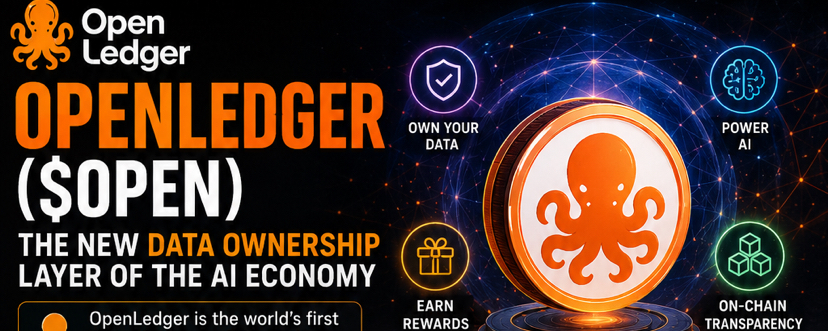
For the past few days, I’ve been thinking deeply about one thing: @OpenLedger is not just another AI project like ChatGPT or Midjourney. It is building what could become the world’s first AI-Native Layer 2 blockchain infrastructure.
In simple terms, OpenLedger is creating a decentralized backend network that powers AI with transparent, community-owned data and on-chain attribution. Today, I want to explain why I believe this project deserves serious attention based on its technology, roadmap, and token utility.
⚡ Key Innovations of OpenLedger
Traditional AI companies such as OpenAI or Google operate in a centralized manner. Users contribute data every day, yet receive no ownership or rewards from the AI systems trained on their information.
OpenLedger changes this model through three major pillars:
1️⃣ Proof of Attribution (PoA) + Payable AI
This is one of OpenLedger’s biggest innovations.
Every dataset submitted to the network is tracked on-chain through cryptographic attribution. If an AI model uses your data during training or inference, the real contributor automatically receives rewards in $OPEN tokens.
OpenLedger calls this concept “Payable AI” — where data contributors are no longer invisible participants, but active stakeholders in the AI economy.
2️⃣ Datanets (Community-Owned Data Banks)
Datanets are specialized data ecosystems focused on areas such as:
• Legal documents
• Medical datasets
• DeFi exploit analysis
• Financial intelligence
Anyone can contribute high-quality data, while blockchain verification ensures transparency and authenticity. This becomes extremely valuable for enterprise and institutional AI adoption.
3️⃣ ModelFactory + OpenLoRA
🔹 ModelFactory:
A no-code interface that allows developers to fine-tune major AI models like LLaMA, DeepSeek, or Mistral using Datanet data without complex engineering.
🔹 OpenLoRA:
A scalable infrastructure layer that enables thousands of fine-tuned models to run efficiently on shared GPU resources, dramatically reducing computational costs.
🚀 Why OPEN Could Become a Major AI Narrative
1️⃣ 9-Layer Full-Stack AI Roadmap
According to the official roadmap, OpenLedger is building a complete 9-layer AI stack by 2026 designed to transform AI into a transparent, accountable, and fully on-chain economic system.
This includes:
• Autonomous AI agents
• Agent-to-agent payments
• Revenue sharing
• Decentralized AI marketplaces
• Permissionless AI economies
In the future, AI agents may be able to independently earn, pay, and distribute revenue without human intervention.
2️⃣ Strong Utility for the OPEN Token
The value of a blockchain token ultimately depends on utility and ecosystem demand.
$OPEN has multiple utility sinks:
• Gas fees for Layer 2 transactions
• Data quality staking for contributors
• AI marketplace payments
• Access to AI models and agents
• Incentive rewards across the ecosystem
This creates continuous demand pressure as ecosystem usage grows.
3️⃣ Strong Tokenomics + Long-Term Alignment
• Total supply capped at 1B tokens
• 61.71% allocated to community and ecosystem rewards
• Mainnet already live
• Node operators and stakers already earning rewards
• Team/investor allocations use linear vesting mechanisms
• Backed by major firms including Polychain Capital
These factors reduce short-term sell pressure while supporting long-term ecosystem growth.
📌 Final Thoughts
In my opinion, OpenLedger is trying to become the decentralized “HuggingFace” of the AI world — but with ownership, attribution, and on-chain monetization built directly into the protocol.
If the future of AI becomes decentralized, transparent, and economically shared, then projects like OpenLedger may sit at the center of that transformation.
The combination of AI + DeFi + Data Ownership could become one of the strongest narratives of the next market cycle.
What do you think about the future of Payable AI and decentralized data economies? 👇