
It usually arrives around 2 a.m., right after the alerts stop sounding urgent and start sounding repetitive. The dashboards still look healthy. Validators are online. Blocks are finalizing fast enough to satisfy everyone obsessed with throughput charts. Somewhere in another tab, somebody is still arguing about TPS like it’s a religion.
And yet the room feels wrong.
I’ve sat through enough audit calls and risk reviews to know the pattern. Nobody starts by asking whether the chain was fast enough. They ask who approved the wallet access. Why the delegation never expired. Why an automation key still had authority three months later. Why nobody questioned a permission scope because the interface looked clean enough to trust.
That’s the part people avoid admitting publicly.
Most failures in crypto don’t happen because blocks were slow.
They happen because authority stayed alive longer than it should have.
A compromised signer on a high-performance chain is still a compromised signer. Faster execution only accelerates damage when permissions are careless underneath. I think the industry spent so long trying to remove friction that it accidentally normalized permanent exposure.
That’s why OpenLedger caught my attention.
Not because it markets itself as another fast chain. Everyone does that now. Performance metrics became theater years ago. Every infrastructure deck promises speed. Every founder talks about scalability like latency alone can solve operational risk.
I don’t think it can.
What interests me about OpenLedger is that it feels built by people who understand where systems actually break.
Underneath the architecture is an SVM-based high-performance Layer 1 designed for AI-native execution — data, models, and agents interacting continuously instead of occasionally. That matters more than most people realize. Humans pause before clicking things. AI agents don’t. They retry endlessly, inherit permissions automatically, and execute tasks with absolute confidence even when the access they’re using should have expired hours ago.
I think older blockchain systems quietly depended on human hesitation as a security layer.
That assumption doesn’t survive the AI era.
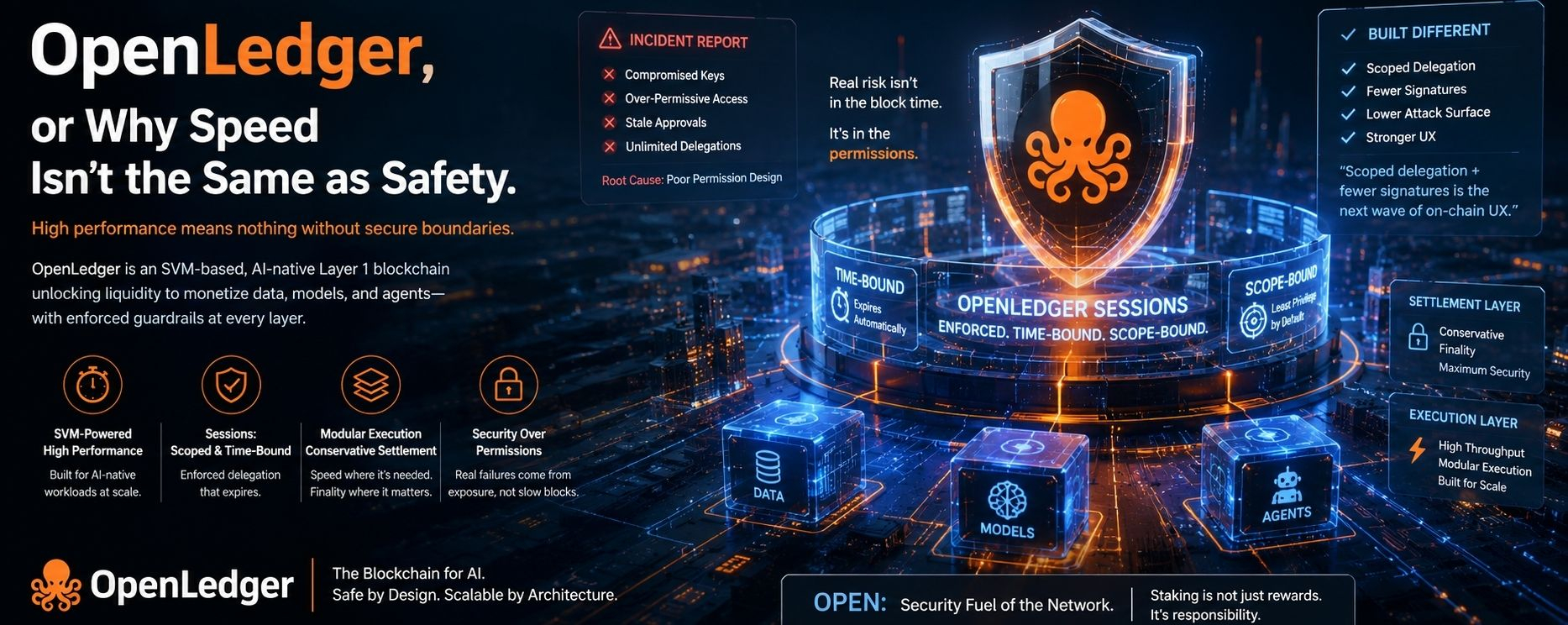
OpenLedger seems to understand that. Instead of treating delegation as an unlimited trust agreement wrapped inside a wallet popup, it introduces something stricter through OpenLedger Sessions: enforced, time-bound and scope-bound delegation.
Permissions that decay.
Authority with boundaries.
Access that expires before it becomes invisible technical debt.
Honestly, that changes the emotional feeling of using a network. Because I don’t think most users are truly afraid of signing transactions anymore. I think they’re afraid of not knowing what still has access afterward.
That fear is justified.
I’ve watched wallet approval debates stretch longer than architecture meetings. Entire compliance teams arguing over whether convenience quietly became systemic exposure. Engineers trying to balance usability against survivability while investors keep asking for higher throughput numbers nobody will remember during an incident review.
The real issue was never signatures alone.
It was unrestricted authority pretending to be UX.
“Scoped delegation + fewer signatures is the next wave of on-chain UX.”
Not because signing is annoying, although it is. Because reducing unnecessary exposure matters more than endlessly optimizing clicks.
That’s the maturity I see in OpenLedger.
The execution layer is modular, sitting above a more conservative settlement foundation instead of forcing every component of the system to optimize for identical goals. I think that separation matters. Some layers should move quickly. Others should be deliberately harder to compromise. Mature infrastructure eventually learns that speed and caution are supposed to coexist, not compete.
A lot of chains still confuse raw performance with resilience.
I don’t.
I’ve read enough internal postmortems to know that catastrophic failures usually sound administrative by the end. Not dramatic. Administrative. Permission drift. Scope confusion. Stale approvals. Delegated authority nobody remembered existed until funds disappeared.
OpenLedger feels designed after accepting those realities instead of marketing around them.
Even the EVM compatibility story feels practical rather than ideological. It reduces tooling friction. Developers keep familiar workflows. Teams migrate without rebuilding everything from scratch. That’s useful, but it’s not presented like some revolutionary event. Just operational efficiency where operational efficiency makes sense.
The more important question is still trust.
Not philosophical trust.
Administrative trust.
Who can execute.
For how long.
Under what constraints.
Whether authority shrinks automatically instead of expanding silently over time.
I think those questions will define whether AI-integrated blockchains survive the next decade.
Because the next generation of failures won’t necessarily come from broken consensus models or network outages. A lot of them will come from overpowered agents, forgotten approvals, inherited permissions, and systems that moved faster than humans could realistically supervise.
That’s why the OPEN token makes more sense to me as security fuel than speculation bait. Staking inside a system like this feels closer to operational responsibility than passive participation. If the network is going to support autonomous execution between users, models, and agents, then economic alignment has to mean something beyond yield farming narratives.
Maybe that’s the philosophical shift happening underneath all this.
I don’t think the future belongs to the chains shouting the loudest about speed anymore.
I think it belongs to the ones mature enough to understand that safety is mostly about limitation.
Not limitation as weakness.
Limitation as discipline.
