
The more I observe the current AI landscape, the more it feels like most discussions only touch the surface.
People debate which model is bigger, which benchmark scores higher, or which “AI token” is getting the most hype. But the more important questions seem far deeper than that.
Who owns the data? Who receives credit for contributions? Who controls the knowledge distribution layer? And most importantly, what kind of incentive system will shape how AI evolves over the next decade?
That’s one reason OpenLedger has been catching my attention lately.
Not simply because of the “AI + crypto” narrative. That phrase has been overused so heavily that it barely carries meaning anymore. What actually made me pause was their focus on a problem the broader AI industry still hasn’t solved properly: attribution.
It may sound technical and unexciting at first, but it could end up being one of the most important layers of the AI economy.
Right now, most major AI systems operate through a strange imbalance. The value is captured at the model layer, while the raw ingredients behind that value—data, user behavior, feedback, labeling, contextual improvements—come from millions of distributed contributors who are rarely acknowledged.
The internet constantly feeds AI systems, yet the internet itself doesn’t truly participate in the ownership of the value being created.
And the issue may become even more complicated over time.
Because once AI starts generating data to train other AI systems, the boundaries between origin, contribution, and ownership become increasingly blurred.
That’s where OpenLedger becomes interesting conceptually.
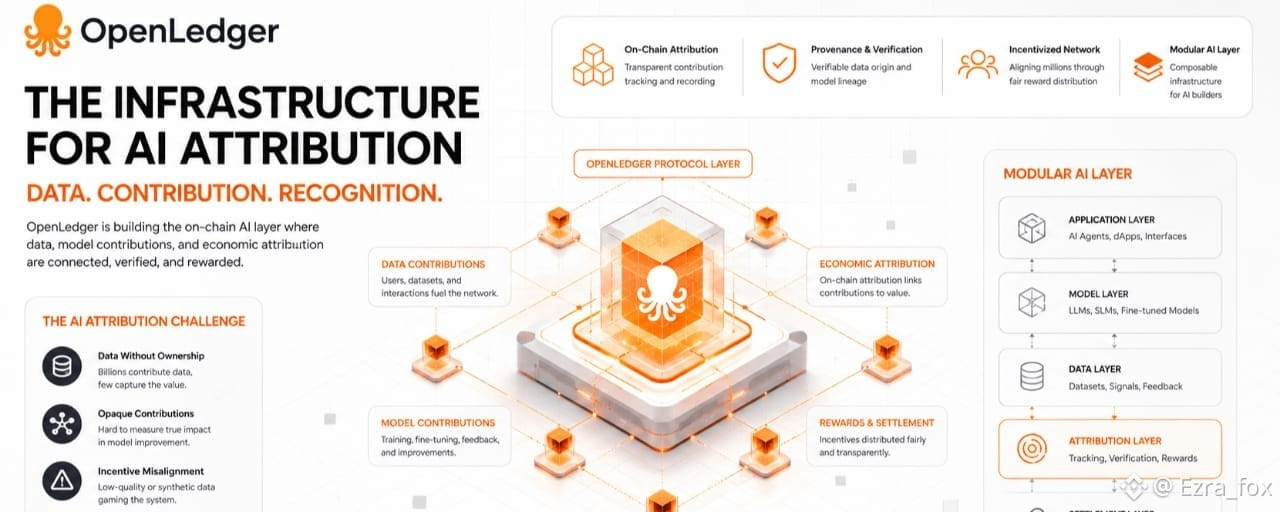
Rather than focusing only on inference layers or AI agents like many other projects, they seem to be exploring infrastructure where data contributions, model participation, and economic attribution are tied together through on-chain mechanisms.
In simple terms, they are attempting to make contributions to AI measurable, traceable, and rewardable.
It’s an ambitious idea.
And also an extremely difficult one.
Because attribution in AI is far more complicated than attribution in DeFi.
In DeFi, value flows are relatively transparent. You can identify where liquidity moves, where fees are generated, and which smart contracts process transactions.
AI contributions are much harder to evaluate.
Did a dataset genuinely improve the model? Did a feedback loop add meaningful intelligence or just more noise? Is a contributor providing useful information, or simply farming rewards with synthetic content?
Blockchain alone probably cannot solve all of that.
But at least OpenLedger appears willing to confront the issue instead of hiding behind marketing narratives.
And that matters more than many people realize.
If AI eventually becomes the foundational infrastructure layer of the internet, then the incentive systems behind it will shape large-scale human behavior. History has already shown that incentives often influence society more than the technology itself.
Social media optimized engagement. The result was the outrage economy.
Search engines optimized click-through rates. The result was SEO spam and content farms.
If future AI networks optimize “data contribution rewards” without properly filtering quality, we could easily enter a world dominated by industrial-scale synthetic manipulation.
Billions of generated data samples designed purely to maximize incentives rather than produce real knowledge.
That gap is dangerous.
And I think OpenLedger is at least aware of some of these pressures, which explains why they emphasize provenance, verification, and modular data infrastructure.
Still, discussing mechanisms is very different from proving they can survive real-world scale.
Scalability will be difficult. Economic extraction will be difficult. And every successful attribution system creates new incentives to exploit it.
Bot networks. Data laundering. Reputation gaming. Collusive validation.
Crypto has already experienced these cycles repeatedly.
AI may simply be preparing to repeat them under a different narrative.
But one reason the AI community seems genuinely curious about OpenLedger is because they are trying to address a question most of the industry still avoids:
If data becomes the labor force of the AI era, how should ownership of that labor actually be defined?
Today’s internet largely runs on extraction. Users generate the data, platforms capture the value, and AI models absorb collective knowledge into increasingly opaque systems.
That structure doesn’t feel sustainable forever.
At the same time, I’m not fully convinced that putting incentives on-chain automatically solves the problem.
It could just introduce another layer of financialization into AI itself. Every interaction could become economically gamified, and when everything is incentivized, intrinsic motivation to create and share knowledge can slowly disappear.
That’s probably the part I think about most.
Maybe the real competition in AI won’t ultimately be about which model is smartest.
Maybe it will be about which system can coordinate millions of people, billions of data points, and countless machine agents without breaking the trust of the participants involved.
And I’m not sure the industry fully understands how difficult that challenge really is yet.