
May 25, 2026
A few months ago, I noticed something strange while watching developers debate AI infrastructure in crypto. Everyone seemed focused on faster models, smarter agents, and cleaner interfaces, but almost nobody was asking what happens when these systems start carrying real economic weight. Crypto has a way of exposing hidden assumptions once incentives get involved. Governance bends toward capital, reputation systems get gamed, and “decentralization” often recenters itself around whoever can survive losses the longest. That is partly why OpenLedger has become interesting to watch in 2026. Not because AI agents are impressive, but because the harder problem may be building trust between agents, contributors, datasets, and economic participants before these systems scale into something extractive.

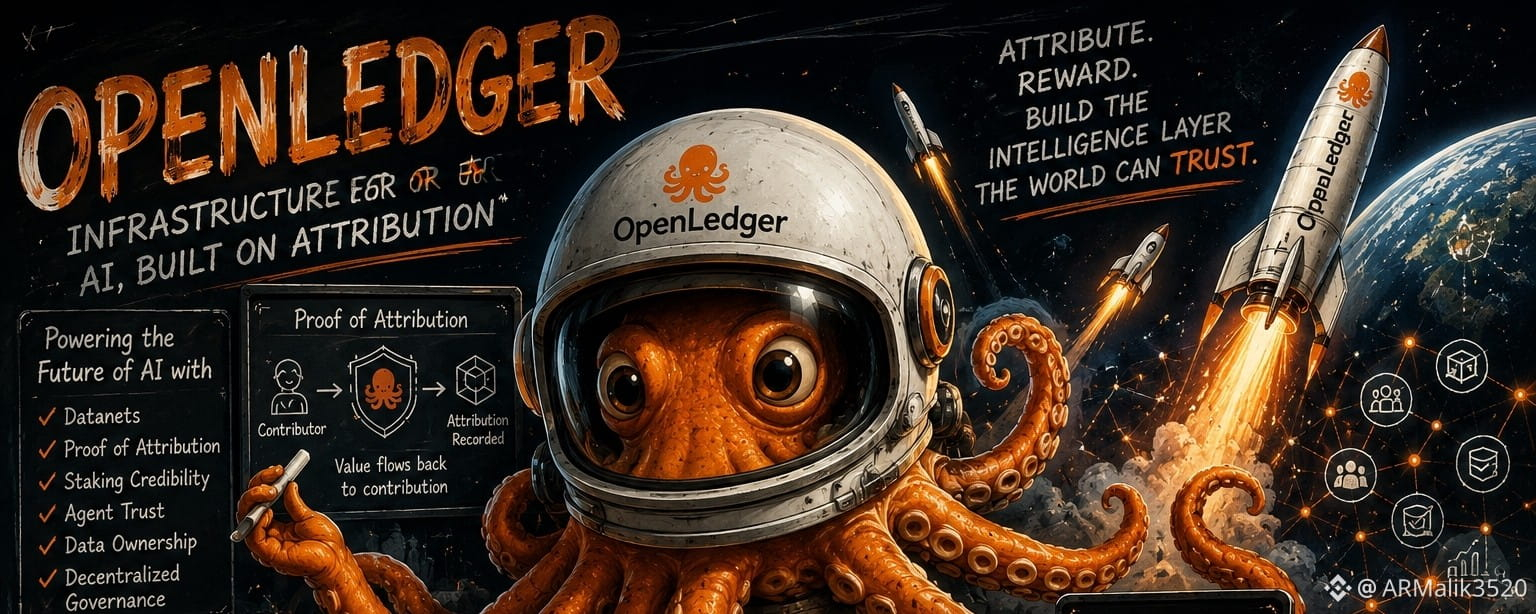
What stands out to me about OpenLedger is the attempt to treat attribution as infrastructure instead of an afterthought. Most digital systems can measure outcomes but struggle to measure contribution. Training data, behavioral feedback, signal quality, and model improvements all blend together until contributors disappear behind the platform itself. OpenLedger’s ideas around datanets, Proof of Attribution, staking credibility, and contribution tracking feel like an attempt to solve that coordination problem economically rather than socially. But systems like this become fragile under pressure. Once attribution gains financial value, people inevitably optimize around metrics instead of meaning. Reputation becomes speculative, governance drifts toward influence concentration, and contributors may prioritize visibility over reliability.

Still, dismissing these experiments feels shortsighted because the alternative model is already unstable. Most AI infrastructure today behaves like a black box economy where contributors rarely understand how value flows or who captures it. As AI agents begin coordinating transactions, data, and decisions autonomously, invisible incentives become attack surfaces. That is why OpenLedger feels less like a polished product story and more like a live infrastructure experiment. The real question may not be whether we can build smarter agents, but whether we can build systems where intelligence, trust, and contribution remain economically legible once the network becomes large enough to manipulate itself.$OPEN
