
Here’s a more human, natural, and professional version that keeps the depth but removes the overly technical feeling:
OPENLEDGER ($OPEN): IS THIS WHAT DATA OWNERSHIP IN THE AI ERA COULD LOOK LIKE?
I’ve been thinking about something a lot lately.
AI is moving fast. Every day we hear about new models, smarter agents, and better automation. But one question keeps coming back to me:
If data is becoming one of the most valuable resources in the world… then who actually owns it?
Most of today’s AI systems are powerful, but they’re also heavily centralized. Millions of people create data, interact with platforms, and help improve models indirectly — yet almost nobody shares in the value being created.
That’s where OpenLedger started to feel different to me.
OpenLedger isn’t trying to become another AI chatbot or another model competing for attention.
Its idea is bigger than that.
It wants to build infrastructure where data itself becomes an asset — something that can be tracked, verified, and potentially rewarded.
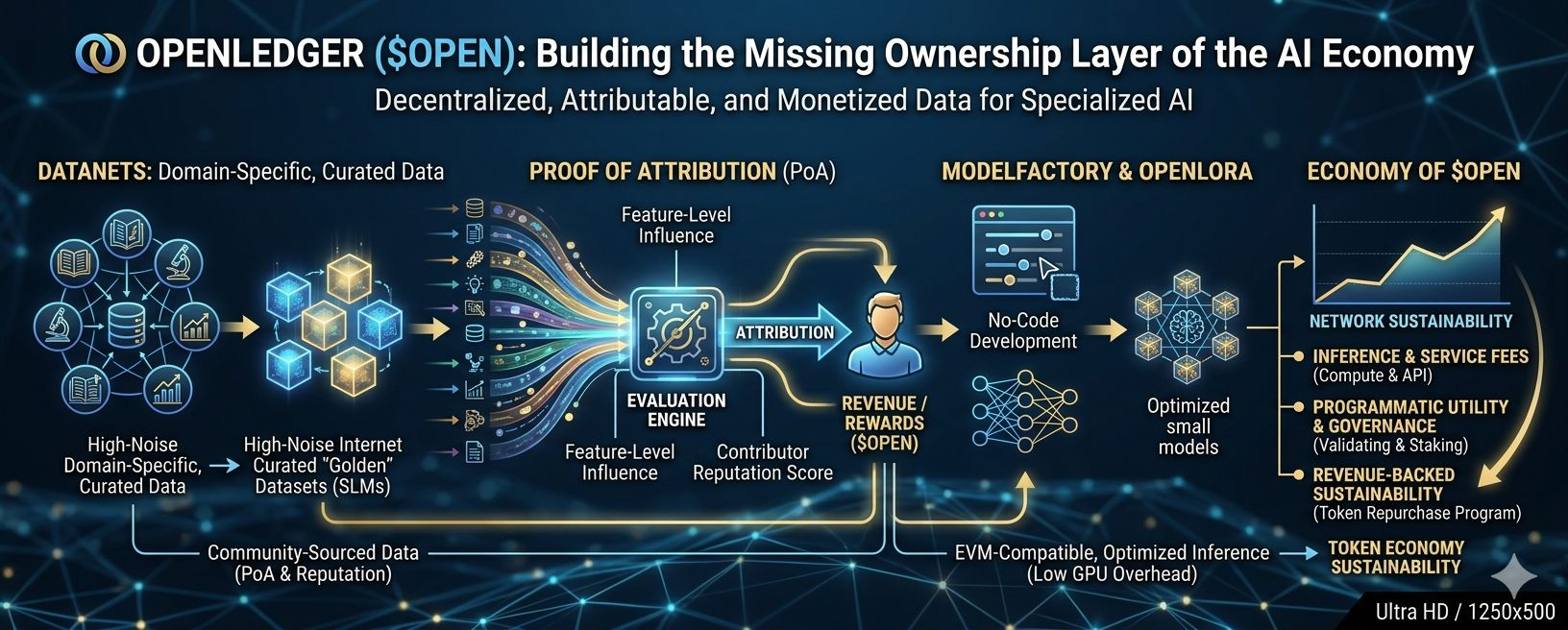
One of the ideas behind this is something called Proof of Attribution (PoA).
The concept is interesting:
If your data contributes to training an AI system or helps produce useful outcomes, there should be a way to recognize that contribution instead of treating all data like it appeared from nowhere.
OpenLedger calls this direction Payable AI — the idea that contributors can become participants in the value chain.
Another part that stood out to me is Datanets.
Think of them like specialized community-owned knowledge networks.
Instead of random datasets floating around the internet, people contribute structured, higher-quality information around specific areas.
Then there’s ModelFactory and OpenLoRA, which seem focused on making AI development more accessible and efficient — lowering the cost and complexity of creating customized AI systems.
But what really caught my attention wasn’t one product.
It was the broader vision.
OpenLedger talks about building a full AI infrastructure stack where AI doesn’t just generate outputs — it becomes part of an economic system.
AI agents interacting.
Data being valued.
Revenue moving transparently.
That’s a very different direction from the current model.
Of course, vision and execution are never the same thing — and every project eventually has to prove itself in real-world adoption.
But conceptually, OpenLedger is asking a question that feels increasingly important:
What happens if people who contribute data stop being invisible?
Maybe that’s where the next phase of AI starts — not just smarter models, but better ownership.
That’s what makes this worth paying attention to.
