
Every cycle eventually develops the same reflex.
At first, markets price infrastructure conservatively because infrastructure appears boring. Then a narrative emerges around a technological frontier — cloud computing, decentralized finance, GPUs, AI agents, data availability, modular execution — and suddenly infrastructure becomes symbolic rather than operational. Capital floods toward abstractions before it understands maintenance costs.
The pattern repeats because speculation prefers potential energy over recurring economics.
In 2021, markets became obsessed with throughput before understanding who would actually pay for blockspace sustainably. In 2022, “move-to-earn” systems briefly convinced participants that financial extraction could masquerade as demand. In 2023 and 2024, AI infrastructure inherited the same psychological structure: investors began valuing intelligence production while largely ignoring intelligence maintenance.
That distinction matters more than it first appears.
Markets get excited about intelligence creation because creation feels exponential. But maintenance economies are where durable cash flows usually emerge. Oil pipelines mattered more than drilling booms. Cloud retention mattered more than initial compute provisioning. Financial exchanges became powerful not because they enabled the first trade, but because they institutionalized settlement, custody, and recurring dependency.
The same question is now beginning to surface inside AI infrastructure.
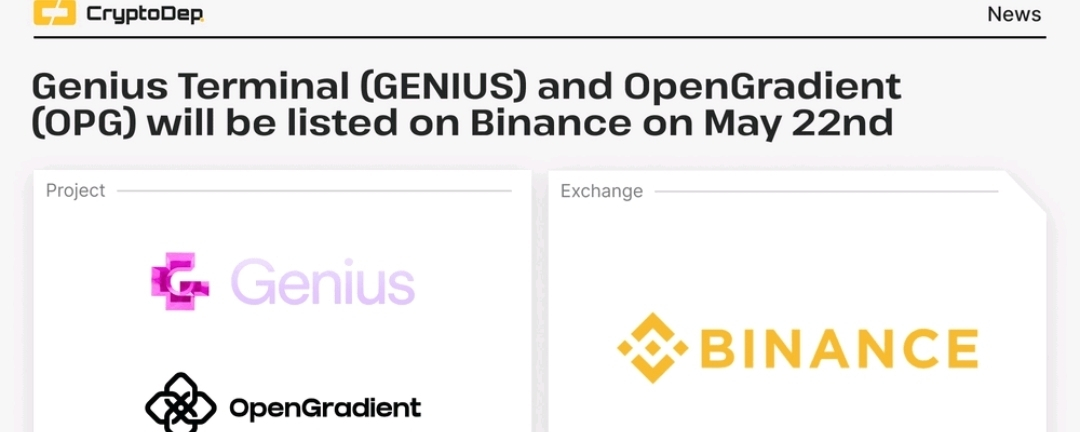
And that is where projects like Genius Terminal — and by extension systems like OpenGradient or OpenLedger-style attribution frameworks — become more interesting than their surface narratives suggest.
At first glance, Genius Terminal appears straightforward enough: an on-chain AI terminal layer positioned around private inference, model interaction, and AI coordination infrastructure. The mainstream interpretation is predictable. Markets see another AI-crypto convergence trade. Another attempt to tokenize access to intelligence infrastructure. Another bet that decentralized AI coordination will absorb value as AI usage scales.
That interpretation is not necessarily wrong.
It is simply incomplete.
The more interesting version is that these systems may evolve into economic coordination layers for AI memory itself.
Not memory in the human sense. Economic memory.
Retention rights. Attribution persistence. Controlled forgetting. Influence tracking. Provenance accounting. Model contribution lineage. Access decay. Historical weighting.
In other words, not merely systems that generate intelligence, but systems that determine which intelligence remains economically alive.
That reframing changes the entire investment discussion.
Because once AI systems become persistent economic actors, memory stops being free.
And memory may eventually become one of the most expensive liabilities in artificial intelligence infrastructure.
Most current AI discussions still operate under an assumption inherited from software culture: more data is always better. More context windows. More retrieval. More historical continuity. More personalization. More permanent memory.
But economic systems rarely reward infinite retention indefinitely.
Financial markets themselves are built around selective forgetting. Volatility resets positioning. Liquidity cycles clear leverage. Bankruptcy exists because systems cannot indefinitely carry all historical obligations. Even biological intelligence relies heavily on forgetting to remain adaptive.
AI systems may eventually face the same constraint.
As models accumulate interactions, contributors, fine-tuning layers, proprietary datasets, attribution claims, and behavioral traces, the burden of persistent memory compounds operationally and legally. Every retained influence becomes a future accounting problem.
Who owns model influence after thousands of distributed contributions?
How long should attribution persist?
What happens when enterprises demand provable removal of proprietary training influence?
What is the economic cost of maintaining historical traceability forever?
These are not philosophical questions anymore. They are infrastructure questions.
And infrastructure questions eventually become token demand questions.
That loop matters.
Because many crypto infrastructure projects fail precisely where recurring economic obligations fail to emerge. Markets often confuse activity with dependency. Airdrop participation looks like adoption until incentives disappear. Wallet counts appear meaningful until liquidity leaves. Transaction volume appears durable until speculation rotates elsewhere.
The real question is always simpler: what recurring economic behavior forces continued participation?
For Genius Terminal and adjacent attribution infrastructure models, the answer may not ultimately come from intelligence access itself. Intelligence commoditizes quickly. Open-source diffusion ensures that eventually most models converge toward acceptable performance for many tasks.
The scarcer layer may become verifiable memory management.
Not generating outputs — governing historical influence.
If Genius Terminal evolves toward becoming an operational coordination layer where enterprises, agents, and models negotiate attribution persistence, memory rights, or retained influence weighting, then token demand potentially acquires a very different structure.
Instead of one-time speculative usage, the system could theoretically create maintenance-based demand loops.
Persistent storage fees.
Verification settlement.
Attribution disputes.
Retention extensions.
Memory expiration markets.
Inference provenance audits.
Access control renewals.
Model lineage verification.
These are operational expenditures, not ideological expenditures.
And markets historically underestimate operational expenditures because they appear unexciting.
Yet operational friction is often where the strongest infrastructure monopolies emerge.
AWS became powerful because companies did not want to manage servers. Bloomberg became unavoidable because financial coordination demanded standardized information infrastructure. Ethereum itself derives value partly because applications inherit settlement guarantees rather than recreating them independently.
Infrastructure durability emerges from recurring coordination dependency.
The challenge is whether AI attribution infrastructure genuinely creates that dependency — or merely simulates it temporarily through token incentives.
Liquidity tells its own truth.
Many infrastructure tokens discover too late that usage does not necessarily create buy pressure. Some systems generate enormous transactional throughput while leaking value structurally because token ownership remains disconnected from operational necessity.
The distinction between “token-adjacent activity” and “token-required activity” becomes critical.
If Genius Terminal’s token primarily functions as a speculative coordination asset, reflexivity dominates temporarily but weakens over time. Speculation can bootstrap liquidity, but it rarely sustains infrastructure value indefinitely without recurring absorption mechanisms.
Token sinks therefore matter far more than headline adoption metrics.
Are enterprises required to hold tokens for memory persistence guarantees?
Does attribution verification consume supply permanently or temporarily?
Are retention extensions burned, staked, or recycled?
Can protocol usage occur abstracted away from token exposure?
Does governance create operational dependency or merely symbolic participation?
These questions determine whether economic gravity forms.
Because crypto markets repeatedly overvalue participation while undervaluing maintenance.
Maintenance economies are structurally different from growth narratives. Growth narratives rely on expansion assumptions. Maintenance economies rely on recurring friction. One is cyclical optimism. The other is operational necessity.
The strongest infrastructure businesses in history often became powerful not because users loved them, but because systems quietly became dependent on them.
That may ultimately become the most important question around AI infrastructure tokenization.
Can dependency emerge before speculation exhausts itself?
There are reasons for skepticism.
Attribution itself is extraordinarily difficult to verify at scale. Modern AI systems are probabilistic mixtures of training influence rather than deterministic ownership chains. Provenance sounds elegant conceptually, but operationalizing it introduces immense complexity.
Verification costs may exceed economic value in many contexts.
Enterprises may resist exposing internal model architecture to external settlement systems.
Open-source competition may compress monetization.
Users may not care about attribution until legal pressure forces them to care.
And even if attribution markets emerge, they may consolidate around centralized providers rather than tokenized coordination systems.
This is where many crypto infrastructure theses weaken under pressure.
Markets frequently assume decentralization itself creates value. Historically, decentralization only persists where coordination costs exceed centralization efficiencies.
Otherwise, centralization wins economically.
That tension sits directly beneath the AI attribution narrative.
There is also the problem of artificial activity.
Crypto infrastructure markets are deeply vulnerable to spoofed demand because incentives can temporarily manufacture engagement statistics. Wallet counts, transactions, node participation, and staking participation can all be economically subsidized in ways that appear organic before collapsing once rewards normalize.
The AI sector adds another layer of distortion because “AI usage” itself is difficult to audit externally.
An ecosystem can appear active while most interactions remain economically circular.
That creates dangerous reflexivity during early valuation phases.
Especially when FDVs expand faster than actual dependency formation.
The market structure issue here is substantial.
Infrastructure tokens often launch into valuations that implicitly assume future monopolistic positioning before operational economics stabilize. Unlock schedules then create persistent sell pressure precisely during the period when real demand remains uncertain.
If recurring token sinks fail to emerge quickly enough, reflexive speculation weakens before durable infrastructure dependency forms.
That pattern has repeated across multiple crypto cycles.
Markets reward narrative compression immediately but reward operational durability slowly.
And operational durability is psychologically harder to price because it develops incrementally rather than explosively.
This is why the memory framing matters more than the intelligence framing.
Intelligence narratives invite speculative overvaluation because they imply exponential upside. Memory infrastructure invites operational analysis because it revolves around recurring obligations.
The former attracts traders.
The latter potentially attracts institutions.
There is a subtle but important difference between systems that create intelligence and systems that govern persistence.
Creation can commoditize rapidly.
Persistence creates switching costs.
If AI eventually becomes abundant, then scarcity may migrate toward verifiable continuity, authenticated lineage, trusted deletion, and controlled retention rights.
In that world, forgetting itself becomes economically valuable.
And that may sound counterintuitive until viewed historically.
Financial systems price expiration constantly. Options decay. Leases expire. Licenses renew. Patents lapse. Copyrights terminate. Debt matures.
Economic systems remain functional partly because obligations do not persist infinitely.
AI may eventually require similar structures.
A future market for controlled forgetting is not impossible.
In fact, it may become necessary.
Imagine enterprise AI systems negotiating legal obligations around historical training influence. Imagine jurisdictions requiring provable removal of proprietary datasets. Imagine AI agents whose historical interactions create liability exposure. Imagine attribution royalties that decay over time rather than persist permanently.
Suddenly memory itself becomes an actively managed economic layer.
Not static storage. Dynamic governance.
That is the more interesting version.
Whether Genius Terminal or adjacent projects actually capture that layer remains entirely unresolved.
Because conceptual elegance is not economic proof.
Crypto markets often identify important future problems correctly while investing in the wrong implementation layer entirely.
The internet thesis was right long before most internet companies failed.
The AI infrastructure thesis may also be directionally right while many current token structures prove economically weak.
Still, certain behavioral patterns deserve attention.
Markets repeatedly underestimate systems that monetize maintenance rather than excitement.
Recurring coordination costs tend to outlast speculative enthusiasm.
And infrastructure durability usually emerges not when technology appears revolutionary, but when users quietly stop being able to operate efficiently without it.
For now, Genius Terminal exists somewhere between speculative AI infrastructure narrative and a potentially deeper coordination mechanism around AI persistence economics.
The gap between those two identities is enormous.
One attracts temporary liquidity.
The other potentially restructures how artificial intelligence systems negotiate memory, attribution, and economic continuity.
But markets are still early in distinguishing between the two.
Which leaves the more important unresolved question:
If artificial intelligence eventually becomes abundant and commoditized, will the real scarcity reside not in generating intelligence — but in deciding what must be remembered, what can be forgotten, and who gets paid while memory persists? @GeniusOfficial #Geniu $GENIUS