
I noticed the shift while sitting at my desk late at night with a quiet screen and one unfinished task still open. I did not need another smart answer. I needed something that could understand the context and help move the work forward. That is where OpenLedger’s OctoClaw direction started to feel more serious to me.
OpenLedger’s official site describes OctoClaw as live and focused on building automating and executing with AI agents in real time. That wording matters because it moves the project beyond the familiar idea of AI as a response engine. I see it as a move toward AI as an execution layer where models do not only explain what should happen but begin to participate in the workflow itself.
I think this is an important change because many AI tools still stop too early. I can ask a model for analysis and get a useful answer. I can ask for a summary and get a clean version of a messy idea. But after that I still carry the burden. I still check the source. I still move between tools. I still decide whether the answer is grounded enough to act on. That gap between response and action is where many products lose practical value.
OpenLedger’s MCP writing helps explain why this gap exists. The project describes MCP as a way to connect AI models with real time data sources such as blockchains APIs databases and software tools through a more standard interface. I see that as the missing rail between intelligence and action. A model that cannot reach live systems is limited. It may sound confident but it is still separated from the moving environment where decisions actually happen.
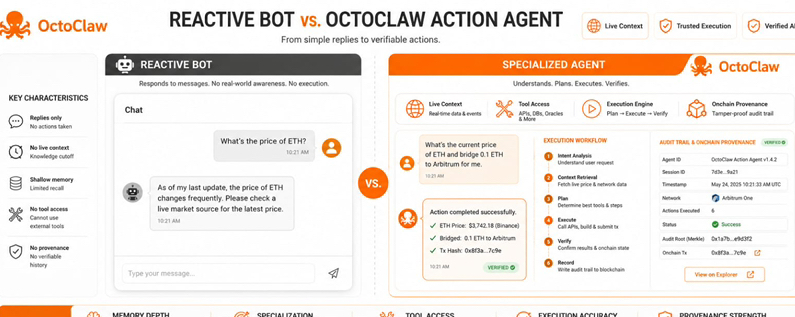
OctoClaw becomes interesting to me because it fits into that problem rather than avoiding it. An AI agent should not only produce a polished answer. It should understand the task environment. It should use live context. It should interact with tools. It should leave a clear trail so the user can understand what happened. I do not think this makes agents magically autonomous. I think it makes the standard for useful agents much higher.
The official OpenLedger writing on agents is careful about this point. It says many current agents are still reactive and often lack stronger memory pattern recognition and learning. That matches what I see in practice. A reactive bot can reply to a prompt. A more useful agent needs specialized knowledge and a repeatable way to improve task performance. Without that foundation the word agent becomes more like branding than infrastructure.
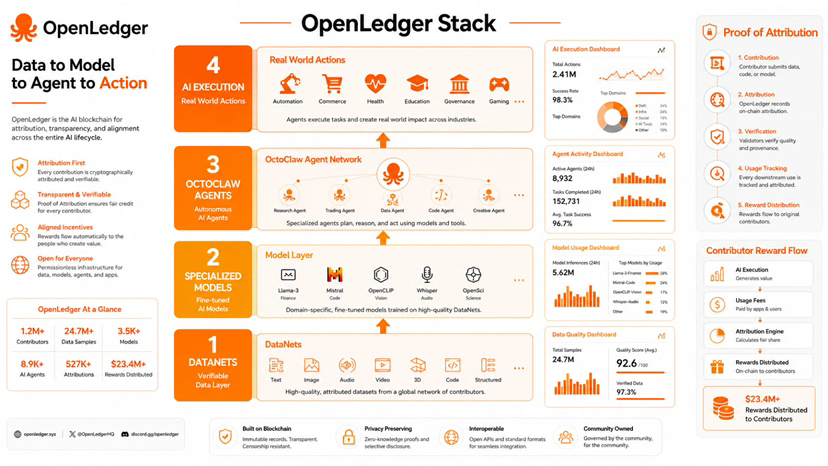
This is where OpenLedger’s broader design becomes relevant. DataNets are about structured domain data. Proof of Attribution is about tracking contribution and influence. Model creation tools are about turning data into specialized intelligence. OctoClaw can be read as the next layer where that intelligence is pushed toward real time action. I see the logic as a chain. Data informs models. Models inform agents. Agents execute tasks. Execution creates a stronger need for provenance.
My practical view is that the project becomes more interesting when these pieces are judged together. If data is verified but never used then the system has weak demand. If models are built but rarely queried then the economic loop stays thin. If agents act without traceability then trust becomes fragile. OctoClaw matters because it gives OpenLedger a product direction where data models agents and attribution can meet in a visible workflow.
There is still real execution risk. Real time action is harder than content generation. Poor data can create poor decisions. Weak permissions can create user discomfort. A confusing audit trail can reduce confidence instead of improving it. I would not treat OctoClaw as proof that the whole vision is solved. I would treat it as a serious test of whether OpenLedger can turn verified AI infrastructure into something people actually use.
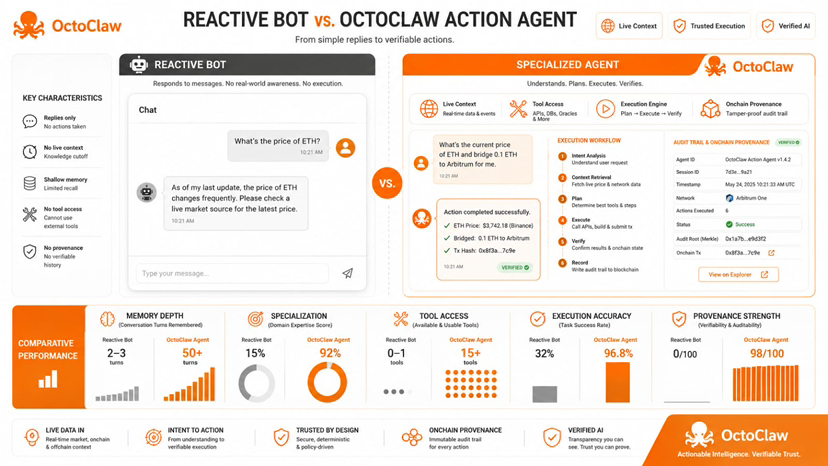
That is why I like this title. When AI stops explaining and starts executing with proof the question changes. I am no longer only asking whether the answer sounds smart. I am asking whether the system can act with context and whether I can inspect the path behind that action. For OpenLedger that may be the sharper story. Not just AI that talks. AI that works with a record.
Final note: I am watching utility execution and verified contribution more than short term noise.
