
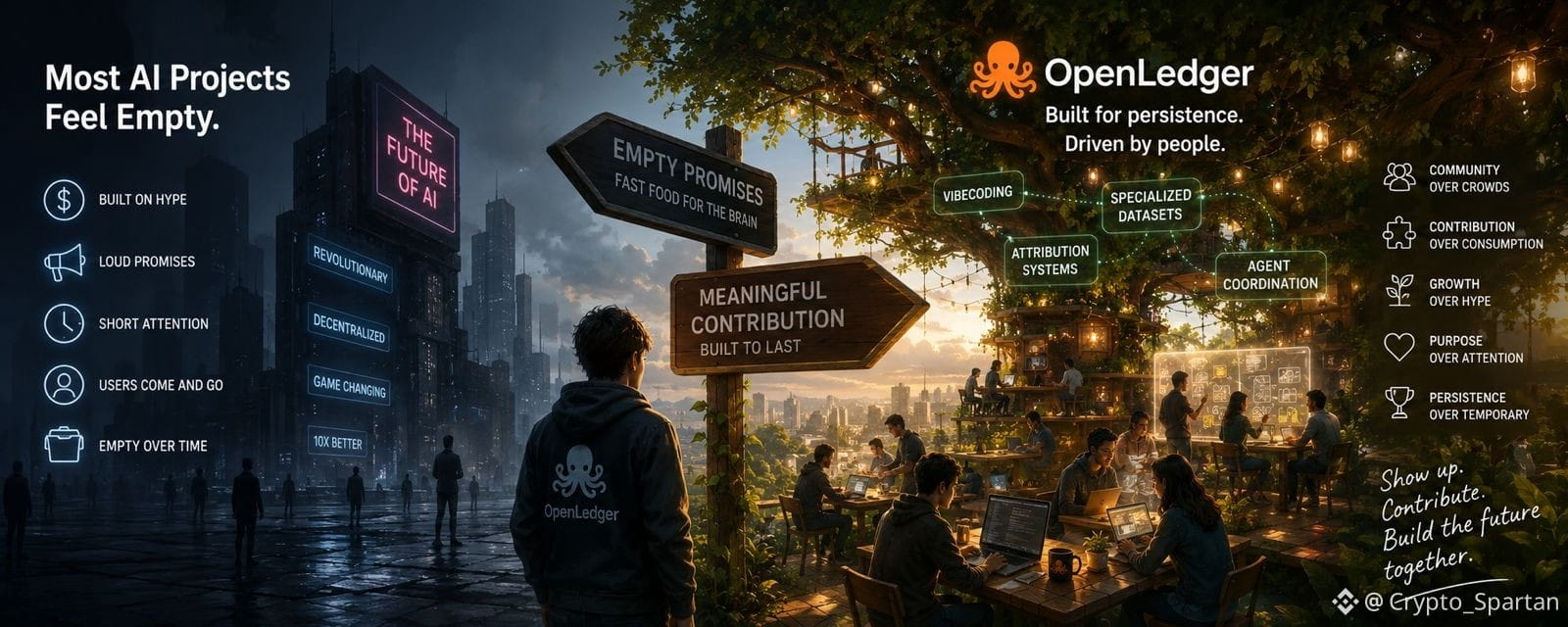
I’ll be honest, when I first saw the whole thing around @OpenLedger and the $OPEN ecosystem, my first reaction was basically “here we go again.” Another AI project talking about changing the future. Another fancy website full of glowing lines, nodes, and big words like “decentralized intelligence.” At this point the space is flooded with these kind of projects, and most of them honestly sound the same. Feels like half the internet just throws AI buzzwords together and hopes people get excited. So yeah, I didnt expect much from it at all.
But then something kinda started bothering me the more I looked into it. Almost every AI project only talks about what the tech can do. Faster models, smarter systems, more automation, all that stuff. But barely any of them feel connected to actual human behavior. Everything sounds super efficient but also weirdly empty at the same time. Like a perfect kitchen where nobody actually cooks anything.
That feeling got stronger when I compared it to what OpenLedger seems to be building. Most AI apps are made for quick use. You open it, press a button, get something cool from AI, then leave and forget about it ten minutes later. It’s basically fast food for the brain. Fun for a second but nothing really sticks.
OpenLedger doesnt really feel like that to me. The whole thing seems more focused on people continuously contributing instead. Stuff like vibecoding, attribution systems, niche datasets, AI agents working together — none of that really works if people only show up for one day and disappear. The whole system kinda depends on people staying around, improving small things over time, building weird niche workflows nobody else even notices.
And honestly, that changes the vibe completely.
At some point I stopped thinking about it as just “AI software.” It started feeling more like internet culture slowly forming in real time. Small groups building tiny systems together. People improving tools that might look boring to outsiders but are super valuable inside those communities. And thats actually rare online now.
Usually what happens on the internet is someone spends years learning some random niche skill, shares valuable knowledge for free, gets ignored by algorithms, then disappears. OpenLedger kinda feels like it’s asking: what if those people actually got rewarded for continuing to show up and contribute over time?
That idea stuck with me alot more than the tech itself honestly.
The economic side is probably the first thing that made sense to me. Most AI projects survive on hype. Big announcements, huge promises, massive funding rounds, then everyone moves onto the next shiny thing a few months later. OpenLedger feels more built around persistence instead. If the ecosystem depends on ongoing contribution and refinement, then slow consistent work actually becomes valuable. That’s pretty uncommon these days.
Then there’s the cultural side of it. I’m honestly tired of AI products that feel cold and sterile. Everything looks polished but has zero personality. OpenLedger weirdly reminded me more of small workshops than giant factories. Tiny groups obsessing over attribution systems or building tools only like twelve people care about right now. Thats how real culture usually starts though. Quietly. Slowly. Not through massive hype cycles.
And the biggest thing for me was probably the behavioral side. Most AI projects are built around curiosity. You visit, mess around for a bit, then leave. OpenLedger feels more built around commitment. If you only show up temporarily, you probably won’t get much value from it. The system almost pushes people to stay involved, contribute, refine things over time. It changes users from tourists into actual residents. And in my experience, residents are the people who actually build valuable things long-term.
I’m not saying OpenLedger is perfect or that it magically solves everything. The space is still early and obviously a lot can still go wrong. But what made it interesting to me is that it doesnt really feel like another short-term AI narrative fighting for attention. It feels more focused on human persistence. The slow invisible work people do over long periods of time that usually never gets rewarded properly online.
And honestly, that kind of work is usually the stuff that lasts the longest.
The first era of the internet rewarded speed. Then social media rewarded attention. Maybe this next AI era rewards consistency instead. People who keep showing up. People who build slowly. People who stick around even when the hype disappears.
That’s probably the first time OpenLedger actually felt genuinely interesting to me. Not because it sounds futuristic or flashy. But because it weirdly feels more human than most AI projects I’ve seen lately.
So yeah, I started off pretty skeptical. But the more I thought about the economics, the culture, and the behavior side of it, the more I felt like maybe this project is aiming at something different. Not louder. Not shinier. Just built for the long run.
And these days, thats honestly pretty rare.#OpenLedger $OPEN
