
At some point around 2 AM, after going through another stack of AI x crypto whitepapers that all started sounding suspiciously identical, OpenLedger was one of the few projects that actually made me stop scrolling for a minute.
Not because it promised AGI.
Not because it claimed to “revolutionize decentralization.”
God knows this industry has already burned through enough of those narratives.
We had DeFi summer. Then GameFi. Then metaverse land speculation somehow became a serious investment thesis for six months. Then modular chains arrived and suddenly everyone was pretending execution environments were dinner table conversations.
Now it’s AI.
Every project suddenly has “AI infrastructure” somewhere in the bio, whether it makes sense or not.
So naturally, the first instinct with OpenLedger was skepticism. Probably deserved skepticism too.
But after reading deeper into the architecture, the attribution model, the data layer mechanics… I’m not completely convinced it’s just another narrative rotation farm either.
And honestly, that’s becoming rare.
The strange thing about AI right now is that everyone talks about models, but almost nobody talks seriously about where intelligence itself comes from economically.
The entire industry quietly depends on massive amounts of human contribution. Researchers publishing papers for years. Open-source developers maintaining libraries for free. Communities generating discussions and niche knowledge online. People feeding the internet with constant streams of information that eventually become training material for systems worth billions.
Yet contributors are mostly invisible once value starts accumulating.
That feels… unstable.
Not morally even. Structurally.
Because eventually people notice when extraction becomes one-sided long enough.
OpenLedger seems built around that exact tension.
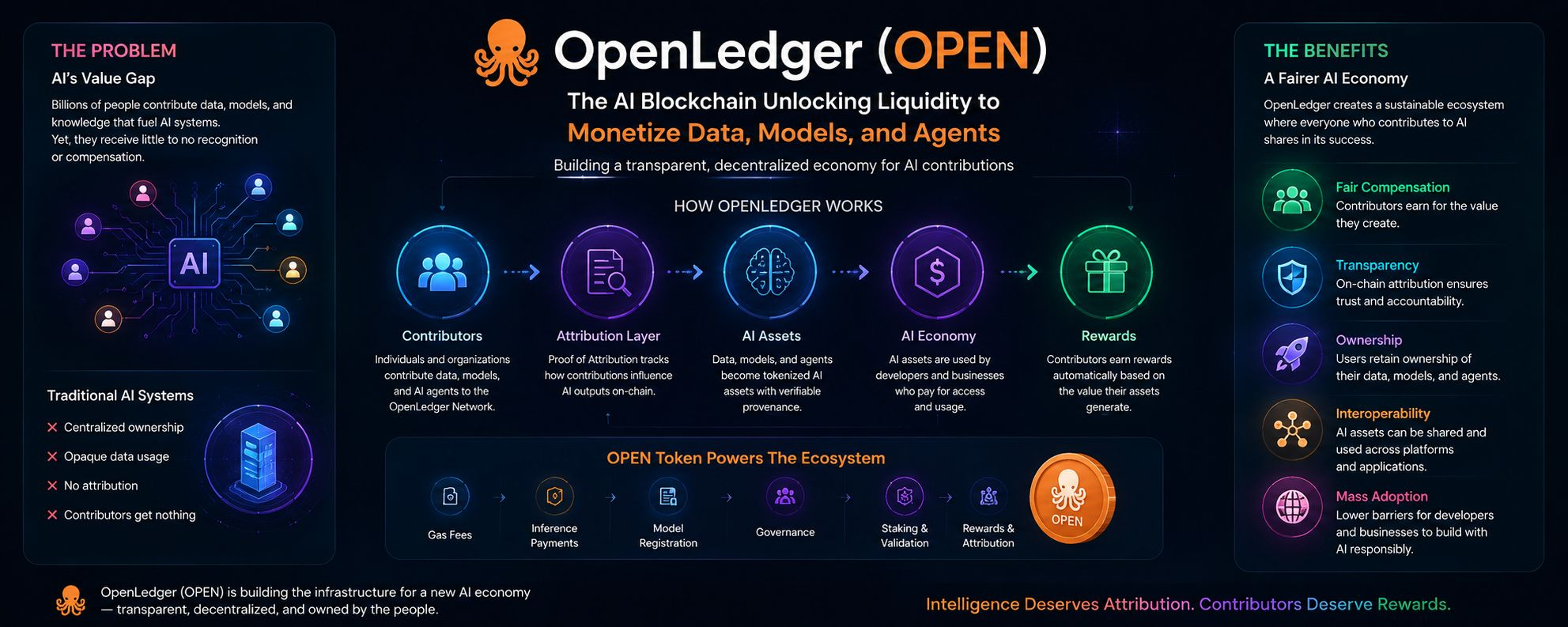
The project keeps pushing this idea that data, models, and AI agents should function as economically attributable assets instead of disappearing into centralized black boxes. Which, to be fair, sounds very theoretical at first. Crypto is full of elegant theories that collapse on contact with reality.
Still, the more I sat with it, the more the logic started connecting together.
If AI really becomes foundational infrastructure over the next decade — and it probably will in some form — then attribution suddenly matters a lot more than people think right now.
Who contributed to the model?
Which datasets influenced outputs?
How do contributors get compensated?
Can intelligence itself become monetizable without centralized ownership sitting in the middle of everything?
Those questions sound philosophical until there’s trillions of dollars sitting on top of the answers.
That’s where OpenLedger’s “Proof of Attribution” idea actually becomes interesting. Not hype-interesting. Structurally interesting.
The system attempts to track how datasets and contributors influence model behavior over time, then route rewards accordingly. Sort of like royalties, except for intelligence production instead of music streams.
And honestly, I keep circling back to the same thought:
Why doesn’t something like this already exist at scale?
The current AI economy feels weirdly incomplete without it.
Right now, most AI systems operate like giant value absorption machines. They consume data, interactions, research, creative output — basically human cognition at internet scale — then consolidate the upside into a handful of centralized entities with enough compute and distribution.
Maybe that model survives long term.
Maybe it doesn’t.
But OpenLedger at least seems to recognize the pressure building underneath it.
Another part that stood out was the focus on specialized datasets through these “Datanets.” Initially I almost ignored it because crypto naming conventions have damaged my brain permanently at this point. Every protocol sounds like it was named during a caffeine overdose in a Telegram call.
But the underlying idea makes sense.
General internet data is becoming less valuable. Everyone already scraped everything. The next AI race probably revolves around proprietary, domain-specific intelligence — healthcare datasets, legal workflows, financial systems, scientific environments.
That’s where real value starts concentrating.
And centralized AI companies are going to have a harder time extracting that data freely because enterprises and institutions increasingly understand what they’re sitting on.
So OpenLedger positioning itself around decentralized ownership and monetization of specialized datasets actually feels directionally aligned with where the market may evolve.
The keyword there being may.
Because execution here is brutally difficult.
That’s the part crypto researchers sometimes avoid admitting after getting emotionally attached to narratives. Infrastructure is hard. AI infrastructure is even harder. Decentralized AI infrastructure competing against trillion-dollar centralized players with absurd GPU access? That’s another level entirely.
You can have beautiful tokenomics diagrams and still fail completely.
And OpenLedger still has to solve the same brutal realities every serious AI protocol faces:
compute scaling,
latency,
developer adoption,
data quality verification,
economic sustainability,
regulatory pressure,
and whether users actually care enough about decentralization to change behavior.
Historically… convenience wins most of the time.
That’s the uncomfortable truth sitting underneath almost every Web3 ideal.
Still, something about OpenLedger feels less performative than a lot of AI-token ecosystems surfacing lately. Maybe because it’s not trying to sell some sci-fi fantasy where blockchain magically creates consciousness. Maybe because the problem it’s targeting already exists in plain sight.
AI has an ownership problem.
A compensation problem.
An attribution problem.
Most people just haven’t fully processed the implications yet because the industry is still moving too fast.
And maybe OpenLedger itself won’t be the project that solves it. That’s entirely possible. Crypto history is filled with early infrastructure ideas that mattered conceptually even if the original execution failed.
But the broader thesis feels harder to dismiss the longer you stare at it.
What happens when intelligence itself becomes an asset class?
Not software.
Not content.
Not social media attention.
Actual intelligence.
Traceable. Monetizable. Programmable.
That sounds abstract until you realize the global economy is already drifting in that direction piece by piece.
Honestly, maybe that’s why the project stayed in my head longer than most. Not because I’m convinced it wins. I’m not there yet. This market has trained skepticism into anyone who’s survived enough cycles.
But somewhere underneath the AI hype, the token launches, the endless “next paradigm” threads on X… OpenLedger feels like one of the few projects at least asking a real question.
And lately, that alone separates projects more than people think.