
I was supposed to sleep early yesterday but somehow ended up watching OpenLedger activity for almost an hour straight lol.
Not charts. Not influencer threads. Not the polished marketing stuff.
Just raw activity on the network.
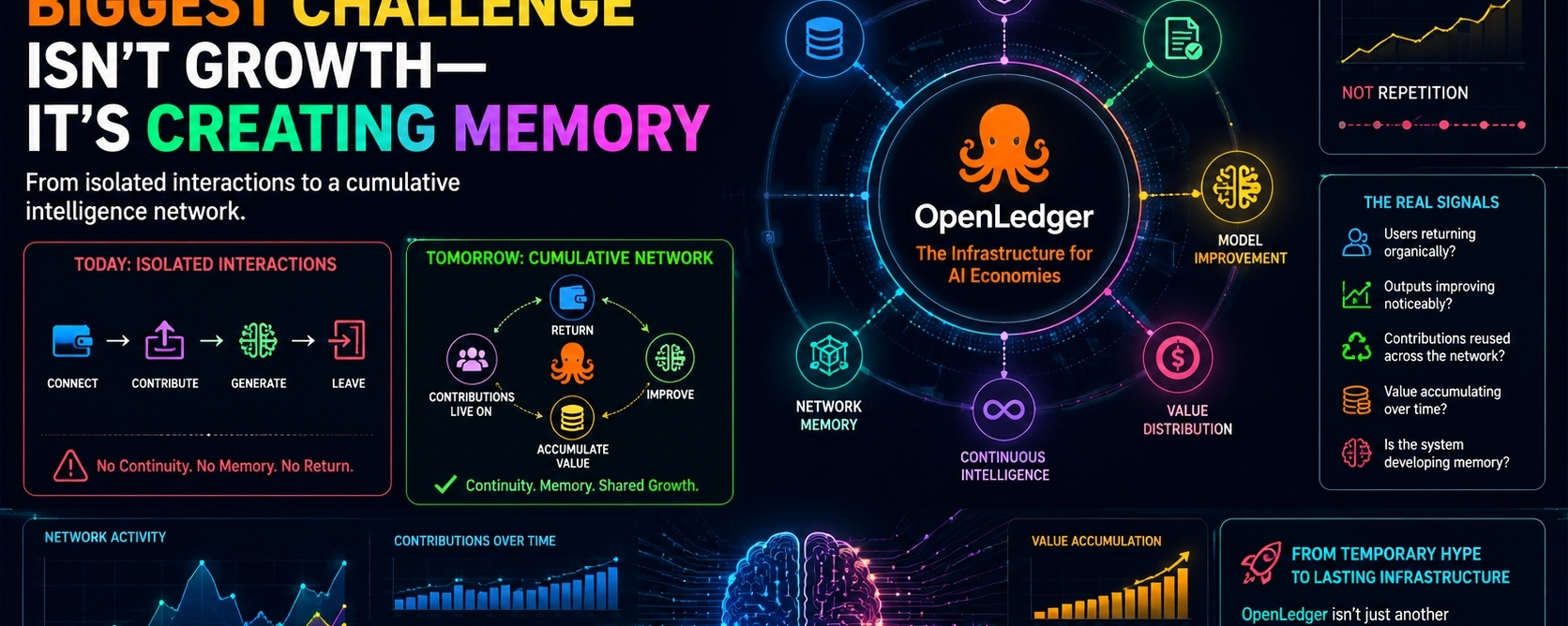
Wallets connecting. People submitting datasets. Models generating outputs. Users leaving.
At first it honestly looked bullish. Constant movement everywhere. The type of activity that usually makes people post “early gem” threads on CT.
But after watching longer, something started feeling weird to me.
Nothing seemed to carry forward.
Every interaction felt isolated. A person comes in, contributes something, gets a result, then disappears. After that, another wallet repeats the exact same flow.
Different user. Same pattern. Same ending.
And that’s when the real issue clicked in my head.
I don’t think OpenLedger’s biggest challenge right now is getting users.
I think it’s giving users a reason to come back.
That’s a completely different problem.
Most people still describe OpenLedger like it’s just another decentralized AI project. Personally, I think that explanation misses the entire point.
The deeper idea here is actually pretty ambitious.
OpenLedger is trying to rebuild how value works inside AI systems.
Right now almost every major AI company works the same way if we’re being real. People feed the system everything: data, conversations, feedback, creative work, behavior patterns, sometimes years of knowledge honestly…
Then the model improves, the company becomes more valuable, and contributors basically disappear from the equation.
No ownership. No visibility. No real participation in the upside.
That model has always felt broken to me.
OpenLedger is trying to flip it.
Instead of invisible extraction, contributions become traceable. Data can be attributed. Outputs connect back to sources. Contributors can theoretically benefit when value gets created.
That’s not just “AI infrastructure.” That’s an attempt to financialize contribution itself.
And honestly, that idea is way bigger than most people realize right now.
But here’s the thing I kept thinking about while watching all this activity.
Assets only matter when they continue producing value after the first interaction.
That’s where the current experience still feels incomplete to me.
Right now the flow feels too temporary.
You contribute. The model processes it. You get an output. Then the cycle basically resets.
As a user, it’s hard to clearly feel whether your contribution keeps working after you leave.
Does it improve future outputs? Does it strengthen the network for other users later? Does the system actually become smarter because you participated?
That continuation layer still feels blurry.
And honestly, I think that matters more than most surface-level metrics people track.
Because strong networks are built on accumulation.
Not repetition.
Airdrop farming creates repetition. Real ecosystems create dependency.
Big difference.
People don’t return to systems just because they’re fair. They return because the system becomes useful enough that leaving feels irrational.
That’s the behavioral layer OpenLedger still needs to fully unlock.
And no, incentives alone won’t solve it.
Crypto has already taught us that lesson like 500 times lol.
Rewards can attract activity fast. But activity is not the same thing as retention.
Retention happens when users feel ongoing value.
When the network starts remembering them.
That’s the missing feeling right now.
A strong AI economy should feel cumulative.
Models should noticeably improve because of previous contributions. Outputs should become smarter over time. Users should feel their old participation still matters later.
Basically, the system should feel alive instead of reactive.
And to be fair, I don’t even think OpenLedger is far from reaching that point.
The foundation is already strong.
Most AI companies still treat contributors like invisible fuel. Meanwhile OpenLedger is already thinking about attribution, ownership, and contributor economics at infrastructure level.
That’s actually ahead of the market in my opinion.
But the next stage is psychological as much as technical.
The platform has to create visible continuity between actions.
Because once users start feeling that their contributions continue generating value after submission, behavior changes naturally.
At that point, participation stops feeling like short-term farming and starts feeling more like ownership inside a growing intelligence network.
That changes everything.
And honestly, that’s why I don’t think wallet counts or interaction numbers tell the full story here.
The more important questions are:
Are users returning without constant incentives? Are outputs improving in ways people can actually notice? Are contributions being reused across the network? Can users feel value accumulating over time? Is the system developing memory?
Those are the signals that determine whether this becomes temporary hype or real infrastructure.
Because usefulness always survives longer than narratives do.
And if OpenLedger solves this properly, I genuinely think people will stop viewing it as “another AI crypto project” and start viewing it as foundational infrastructure for how AI economies operate in the future.
That’s a much bigger category.