I’ve been thinking a lot lately about how strange the internet has quietly become. Not in the dramatic sci-fi way people usually describe it, but in a softer, more uncomfortable sense. Almost everything we do online now leaves behind a trail. Every search, every wallet interaction, every click on a decentralized application, every trade, every token transfer — all of it sits somewhere permanently, waiting to be analyzed. And the funny part is that crypto originally arrived with this aura of freedom and independence, as if it would finally allow people to operate outside traditional surveillance systems. But somewhere along the way, transparency became so extreme that privacy almost started feeling illegal.
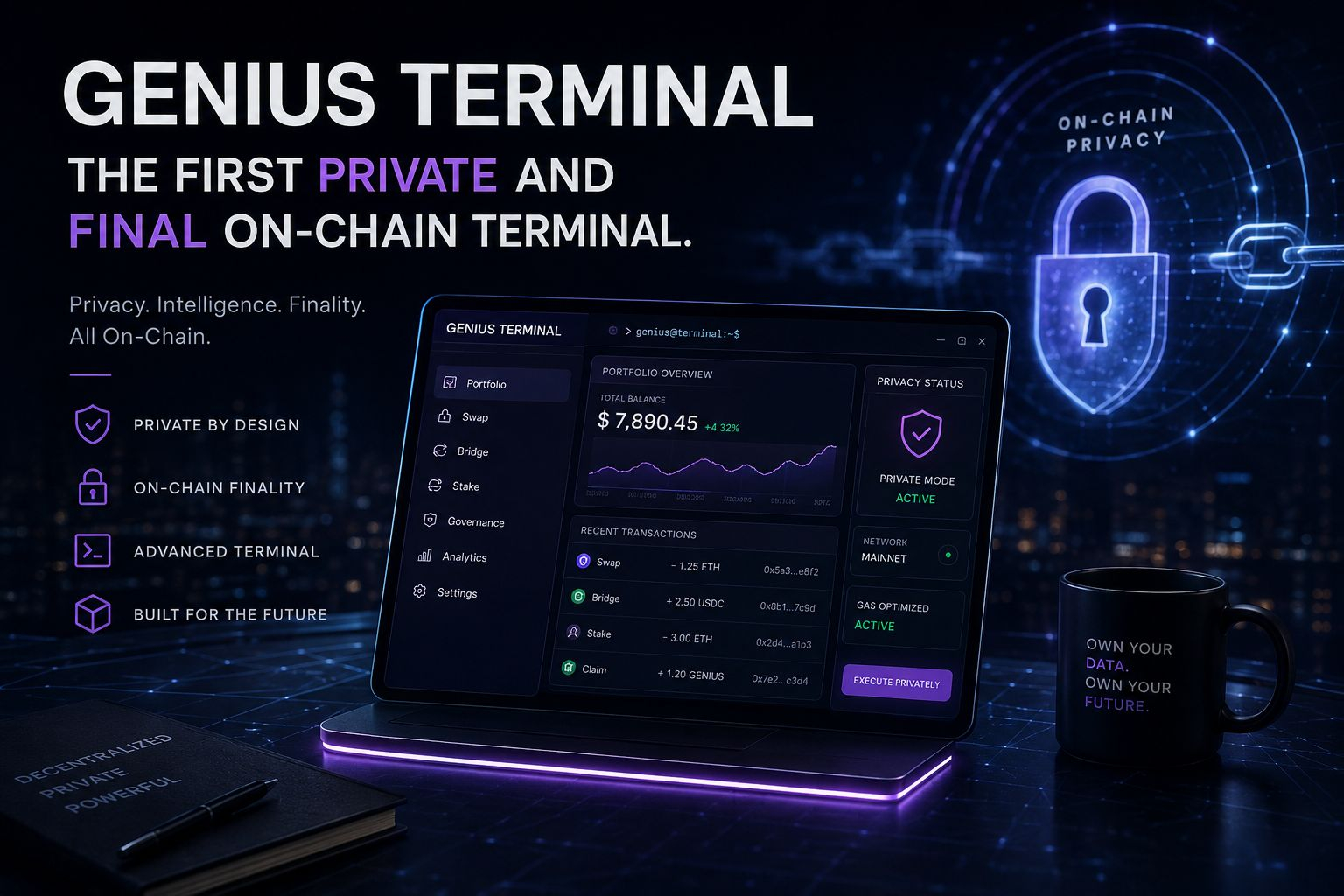
That’s probably why the idea behind Genius Terminal caught my attention. “The first private and final on-chain terminal” sounds dramatic at first, maybe even slightly overconfident. But the more I sat with the phrase, the more I realized it reflects a very real tension inside the crypto world. People want decentralization, yes. They want ownership, transparency, composability, open finance — all the big Web3 promises. But at the same time, they also want silence. They want moments where their actions are not endlessly dissected by bots, analytics dashboards, or wallets tracking their every move like digital paparazzi.
And honestly, yahi contradiction poori crypto industry ke center mein hai.
The average person doesn’t fully realize how exposed blockchain activity really is. A wallet address may not directly reveal your name, but patterns emerge quickly. One interaction connects to another, one token purchase links to a trading behavior, and eventually entire profiles begin forming around anonymous users. It’s almost like walking through a city wearing a mask while broadcasting your GPS location to everyone nearby. Technically anonymous, practically traceable.
Genius Terminal seems to emerge from this growing discomfort. Not just as another crypto tool, but as an attempt to rethink how people interact with on-chain systems altogether. The concept of an “on-chain terminal” itself is interesting because terminals historically represent power-user environments. They’re places where advanced traders, developers, and operators interact directly with systems instead of relying on simplified interfaces. A terminal suggests seriousness. Precision. Control. But adding the word “private” changes the emotional tone completely.
Privacy in crypto has always existed in a slightly awkward position. Everyone claims to support it in theory, but when actual privacy tools appear, reactions become complicated. Regulators worry about misuse. Exchanges hesitate. Some users associate privacy with suspicious activity because modern internet culture has normalized surveillance so deeply that asking for privacy itself begins to look suspicious. It’s a strange psychological shift when you think about it.
But privacy is not automatically secrecy in the criminal sense. Sometimes privacy is simply dignity.
A simple analogy keeps coming to my mind. Imagine sitting inside a café talking with a friend. Even in a public place, you expect some level of conversational privacy. You don’t expect every sentence to be recorded, indexed, monetized, and permanently searchable. Yet on-chain behavior today often works exactly like that. Wallets become public diaries people never intended to publish.
What Genius Terminal appears to be exploring is whether blockchain interaction can evolve beyond this extreme openness without sacrificing decentralization itself. That’s the difficult balance. Because the blockchain world depends heavily on verifiability. Remove too much transparency and trust mechanisms weaken. Keep everything exposed and ordinary users eventually feel uncomfortable participating deeply.
Somewhere between those two extremes is where projects like this are trying to build.
I think another reason the idea resonates now is because crypto users are becoming more mature. A few years ago, most participants were mainly focused on speculation. Fast profits, meme coins, NFT hype cycles — the culture moved quickly and loudly. But now there’s a quieter layer emerging underneath. Builders, researchers, long-term users, even ordinary traders are starting to ask more serious questions about sustainability, identity, ownership, and digital autonomy.
Can decentralized systems really become mainstream if every financial move remains publicly traceable forever?
Can institutions use public blockchains comfortably if competitors can monitor strategies in real time?
Can AI agents operate independently on-chain without exposing sensitive logic or behavioral patterns?
These questions matter more now than they did before.
The phrase “final on-chain terminal” also feels psychologically interesting. Finality implies completeness, as if the creators believe current crypto interfaces are fragmented and inefficient. And honestly, they kind of are. Most users today juggle multiple dashboards, wallets, analytics tools, bridges, decentralized exchanges, messaging systems, and AI copilots separately. The experience often feels less like using a coherent operating system and more like assembling random machine parts together every morning.
Maybe Genius Terminal is trying to simplify that chaos into a single environment where execution, privacy, intelligence, and on-chain activity converge naturally. If that vision works, it could reshape how advanced users interact with blockchain ecosystems altogether.
But I also keep wondering whether the market is emotionally ready for it.
That’s the thing about infrastructure projects. They’re usually important long before they become popular. Most people only notice infrastructure after it fails. Nobody thinks about electricity until the lights go out. Nobody thinks about internet routing until websites stop loading. Privacy infrastructure works similarly. Users rarely appreciate it until exposure creates discomfort.
And there’s another challenge too: trust.
Ironically, privacy-focused systems often require even greater trust from users because people cannot always easily verify what’s happening underneath. If a project claims to protect transaction privacy or operational anonymity, users need confidence that those protections genuinely work. One exploit, one leak, one hidden vulnerability — and trust disappears instantly.
That’s probably why building something like Genius Terminal is not merely a technical challenge. It’s also a social challenge. A behavioral challenge. Maybe even a philosophical one.
Because ultimately the project touches a deeper question modern technology keeps forcing us to confront: what does freedom actually look like in digital spaces?
For years, the internet evolved toward convenience above all else. Convenience usually demands data collection. Personalized systems require observation. AI models improve through behavioral analysis. Platforms optimize engagement by studying users constantly. Slowly, people accepted surveillance as the price of usability.
Crypto was supposed to disrupt some of that dynamic. Yet public blockchains accidentally introduced a different form of visibility altogether. Decentralized, yes. But also permanently exposed.
So now the ecosystem appears to be correcting itself.
And maybe that correction was inevitable.
I don’t think privacy alone guarantees success for Genius Terminal or any similar project. Technology history is filled with good ideas that arrived before users emotionally understood why they mattered. Timing matters almost as much as functionality. Education matters too. Most ordinary users still struggle to understand blockchain basics, let alone advanced privacy infrastructure.
But at the same time, shifts often begin quietly. The earliest internet users probably didn’t fully understand how essential encrypted communication would become later. Early smartphone users didn’t predict how deeply mobile computing would reshape human behavior. Sometimes technologies start as niche tools for technical people before gradually becoming invisible layers of everyday life.
Maybe privacy-centric on-chain terminals are entering that early phase now.
Or maybe the market still prioritizes speed and speculation over thoughtful infrastructure. That possibility exists too. Crypto remains emotionally volatile, heavily driven by narratives and momentum cycles. Deep infrastructure projects often struggle to compete for attention against louder trends.
Still, I can’t shake the feeling that conversations around privacy are slowly changing. People are becoming more aware of digital footprints, algorithmic monitoring, behavioral profiling, and data extraction. AI is accelerating those concerns further because intelligent systems amplify the value of collected information dramatically.
In that environment, a project like Genius Terminal feels less like a luxury and more like an early response to a future problem.
Not a perfect solution. Not necessarily a guaranteed revolution. But perhaps an important signal about where the ecosystem is emotionally heading.
And honestly, that may be the most interesting part of all.
Because sometimes the significance of a project isn’t only about the product itself. Sometimes it’s about the question it forces people to ask. In this case, the question seems surprisingly simple: if decentralized systems are truly meant to empower individuals, then shouldn’t users also have the right to disappear a little within them.