Artificial intelligence is rapidly transforming the digital world. From AI chatbots to image generators and autonomous agents, the industry is evolving faster than ever before. Yet behind all this innovation lies one critical issue that many people still ignore: data ownership.
Most AI systems today are controlled by centralized corporations. These companies collect enormous amounts of user data, train powerful AI models, and generate massive profits from it. However, the individuals whose data contributes to these systems rarely receive recognition, transparency, or financial rewards.
This is where is beginning to stand out.
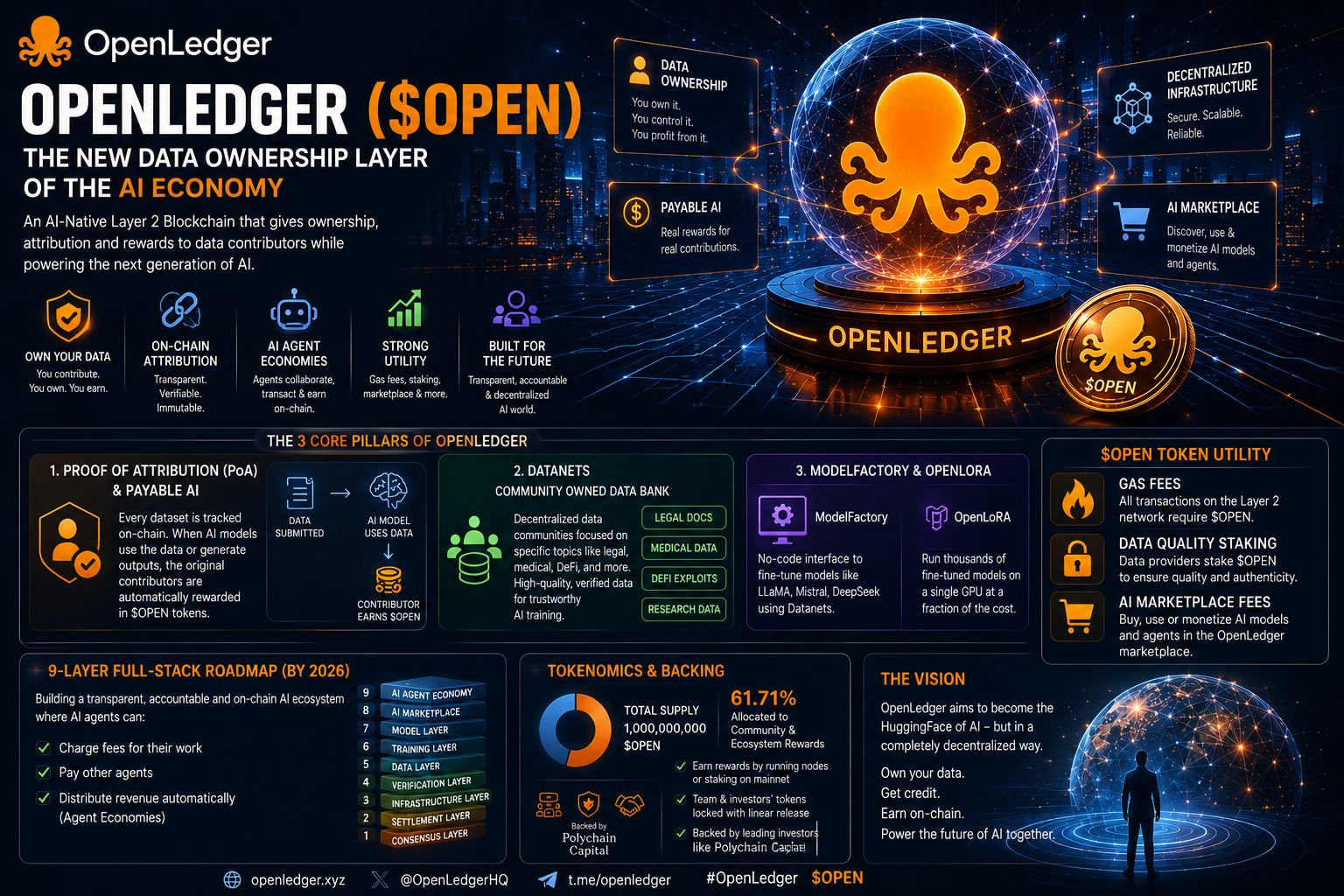
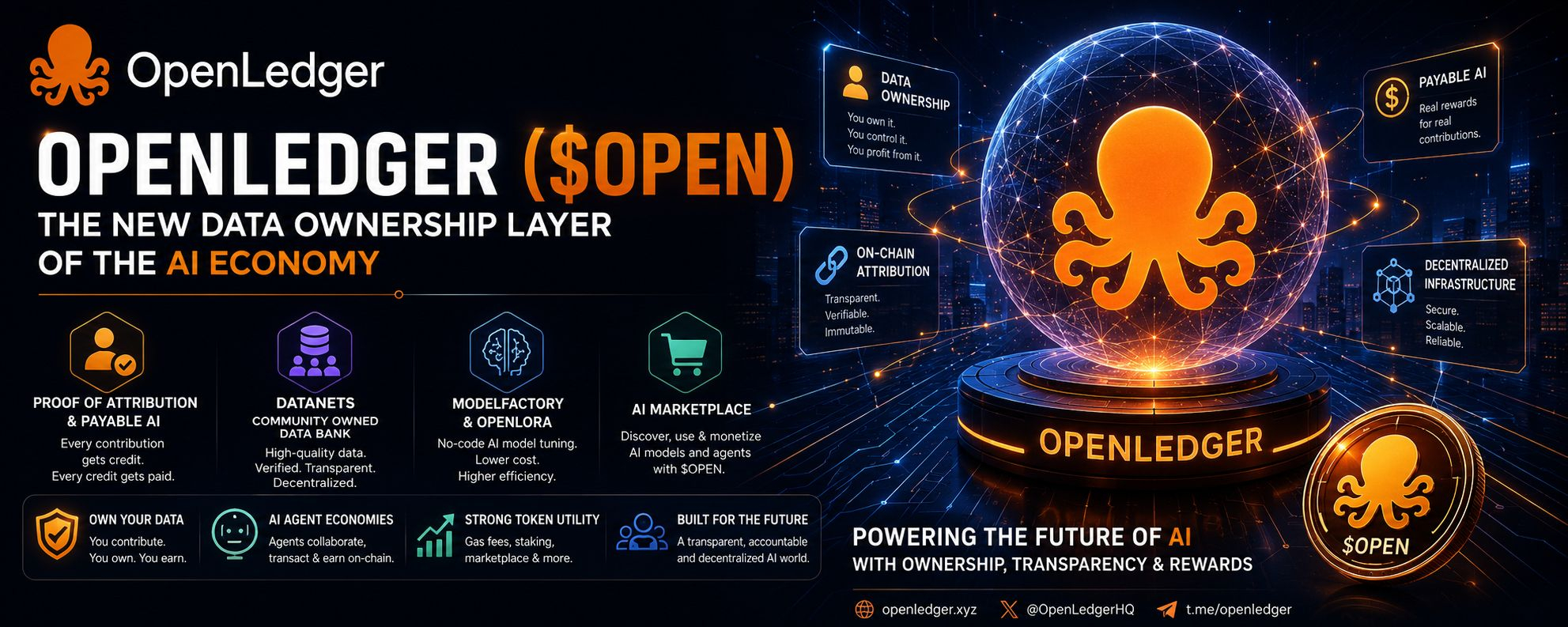
Rather than operating as just another AI application, OpenLedger is building an AI-native Layer 2 blockchain focused on decentralizing the relationship between data, artificial intelligence, and economic rewards. Its vision is simple but ambitious: contributors should own the value they help create.
A New Approach to AI Infrastructure
OpenLedger combines blockchain transparency with AI infrastructure to create a decentralized ecosystem where datasets, AI models, and contributors can interact fairly and efficiently.
Unlike traditional AI platforms, OpenLedger introduces mechanisms that allow contributors to receive attribution and compensation whenever their data helps power AI systems. This concept is designed to shift AI away from centralized ownership and toward a more open economic structure.
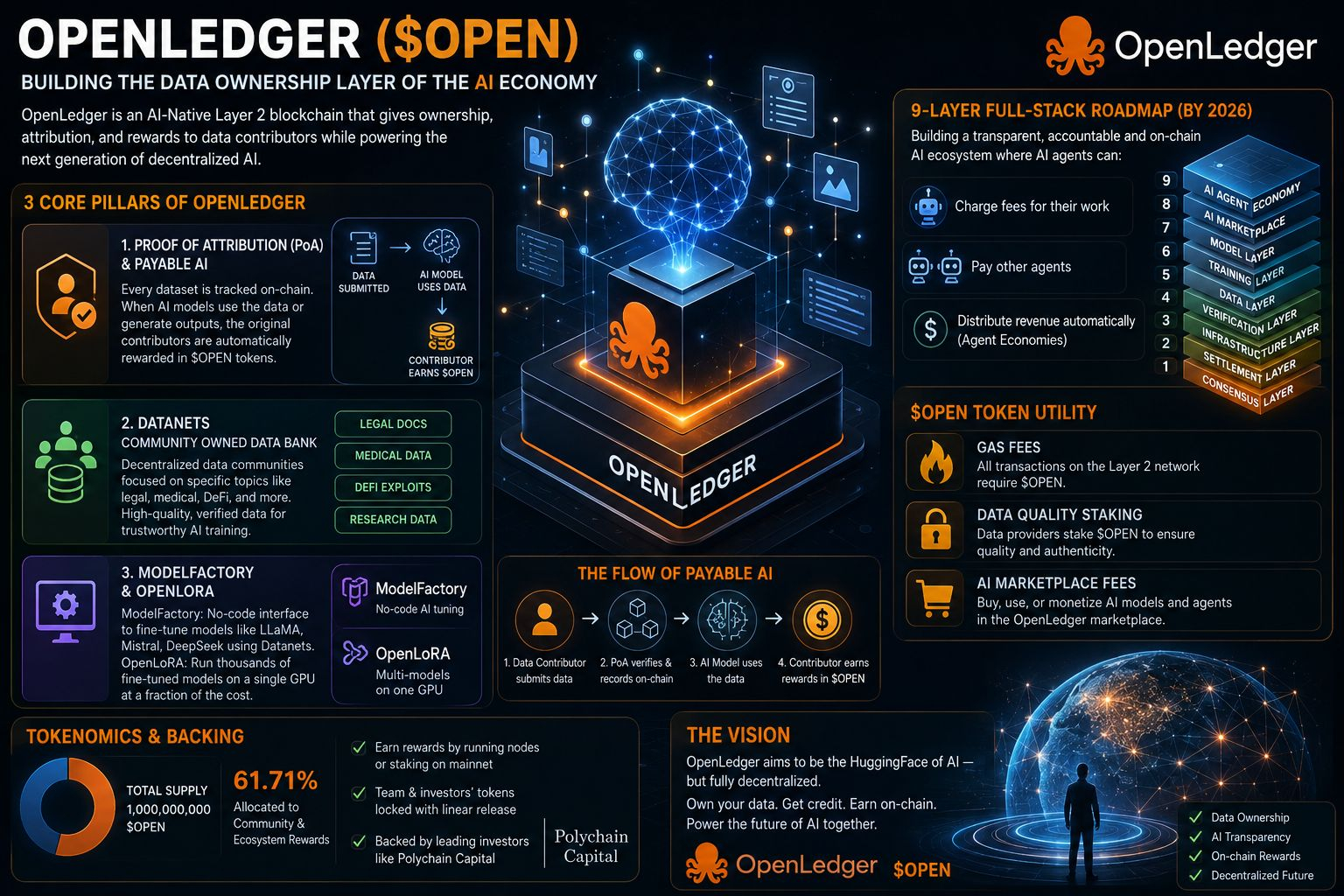
The project focuses on three major components that define its ecosystem.
Proof of Attribution and Payable AI
One of the most innovative systems within OpenLedger is its Proof of Attribution (PoA) mechanism.
This technology records datasets directly on-chain and tracks how those datasets are used during AI training or inference. Whenever a model generates outputs using contributed data, the original contributors can automatically receive rewards through smart-contract systems.
OpenLedger refers to this concept as “Payable AI.”
In traditional AI ecosystems, users often lose control of their contributions forever once data is submitted. OpenLedger attempts to change that by creating verifiable ownership and transparent attribution for contributors.
As AI continues to expand globally, transparent reward systems could become increasingly valuable for creators, researchers, and communities contributing useful information.
Datanets: Community-Owned Data Networks
Another major feature of the ecosystem is the development of Datanets.
Datanets function as decentralized, topic-focused data communities where contributors can provide curated information for AI training. These datasets may focus on areas such as finance, healthcare, cybersecurity, legal research, or decentralized finance.
The goal is to improve both quality and trust.
Instead of relying on random internet scraping, OpenLedger encourages structured and verifiable data contributions. This becomes especially important for enterprise and institutional AI systems where reliability and transparency are essential.
Community ownership also creates stronger incentives for maintaining high-quality datasets over time.
ModelFactory and OpenLoRA
OpenLedger is also attempting to simplify AI model development.
Through ModelFactory, users can fine-tune open-source AI models like LLaMA, Mistral, and DeepSeek using a no-code interface. This lowers technical barriers and allows more creators to participate in AI development without requiring deep machine-learning expertise.
At the infrastructure level, OpenLoRA is designed to improve efficiency by enabling multiple fine-tuned AI models to run on shared GPU resources. This can significantly reduce computational costs while improving scalability for developers.
As AI hardware costs continue rising across the industry, optimization technologies like this could become increasingly important.
The Utility Behind the $OPEN Token
The $OPEN token plays a central role throughout the ecosystem.
It is expected to be used for network transaction fees, staking mechanisms, data validation, AI marketplace activity, and access to AI services built on the platform.
Data providers may need to stake OPEN tokens to verify dataset quality, while developers and users may require the token to monetize or interact with AI models and autonomous agents.
According to OpenLedger’s long-term roadmap, the project also aims to support “agent economies,” where AI agents can independently transact, distribute revenue, and pay for services on-chain without direct human coordination.
Final Thoughts
OpenLedger is positioning itself at the intersection of blockchain infrastructure and artificial intelligence — two of the most influential technological trends in the world today.
broader mission goes beyond building another crypto project. The platform is attempting to create a future where data ownership becomes transparent, contributors are rewarded fairly, and AI systems operate within decentralized economic frameworks.
Whether OpenLedger fully achieves this vision remains uncertain, but its focus on attribution, decentralized datasets, and AI monetization makes it one of the more interesting projects emerging in the evolving AI economy.
As conversations around transparency, ownership, and AI accountability continue to grow, OpenLedger is clearly aiming to become part of that future.
#openledger @OpenLedger #Ai #Web3