One week everyone is talking about AI agents. Next week it’s decentralized compute. Then suddenly the market moves toward automation tools, AI trading systems, or data protocols.
But honestly, I think most people are still missing the bigger picture.
AI doesn’t only need intelligence.
It needs an economy around it.
That’s why I started paying more attention to @OpenLedger recently.
The more I look into it, the more it feels like the project is trying to solve something much deeper than launching another AI token with hype marketing around it.
OpenLedger is building around a simple but important idea:
The people contributing value to AI should not be invisible.
Right now most AI systems are powered by massive amounts of user data, feedback loops, research, community interaction, and training inputs. But the reality is most contributors never really benefit from the value being created.
Big companies collect the data.
Models improve.
Platforms monetize everything.
Meanwhile the users helping power these systems usually get nothing back.
That imbalance is becoming impossible to ignore.
And honestly, this is where OpenLedger starts making sense to me.
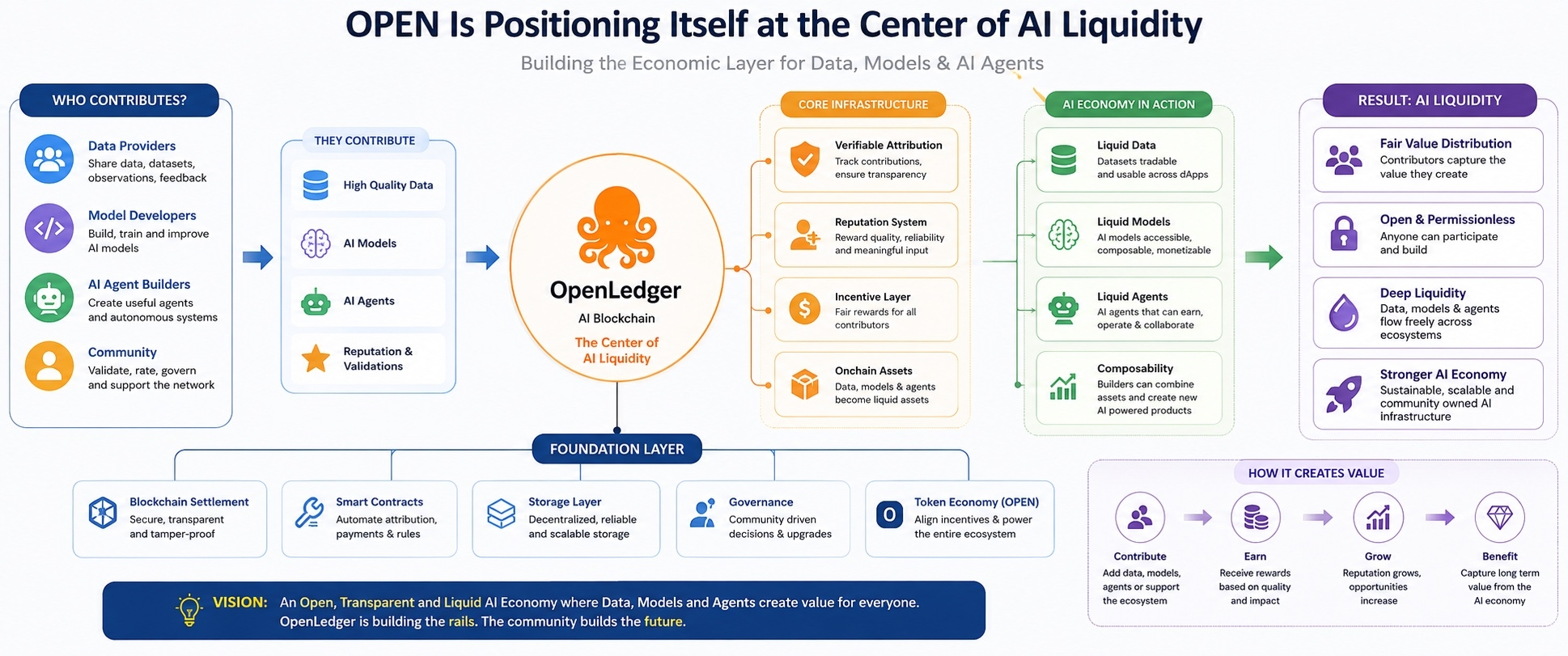
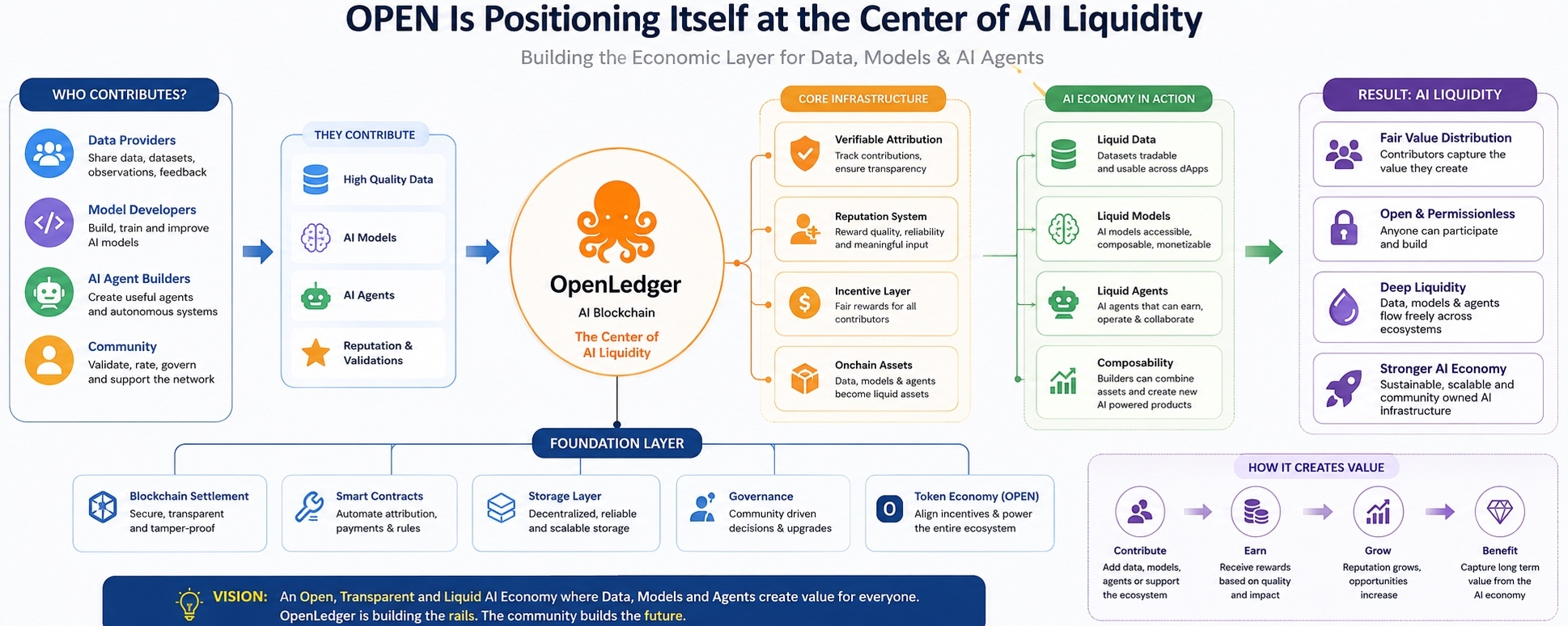
Instead of focusing only on AI applications, the project seems focused on building infrastructure where data, models, and AI agents can actually become liquid onchain assets.
That’s a very different direction from most AI projects.
The idea of “AI liquidity” sounds abstract at first, but when you simplify it, it becomes easier to understand.
AI runs on data.
Good data has value.
Useful models have value.
AI agents that can perform tasks autonomously also have value.
So the real question becomes:
Who owns that value?
Who controls it?
And who gets rewarded when AI systems grow?
OpenLedger looks like it’s trying to build the rails around that entire economy.
What I personally find interesting is the focus on attribution and reputation.
A lot of open AI systems struggle because anyone can spam low-quality inputs. Open systems sound great in theory until the ecosystem becomes noisy, manipulated, or filled with useless data.
That’s why attribution matters.
If contributors can build reputation over time and verifiable participation becomes part of the system, the quality of the network improves naturally.
At least that’s how I see it.
The project also feels more infrastructure-focused than hype-focused, which I usually prefer long term.
Most AI crypto narratives today are fighting over attention.
OpenLedger seems more focused on coordination.
How does data move across ecosystems?
How do contributors monetize their participation?
How can AI models become composable assets?
How do agents access information and operate autonomously?
Those questions matter more than most people realize.
Especially if AI agents eventually become part of everyday digital activity.
And honestly, I think that future is closer than people expect.
At some point AI agents won’t just be tools anymore.
They’ll interact with applications, move assets, process information, make decisions, and maybe even coordinate with other agents automatically.
If that future actually happens, then these systems will need infrastructure underneath them.
Not just compute.
Not just interfaces.
Economic infrastructure.
That’s the area where OpenLedger feels positioned early.
Another thing I respect is that the project leans into openness instead of building a fully closed ecosystem.
The AI industry is becoming extremely centralized right now. The biggest players already control enormous datasets, massive computing power, and distribution channels.
Crypto communities naturally push back against that kind of concentration.
People still want open participation.
They want ownership.
They want transparency around how value flows through networks.
OpenLedger seems aligned with that direction.
Of course, execution is everything.
The vision sounds strong, but every AI project sounds strong during early stages. The real challenge starts later when adoption, scalability, developer activity, and data quality actually get tested.
That’s where the difference between narratives and real infrastructure becomes obvious.
So I’m still watching closely.
I want to see how developers build on it.
I want to see whether communities actually contribute useful datasets.
I want to see if the incentive systems work properly without turning into spam farms.
Because building decentralized AI infrastructure is honestly one of the hardest things to do right now.
Still, I think the broader thesis makes sense.
Crypto already went through liquidity cycles around DeFi, NFTs, gaming, and RWAs.
Now AI is entering that conversation too.
And if AI becomes one of the biggest industries of the next decade, then liquidity, ownership, attribution, and monetization around AI will matter a lot more than people currently think.
That’s why OpenLedger keeps standing out to me lately.
It feels less focused on short-term hype and more focused on building the economic layer around AI itself.
Maybe the market fully understands that later.
Maybe it doesn’t.
But the direction is definitely interesting enough to keep watching closely.