
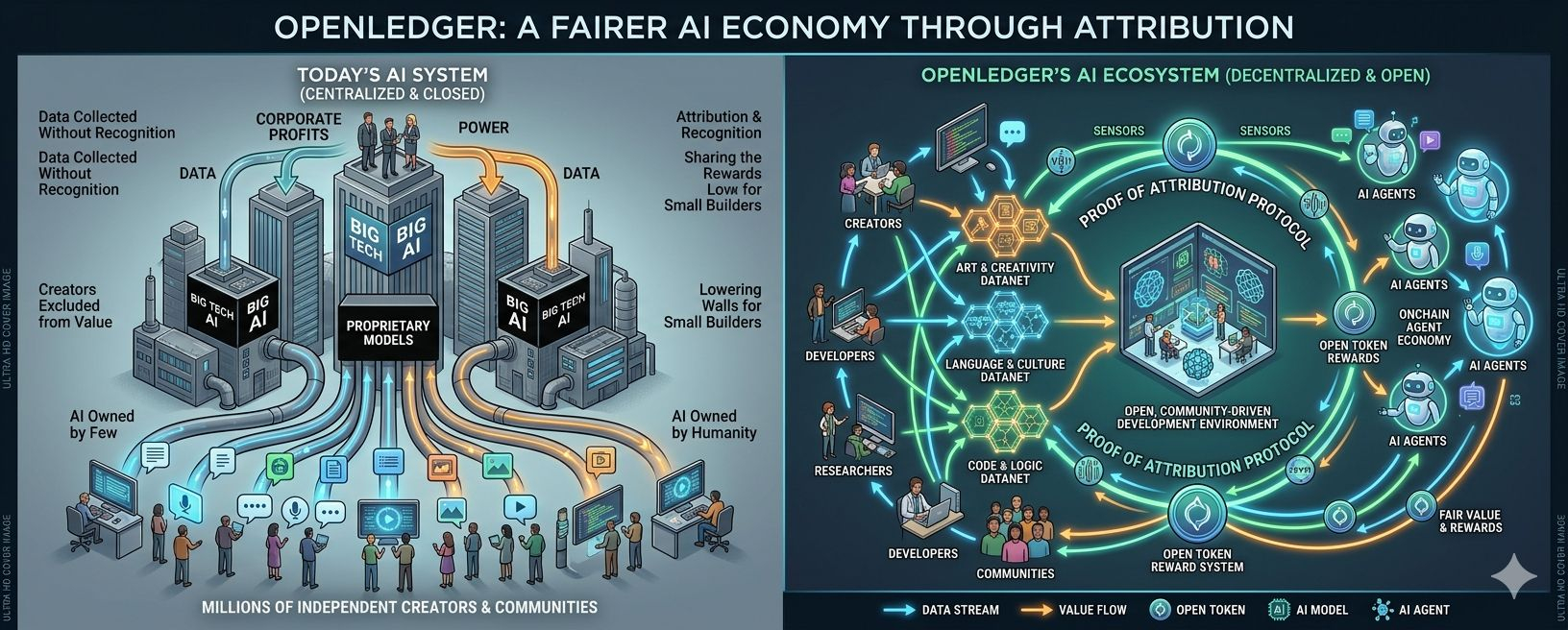
Most AI projects today feel cold. Giant companies quietly collect data from millions of people while everyday users watch from the sidelines without realizing their ideas conversations creativity and knowledge are helping train the future of artificial intelligence. People spend years creating content sharing opinions building communities and feeding the internet with human experience yet almost none of them ever receive a piece of the value being created.
That growing imbalance is exactly where OpenLedger enters the conversation.
OpenLedger is not just trying to build another blockchain. It is trying to build a future where the people helping shape AI are no longer invisible. Instead of intelligence being controlled by a handful of powerful corporations OpenLedger wants AI to become something more open more transparent and more human.
At the heart of the project is one emotional idea that instantly connects with people. If human knowledge is powering artificial intelligence then humans should share the rewards too.
That thought alone changes everything.
Right now AI is evolving at a speed the world has never seen before. Models are writing code generating videos creating art replacing jobs automating research and slowly becoming part of everyday life. But behind all this innovation there is also fear. Fear that intelligence itself may become owned by only a few companies powerful enough to control information creativity and digital economies.
OpenLedger is trying to push back against that future.
The project introduces something called an AI Blockchain which focuses on data models attribution and AI agents. But underneath all the technical language the real goal is simple. OpenLedger wants to build an economy where contribution matters and where people who help train AI systems are finally recognized instead of forgotten.
One of the most powerful ideas inside OpenLedger is something known as Proof of Attribution. In todays AI world almost nobody knows where model knowledge truly comes from. Data gets absorbed into giant systems and disappears into black boxes. OpenLedger wants to shine light into those dark corners.
The network attempts to track which datasets and contributors helped influence AI outputs. If certain data helps a model generate value contributors may receive rewards automatically. For many people this feels deeply personal because it touches a frustration that has been growing quietly for years. The internet was built by millions of humans yet the rewards often flow upward to only a few massive corporations.
OpenLedger is trying to flip that story.
The project also introduces Datanets which act like decentralized data economies. Communities can contribute datasets improve them and potentially earn from the value those datasets create over time. Instead of information being locked away inside private servers data becomes part of an open ecosystem where ownership and contribution are visible.
That vision carries emotional weight because data is not just numbers. Data is human experience. It is language culture creativity memories opinions and years of collective effort from people across the world.
OpenLedger seems to understand that.
Another important part of the ecosystem is ModelFactory which gives developers tools to build and monetize AI models more openly. Today AI development is heavily centralized because training powerful systems requires enormous resources. Smaller builders often struggle to compete with tech giants that dominate infrastructure and funding.
OpenLedger wants to lower those walls.
The idea is to create a space where independent developers researchers and communities can participate in AI creation without needing billions of dollars behind them. There is something hopeful about that because innovation often comes from small passionate builders not just giant corporations.
The project also supports AI agents which are becoming one of the biggest conversations in technology right now. These agents can make decisions interact with applications complete tasks and operate almost like digital workers. OpenLedger wants these agents to function inside an open onchain economy where they can use models access data pay for services and interact autonomously.
It sounds futuristic but in many ways the future is already arriving faster than people expected.
The OPEN token powers the entire ecosystem. It is used for rewards governance transactions staking and model usage. Contributors developers and participants all interact through the token economy. But unlike many crypto projects where tokens feel disconnected from reality OpenLedger is trying to tie its token directly to actual AI activity and contribution.
That distinction matters.
People are becoming tired of empty hype cycles. They want projects connected to real problems and real human value.
Still the road ahead for OpenLedger will not be easy.
The technical challenges are massive. Tracking attribution inside complex AI systems is incredibly difficult. Scaling decentralized AI infrastructure is hard. Competition is growing rapidly across the AI and blockchain sectors. Adoption remains uncertain and regulation around AI ownership and data rights could reshape the industry at any moment.
But despite all those risks OpenLedger touches something emotional that many people already feel deep down.
A sense that the future of AI should not belong only to giant corporations.
A sense that human contribution should matter.
A sense that the people feeding intelligence into these systems deserve more than silence.
That emotional layer is what gives OpenLedger its strength.
Because this project is not only selling technology. It is selling the possibility of a fairer AI economy. One where creators contributors developers researchers and communities are not treated like disposable fuel for machines.
Whether OpenLedger fully succeeds or not remains unknown. The journey ahead is long and difficult. But the idea behind it speaks directly to one of the biggest fears of the modern internet age.
The fear that humanity could help build the future while owning none of it.
And maybe that is why projects like OpenLedger resonate so deeply right now.
People are no longer just asking what AI can do.
They are starting to ask who AI should truly belong to.