
Title: The People Behind AI Deserve More Than Silence
The artificial intelligence industry is growing faster than almost anyone expected. Every week there is a new model, a new automation tool, or another company promising to redefine the future through AI. Most people focus on what these systems can do. Faster answers. Smarter automation. Better predictions. But the deeper I look into the space, the more I realize the real foundation of AI is not the model itself.
It is the people behind it.
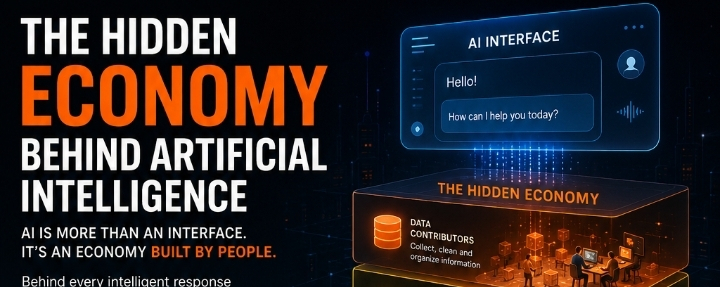
Every intelligent system depends on human contribution at nearly every stage. Developers train and optimize models. Researchers improve performance. Communities test outputs and discover weaknesses. Contributors organize massive amounts of data that become the learning foundation for modern AI systems. Yet when the final product launches, most of these contributors disappear from the story completely.
The technology becomes visible.
The people become invisible.
That structure may have worked during the early growth phase of AI, but it feels increasingly difficult to justify as artificial intelligence becomes more economically valuable. If millions of people contribute directly or indirectly to building intelligent systems, should all ownership and rewards remain centralized forever?
This is one reason decentralized AI infrastructure has started attracting more attention recently.
Projects like @OpenLedger are exploring a different approach to the AI economy. Instead of focusing only on creating another AI narrative, the project is attempting to build systems around attribution, transparency, and decentralized contribution. The concept of Proof of Attribution is especially interesting because it introduces the idea that contributions can be verified and recognized rather than absorbed into closed black-box systems.
And honestly, I think this conversation is still in its early stages.
Right now, most people are focused on the visible side of AI:
chatbots,
automation tools,
image generators,
trading systems,
and assistants.
But the invisible infrastructure underneath those systems may eventually become far more important than the products themselves.
AI is no longer developing as a simple software category. It is slowly becoming an economic layer connected to data, computation, ownership, and digital coordination. As that transition continues, questions around contribution and fairness will likely become impossible to ignore.
I also believe the future of AI will become increasingly specialized.
General-purpose models are impressive, but industries like finance, cybersecurity, healthcare, and legal systems require precision, reliability, and trusted data sources. In these areas, transparency matters just as much as intelligence itself. The platforms capable of combining specialized AI with trusted contributor ecosystems may eventually gain a significant advantage.
Of course, decentralized AI still faces serious challenges.
Scalability remains difficult.
Governance systems are still evolving.
Security risks continue to exist.
And contributor incentives must be designed carefully to avoid exploitation or manipulation.
Trust may ultimately become one of the most valuable assets in the entire AI ecosystem.
Still, what interests me most is the long-term shift quietly happening behind the scenes. The internet economy was largely built around centralized platforms controlling both data and monetization. AI could reshape that model completely by turning intelligence itself into the next economic infrastructure layer.
If that happens, the projects building transparent and contributor-focused systems today may eventually become foundational parts of the future digital economy.
That is why I continue paying attention to @OpenLedger.
Not because of short-term hype.
Not because I expect instant results.
But because the ideas around attribution, transparency, and contributor ownership feel increasingly relevant as AI becomes more deeply integrated into global systems.
The future of artificial intelligence may not only depend on how intelligent machines become.
It may also depend on whether the people helping create that intelligence are finally recognized, rewarded, and remembered.
