There is something deeply unsettling about the way the AI world is evolving right now.
The systems shaping the future are not being built by a single genius or one company sitting in a glass tower somewhere. They are being trained on the labor, knowledge, creativity, and behavior of millions of people most of whom will never receive recognition, ownership, or compensation for what they helped create.
That imbalance sits quietly beneath almost every breakthrough in artificial intelligence.
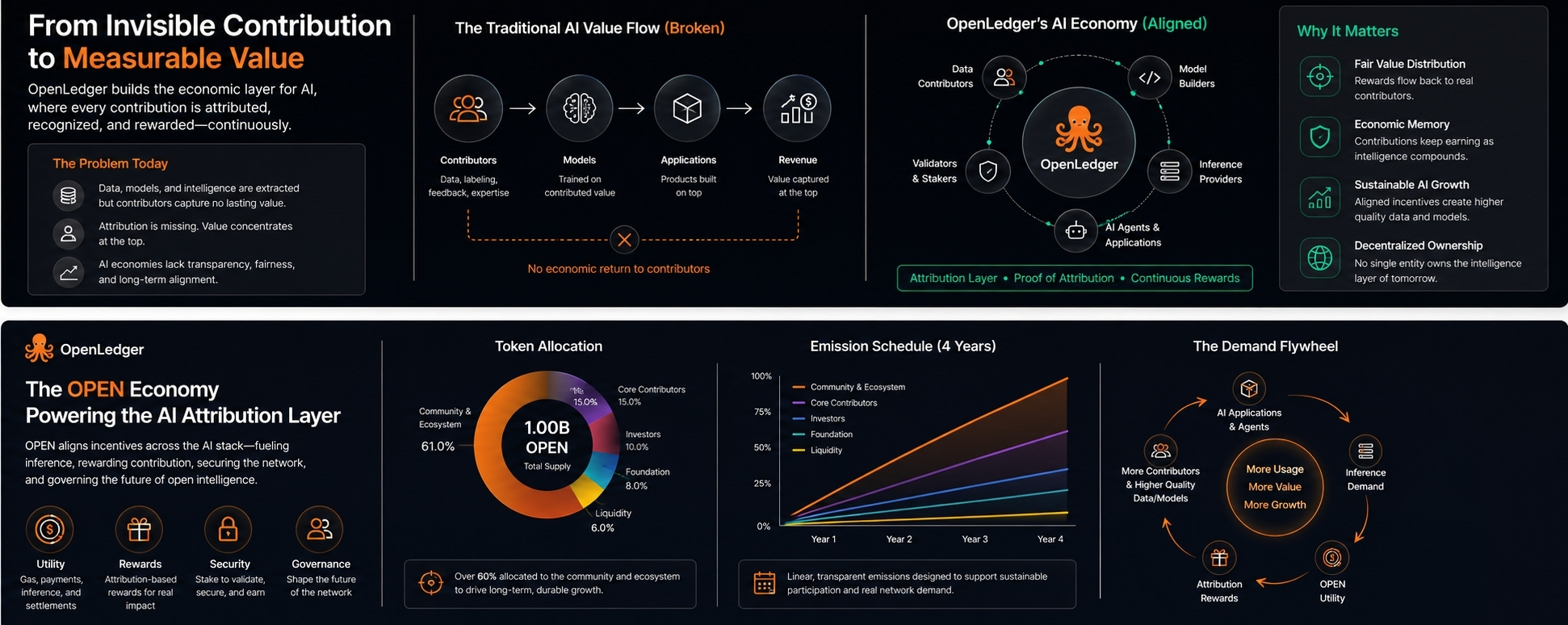
Data is collected endlessly. Human feedback sharpens model behavior. Specialized communities unknowingly train systems through years of interaction. Entire industries contribute knowledge that eventually gets absorbed into models capable of generating enormous economic value. Yet once that value appears, the connection to where it came from disappears almost instantly.
Everything flows upward. Almost nothing flows back.
That is the first reason OpenLedger feels different from most AI crypto projects. It is not just trying to decentralize compute or build another marketplace for AI models. It is trying to answer a more uncomfortable question.
What happens when intelligence itself becomes an economy, but the people contributing to that intelligence remain invisible inside it
OpenLedger is built around the belief that AI is missing something fundamental. Not more hype. Not another chatbot. Not faster narratives. It is missing economic memory.
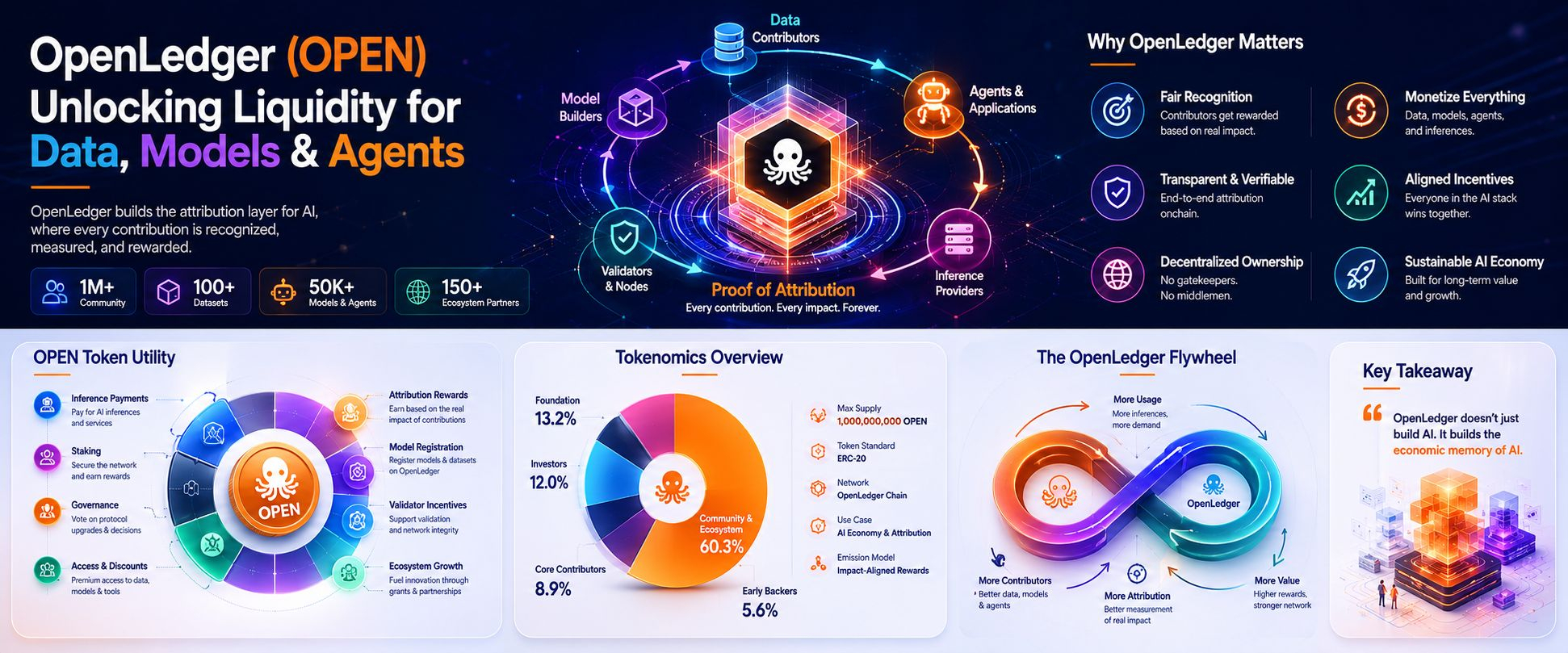
Right now, modern AI systems consume contribution like fire consumes oxygen. Data goes in. Value comes out. The trail between the two vanishes. OpenLedger is attempting to preserve that trail. The project is built around attribution the idea that contributors to AI systems should remain economically connected to the intelligence they help create over time.
At first glance, that might sound technical. But underneath it is a much bigger shift in philosophy.
The protocol treats intelligence as a supply chain rather than a product. Models are not isolated entities. They are built from layers of dependency datasets, human corrections, domain expertise, validators, inference providers, applications, and agents all interacting together. OpenLedger is trying to build infrastructure where those relationships are visible and financially recognized instead of buried beneath centralized ownership.
That changes the entire shape of the system.
Most decentralized AI projects reward participation in ways that eventually break themselves. Once tokens become attached to contribution, networks start attracting noise instead of value. People optimize for rewards, not usefulness. Low quality data floods the system because there is no reliable way to measure whether something actually improved the model.
OpenLedger is trying to solve that with Proof of Attribution.
The idea is deceptively simple. Instead of rewarding people for merely submitting data, the network attempts to measure whether that contribution genuinely influenced model behavior. In other words, the system is trying to distinguish presence from impact.
If that works, the implications become enormous.
Data stops behaving like disposable fuel and starts behaving like an asset capable of generating long term value. A specialized dataset could continue earning rewards as models keep benefiting from it. Knowledge becomes economically alive instead of economically extracted.
That may sound like a small design decision, but it changes the emotional foundation of the network. People are no longer feeding intelligence systems for free while value concentrates elsewhere. They become participants in an economy that remembers where intelligence came from.
And honestly, that idea feels inevitable.
Because the current structure of AI is difficult to sustain forever. The more powerful these systems become, the harder it will be to ignore the invisible labor underneath them. OpenLedger is positioning itself around the belief that future AI economies will eventually need transparent attribution not just for fairness, but for sustainability.
What makes the project more credible is that the OPEN token is not floating around without purpose like many AI tokens today. It sits directly inside the operational mechanics of the network inference, validation, staking, attribution rewards, governance, participation. The token exists because the system needs economic coordination at every layer.
But this is also where the project becomes fragile.
Attribution is extremely hard.
Modern neural systems do not think in straight lines. Intelligence inside large models is diffuse, probabilistic, and often impossible to trace with perfect clarity. Measuring contribution at scale requires computational overhead, approximation models, and difficult tradeoffs between precision and efficiency.
That tension matters more than most people realize.
There is a reason centralized AI companies rarely pursue deep attribution systems even when they publicly talk about creator rights and ethical AI. Transparency introduces friction. And friction slows systems down.
OpenLedger is making a very bold bet that the market will eventually value trust and attribution enough to tolerate that complexity.
Maybe it will.
Maybe it will not.
But at least the project is attacking a real structural problem instead of manufacturing artificial narratives around AI buzzwords.
What also stands out is where the team seems focused. OpenLedger does not appear obsessed with competing against frontier labs in the race toward gigantic general models. That is probably wise. The largest AI companies already dominate compute, infrastructure, and distribution at a scale most decentralized systems cannot realistically challenge.
Instead, the real opportunity may exist in fragmented intelligence.
Specialized datasets. Industry specific workflows. Underrepresented languages. Scientific research. Local knowledge economies. Areas where valuable information exists, but coordination and monetization remain broken.
Ironically, the future of decentralized AI may not come from building the smartest universal model. It may come from organizing the most overlooked forms of knowledge.
That is the part many people still underestimate.
The less glamorous the data, the stronger the moat can become.
A niche medical dataset or industrial workflow may never create headlines, but it can generate enormous value inside targeted systems where precision matters more than scale. OpenLedger seems designed around the idea that these fragmented pockets of intelligence can become economically composable if attribution is handled correctly.
Still, none of this guarantees success.
The network ultimately depends on real adoption. Real developers. Real inference demand. Real ecosystems forming around the infrastructure. If usage grows slower than token incentives, the protocol could drift into the same trap that destroys many crypto networks subsidized activity without durable utility.
Governance is another pressure point.
In a system where attribution determines economic rewards, whoever controls the rules around attribution eventually controls value distribution itself. If influence becomes concentrated among insiders or large stakeholders, the network risks recreating the same centralization dynamics it claims to solve.
And beneath all of this sits an even deeper uncertainty.
Can intelligence truly be broken into measurable economic contribution
That question is bigger than blockchain. Bigger than OpenLedger. Modern AI systems often produce emergent behavior that cannot be traced cleanly back to individual inputs. Attribution may never become fully objective. There may always be ambiguity around who contributed what and how much they deserve.
But maybe perfect precision is not the point.
Maybe the real breakthrough is simply building systems that try to remember contribution at all in a world increasingly designed to erase it.
That is why OpenLedger feels more important than another speculative AI token cycle. It is attempting to build economic infrastructure for a future where intelligence is no longer created in isolation, but through massive interconnected networks of human and machine collaboration.
And if AI truly becomes the defining economic layer of the next era, then ownership of contribution may matter far more than ownership of models themselves.
That possibility is what gives the project weight.
Not hype. Not branding. Not narratives.
Just a difficult question sitting at the center of the AI economy
Who should benefit when intelligence compounds over time.