
Artificial intelligence is creating billions of dollars in value, but there’s a problem that few people talk about.
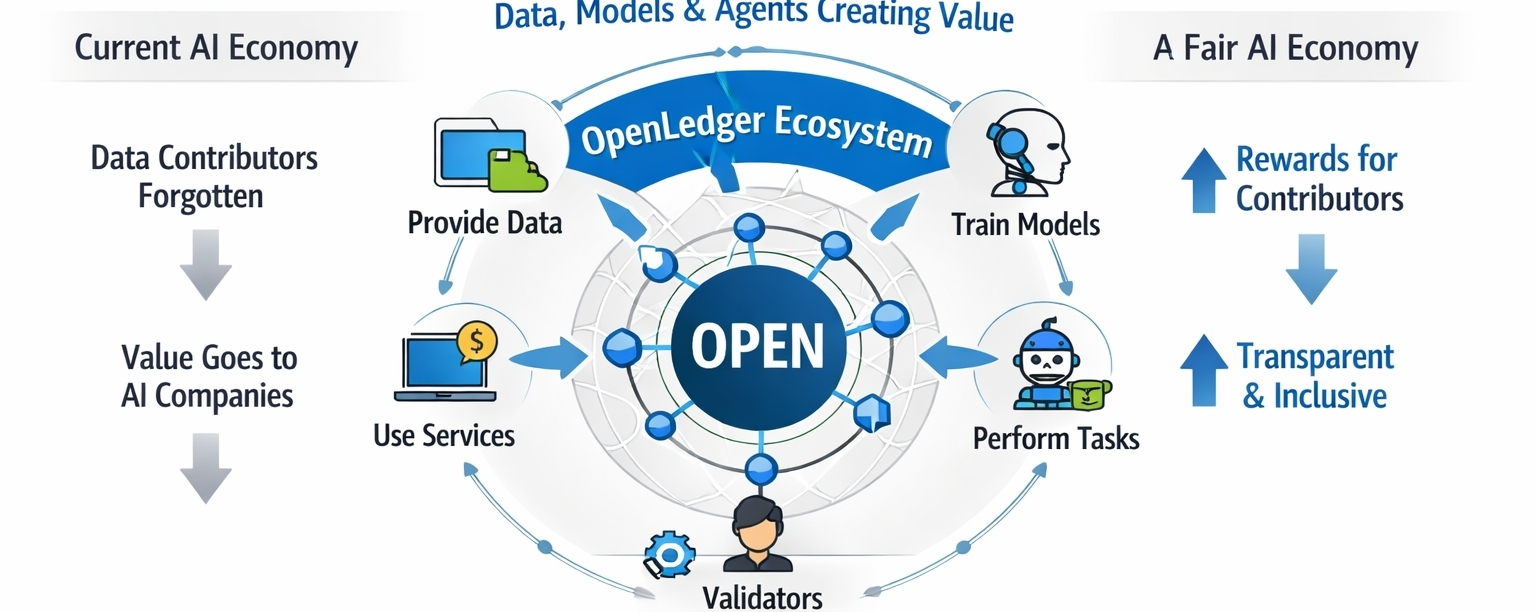
Every AI model is built on data. Every chatbot, recommendation engine, image generator, and AI assistant learns from information created by real people. Yet once that data enters the training process, the people who contributed it are usually forgotten. The value flows to AI companies, platform owners, and model developers, while the original contributors receive little or nothing in return.
This imbalance has become one of the biggest unanswered questions in the AI era.
OpenLedger believes the future should work differently.
Instead of treating data as a disposable resource, OpenLedger is building an ecosystem where data, AI models, and intelligent agents can all become assets that generate value for the people behind them. It is an ambitious vision—one that sits at the intersection of artificial intelligence, blockchain technology, and the emerging creator economy.
The Real Fuel Behind AI
When people discuss AI, they usually focus on powerful models, advanced algorithms, or massive computing infrastructure. Those things matter, but they are not the starting point.
Data is.
Without data, even the most sophisticated AI system is useless. AI learns from examples. It learns from conversations, documents, images, transactions, research papers, and countless other forms of information. Data is the raw material that gives AI its intelligence.
Yet despite being the foundation of the entire industry, data has historically been undervalued.
Imagine helping build a skyscraper but receiving no recognition once construction is complete. That is essentially how the AI economy works today. Contributors provide the material, while others capture most of the long-term value.
OpenLedger is trying to change that dynamic.
A Different Way to Think About Data
Most technology companies treat data like fuel. Once it is collected and used, its job is done.
OpenLedger takes a different view.
The project sees data as an asset that should continue generating value long after it has been contributed. Instead of disappearing into a training pipeline, data becomes part of an ecosystem where its impact can be tracked and rewarded.
It is a simple idea on the surface, but it challenges one of the core assumptions of today’s AI industry.
What if the people who help make AI smarter could share in the value that AI creates?
That question sits at the heart of OpenLedger’s vision.
More Than Another “AI + Blockchain” Project
The crypto industry has no shortage of projects combining AI and blockchain. Many launch tokens, promise decentralized intelligence, and market themselves as the future of AI.
The challenge is that branding alone does not create value.
What makes OpenLedger interesting is that it focuses on a specific problem rather than a broad narrative. The project is not simply asking how blockchain can support AI. It is asking how blockchain can make the AI economy fairer, more transparent, and more accountable.
That distinction matters.
Instead of concentrating solely on infrastructure, OpenLedger is attempting to build an economic system where contributions can be measured and rewarded.
Whether that goal can be achieved at scale remains an open question, but the problem itself is very real.
The Attribution Challenge
One of the hardest technical challenges in artificial intelligence is understanding influence.
When an AI model generates a response, which data points helped create that answer?
Which contributors made the biggest impact?
Which datasets improved the model’s performance?
The reality is that modern AI systems are incredibly complex. Information is absorbed through billions of parameters, making it difficult to trace outcomes back to specific sources.
OpenLedger is attempting to tackle this challenge through attribution mechanisms designed to connect value creation with contribution.
If successful, this could represent one of the first serious attempts to build an AI economy where rewards are linked to measurable impact rather than simple participation.
That is a much harder problem than launching a token or creating a marketplace—but it is also far more meaningful.
Building an Economy Around Intelligence
What makes OpenLedger unique is that it is not focused solely on AI models.
It is trying to create an ecosystem.
In this ecosystem:
Data contributors provide valuable information.
Developers build specialized AI models.
AI agents perform tasks and generate activity.
Validators maintain trust across the network.
Users access AI-powered services.
Each participant contributes something different, and each participant can potentially benefit from the value created within the network.
The result is a model that looks less like a traditional software platform and more like a digital economy.
Why Specialized AI Could Be the Future
For years, the AI conversation has revolved around giant models capable of doing a little bit of everything.
But many experts believe the future may belong to specialized intelligence.
A healthcare AI trained on medical data.
A legal AI trained on legal documents.
A financial AI trained on market information.
These focused systems often outperform general-purpose models in their respective domains.
OpenLedger appears well-positioned for this trend because its framework encourages the creation of domain-specific datasets and models.
As AI becomes more specialized, the value of high-quality niche data could increase dramatically.
That is exactly the type of environment OpenLedger is designed for.
The Opportunity
The timing of OpenLedger’s vision is interesting.
Concerns around AI transparency are growing.
Questions about data ownership are becoming more important.
Businesses increasingly want explainable and accountable AI systems.
At the same time, decentralized technologies continue searching for meaningful real-world applications.
OpenLedger sits at the intersection of these trends.
If the project can successfully connect contributors, developers, and users into a functioning economic network, it could occupy a unique position within the broader AI ecosystem.
The Challenges Ahead
Of course, ambition alone does not guarantee success.
OpenLedger still faces significant hurdles.
Attribution remains technically difficult.
Building network effects takes time.
Competition within both AI and blockchain is intense.
User adoption is never guaranteed.
Perhaps most importantly, the project must prove that its economic model works in practice rather than just in theory.
Many great ideas struggle when exposed to real-world conditions.
OpenLedger’s future will ultimately depend on execution.
Final Thoughts
OpenLedger is attempting to solve a problem that most people have not fully recognized yet.
The AI industry generates enormous value, but the distribution of that value remains highly concentrated. Data contributors help create intelligence, yet they rarely participate in the rewards generated by that intelligence.
OpenLedger’s vision is built around changing that reality.
By creating a system where data, models, and AI agents can all become productive assets, the project is exploring what a more transparent and inclusive AI economy might look like.
Whether OpenLedger becomes a major player or simply influences the next generation of AI infrastructure remains to be seen.
But one thing is clear:
As artificial intelligence becomes more powerful, the question of who deserves to benefit from it will become impossible to ignore.
And OpenLedger is one of the few projects trying to answer that question.