

The moment you introduce penalties into a reward system the entire emotional tone of participation changes. I noticed this first in how people talk about contributing to Web3 data networks. It’s usually framed like an open invitation. Submit data, earn rewards, be part of the ecosystem. Almost like everything is acceptable as long as volume stays high.
But that assumption quietly breaks the moment bad data starts costing something.
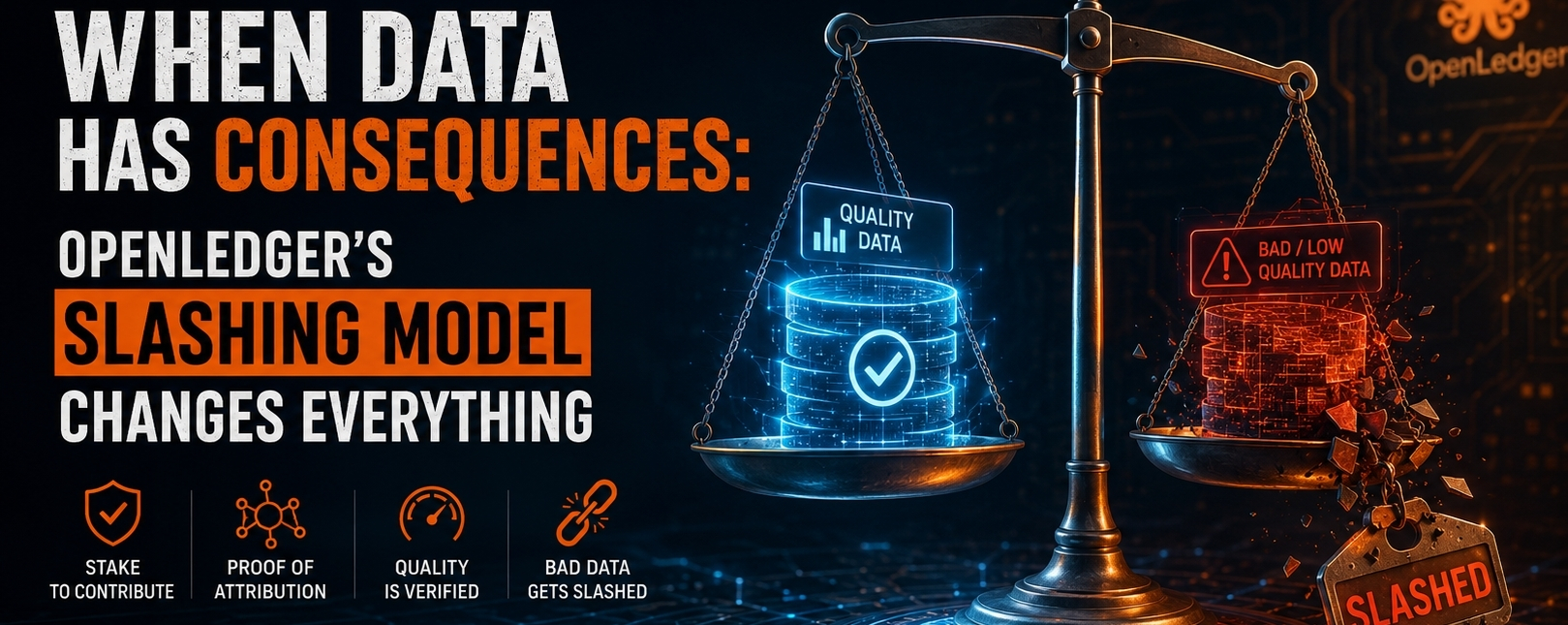
OpenLedger’s Proof of Attribution system doesn’t just reward contribution. It also slashes staked tokens when the input is low quality or adversarial. That detail changes the psychology completely. It stops being a participation space and starts feeling like a responsibility layer.
I think this is where most data economy narratives fall apart. They assume contributors will behave well just because incentives exist. But in reality incentives without consequences always drift toward noise. Especially when AI systems are hungry for scale.
What I find interesting is how OpenLedger leans into that discomfort instead of avoiding it.
When I first looked at their structure, I expected the usual model. Pay people for data, track usage, distribute rewards. But the slashing mechanism suggests a different assumption underneath the system. It assumes contribution is not inherently valuable unless it survives verification pressure over time.
That is a very different starting point.
In OpenLedger’s setup contributors still stake value when they submit data into networks like DataNets. Whether it’s healthcare datasets, agent training inputs, or specialized SLM contributions, everything enters a system where quality is continuously tested by downstream usage. If the data influences outputs positively, attribution flows back through Proof of Attribution. If it harms model performance or looks adversarial, the stake is reduced.
No soft warning. No reputation reset. Real economic loss.
I keep thinking about how rare this is in Web3 AI projects. Most systems still behave like participation trophies. Even low quality inputs get rewarded if they manage to pass basic validation or ride narrative demand. That leads to inflation of data quantity but not necessarily intelligence quality.
OpenLedger feels like it is trying to invert that behavior.
There is something almost uncomfortable about that design. Because it introduces friction where most projects try to remove it. But maybe that friction is necessary if AI systems are going to rely on decentralized contributions at scale.
I also think about how this connects to OpenLedger’s broader architecture.
Since it is built with Ethereum compatibility, the staking, slashing, and reward flows are not isolated inside a closed database. They are enforced through smart contracts. Wallet native participation makes contributors financially accountable in a way that is transparent and verifiable. It is not just platform rules. It becomes protocol behavior.
That matters more than it looks on the surface.
Because once AI systems start depending on external contributors, the biggest risk is not lack of data. It is degradation of data quality over time. Without penalties, systems slowly fill with optimized noise. People learn how to game reward mechanisms instead of improving inputs.
OpenLedger’s slashing model directly challenges that pattern.
Still, I am not fully convinced it scales cleanly.
The hardest question is whether on-chain penalties can actually detect “bad data” in a way that remains fair. AI outputs are probabilistic. Influence paths inside models are not always clean or linear. If Proof of Attribution misattributes negative impact, contributors could be penalized unfairly. That is not a small issue. That could affect trust in the entire system.
There is also the behavioral side.
When you introduce slashing, you filter out casual contributors. That might improve quality, but it also reduces participation diversity. And in AI, diversity of data often matters as much as precision. I wonder how OpenLedger balances that tension between openness and strict accountability.
And then there is a more subtle question I keep coming back to.
Do contributors actually want accountability, or do they just want upside exposure?
Most crypto participation still feels speculative. People enter systems expecting rewards, not responsibility. OpenLedger’s design assumes a more mature participant model, where contributors are willing to risk stake in exchange for long-term attribution and recurring value capture.
That assumption might be ahead of its time.
Or it might be the only way AI data networks survive beyond narrative cycles.
Because without slashing, there is no real consequence for noise. And without consequence, AI systems quietly degrade, even if the reward dashboards look healthy.
I think that is the uncomfortable truth behind OpenLedger’s design. It is not trying to make participation easy. It is trying to make participation meaningful.
But I still wonder if the market is ready for systems that punish contribution instead of celebrating it.