
I’ve been watching the AI industry long enough to notice something weird.
Everybody talks about intelligence.
Almost nobody talks about ownership.
That’s the dirty little secret underneath the entire artificial intelligence boom. The world is obsessing over models, GPUs, and trillion-parameter flexing contests while a much bigger power grab is quietly unfolding underneath the surface. Data is being vacuumed up at industrial scale. Human behavior is being converted into training fuel. And the companies building these systems are locking the economic upside behind corporate walls thicker than a bank vault.
That’s where starts getting interesting.
Not because it promises another shiny blockchain.
We’ve got enough of those already.
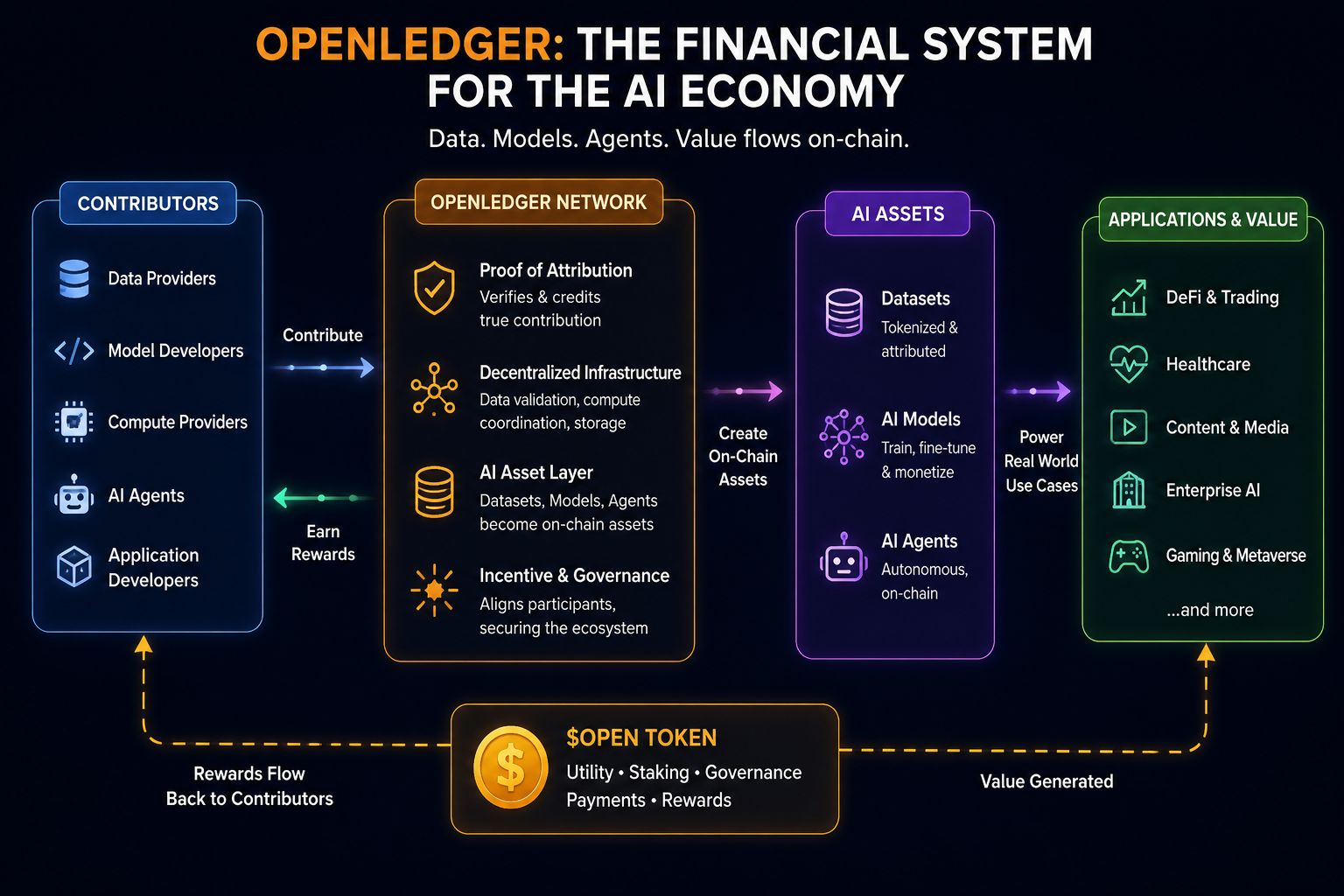
The real hook is that OpenLedger is trying to build financial rails for machine intelligence itself. Not for speculation. Not for meme tokens. For AI economies. Data economies. Autonomous software agents that can transact, earn, spend, and interact without a human babysitting every click.
That sounds futuristic until you realize pieces of it are already happening.
Trading bots already move billions.
AI systems already generate media at scale.
Algorithms already influence financial markets, logistics networks, hiring decisions, and ad auctions every second of the day.
The machines aren’t waiting for permission anymore.
And honestly? That should make people nervous.
The modern AI industry runs on extraction. That’s the blunt reality nobody in Silicon Valley wants to phrase too loudly during investor presentations. Companies scrape oceans of public and private data, train models on top of it, monetize the outputs, and centralize almost all the rewards. Users provide the raw material. Corporations keep the upside.
OpenLedger wants to break that pattern by treating data as a productive economic asset instead of disposable fuel.
Simple idea.
Absolute nightmare to execute.
Because once you start talking about decentralized AI infrastructure, the problems pile up fast. Storage becomes expensive. Validation systems get messy. Compute coordination turns into a logistical migraine. Bad actors flood networks with garbage datasets hoping to farm rewards. Then regulators arrive with clipboards and panic attacks because nobody in government fully understands how autonomous AI economies are supposed to fit into laws written before ChatGPT existed.
Chaos. Pure chaos.
Still, I understand why projects like OpenLedger are gaining attention. The AI market is drifting toward dangerous levels of concentration. A handful of companies now control the models, the cloud infrastructure, the chips, the distribution pipelines, and increasingly the public narrative around artificial intelligence itself.
That’s not healthy.
History usually punishes ecosystems where too much power accumulates too quickly. We saw it with telecom monopolies. We saw it with social media giants. We’re watching it happen again with AI.
The real kicker is that OpenLedger isn’t merely pitching decentralization as a philosophical talking point. The project is trying to engineer actual economic participation into AI systems through something called “Proof of Attribution.” Fancy term. Important concept.
Here’s the simplified version.
Right now, if you contribute data that improves an AI model, your role effectively disappears once the system gets trained. The model becomes a corporate asset. Your contribution gets swallowed by the machine. OpenLedger wants to preserve attribution trails on-chain so contributors can theoretically maintain some financial relationship to the value their data helps generate.
Imagine contributing highly specialized medical datasets that improve a diagnostic AI model. Under the current setup, a centralized company absorbs that value and monetizes it internally. Under OpenLedger’s vision, contributors could receive ongoing rewards tied to the downstream use of that intelligence.
That changes incentives completely.
But it also creates new headaches nobody has fully solved yet.
Verification alone is brutal. How do you determine whether a dataset genuinely improved model performance? How do you prevent manipulation? How do you stop coordinated spam attacks from poisoning decentralized training systems? The infrastructure sounds elegant in theory until real humans show up with greed, shortcuts, and financial incentives.
Humans ruin everything eventually.
And then there’s the hardware problem.
AI infrastructure is not remotely cheap. Training advanced models already requires staggering amounts of compute power, specialized GPUs, cooling systems, bandwidth, and energy consumption. Now layer blockchain coordination on top of that. Suddenly you’re dealing with a technological beast that can burn through capital faster than most startups burn through credibility.
That’s where a lot of decentralized AI projects quietly collapse.
The whitepapers sound brilliant.
The economics don’t.
To OpenLedger’s credit, the project at least appears aware of the complexity. It’s positioning itself less like a generic Layer-1 chain and more like an AI-native economic coordination layer. That distinction matters because most existing blockchains were never designed for autonomous machine economies. They were built for payments, speculative trading, or decentralized finance experiments.
AI introduces an entirely different category of infrastructure stress.
You’re not just coordinating humans anymore.
You’re coordinating software agents capable of making decisions independently.
That changes the equation.
OpenLedger sees AI agents as economic participants instead of passive tools. That means agents can theoretically own wallets, access liquidity, execute transactions, purchase datasets, interact with decentralized applications, and operate continuously without centralized gatekeepers controlling every interaction.
Sounds cool.
Also slightly terrifying.
Because once autonomous systems gain financial agency, the governance questions become deeply uncomfortable. Who becomes responsible when an AI agent causes harm? Who regulates autonomous machine transactions across jurisdictions? What happens when decentralized AI systems begin competing directly with centralized corporate platforms controlling billions in infrastructure?
Nobody has clean answers for this yet.
And that uncertainty matters more than the marketing decks.
I’ve noticed something else lately while covering the AI sector. Developers are getting restless. Open-source communities are growing louder. Governments are becoming increasingly suspicious of concentrated AI power. Enterprises are nervous about becoming permanently dependent on a handful of dominant APIs controlled by giant corporations with shifting business incentives.
That creates an opening.
A risky one.
But an opening nonetheless.
OpenLedger is essentially betting that the future AI economy will demand more transparent ownership structures and more decentralized coordination mechanisms. Maybe that bet works. Maybe it crashes into scalability walls, governance drama, bugs, regulatory headaches, and the brutal economics of infrastructure competition.
Wouldn’t be the first time.
The blockchain industry is littered with ambitious projects that confused compelling narratives with sustainable adoption. Technical elegance means nothing if users don’t show up. Developers care about tooling. Enterprises care about reliability. Investors care about liquidity. Nobody outside crypto Twitter cares how beautiful your tokenomics diagram looks.
Products matter.
Performance matters.
Trust matters.
And corporate ego absolutely matters because the existing AI giants are not going to surrender control willingly. These companies are building some of the most valuable infrastructure in modern economic history. They have capital, political influence, talent pipelines, hardware access, and distribution advantages that decentralized projects simply do not possess.
That’s the mountain OpenLedger is climbing.
Still, the broader idea behind the project feels difficult to dismiss now. AI is rapidly becoming infrastructure for everything — finance, healthcare, logistics, entertainment, cybersecurity, education, defense. As machine intelligence spreads deeper into the global economy, the question of ownership becomes impossible to avoid.
Who controls the models?
Who owns the data?
Who captures the economic upside when autonomous systems start generating value at machine speed?
That fight is only beginning.
And projects like OpenLedger are positioning themselves directly inside the blast radius.